📋 ITR-1 to ITR-7
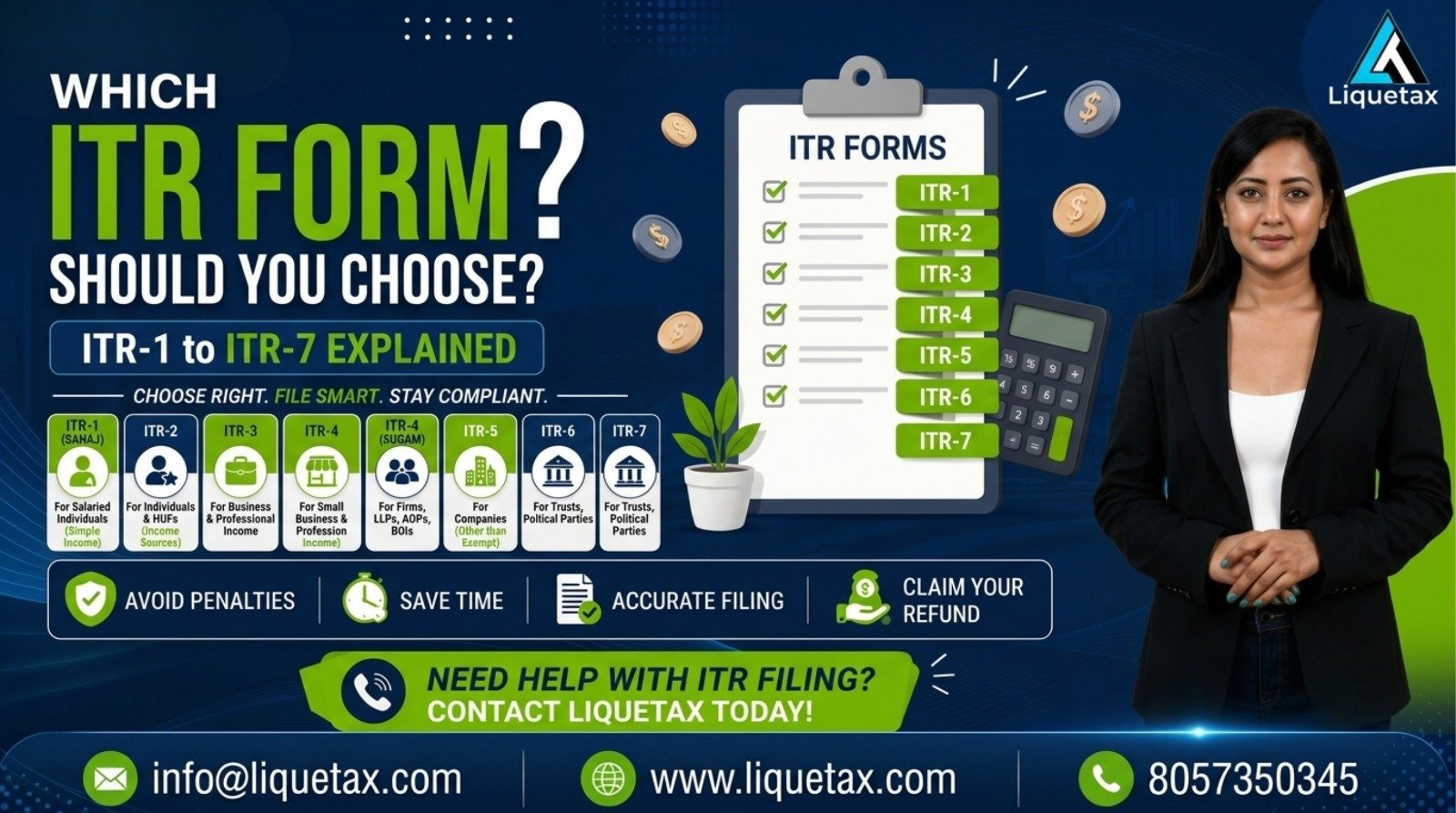
Detailed comparison of all 7 ITR forms – who can file which form.
🧾 Eligibility Criteria
Know which form applies to your income type: salary, business, capital gains, etc.
✅ Expert Selection
Liquetax helps you choose the right form and file error-free.
⚖️ Due Dates & Penalties
Stay compliant with due dates and avoid late fees.
🎬 Watch: ITR Forms Explained – ITR-1 to ITR-7 Simplified
 ▶ Tap to play
Introduction: Choosing the Right ITR Form Made Simple
Filing your Income Tax Return (ITR) starts with choosing the correct form. The Income Tax Department has seven distinct ITR forms – ITR-1 to ITR-7 – each designed for different types of income and taxpayer categories. Selecting the wrong form can lead to rejection or a tax notice. This guide breaks down each form, its eligibility, and helps you pick the one that fits your income profile.
What is an Income Tax Return (ITR) Form?
An ITR form is a document used to report your income, deductions, and tax liability to the Income Tax Department. The form you choose depends on your income sources (salary, business, capital gains, foreign assets) and your status (individual, HUF, company, etc.). Filing the correct form ensures your return is processed smoothly.
- Financial Year: 2025-26 (April 1, 2025 – March 31, 2026)
- Assessment Year: 2026-27
- Due Date (Individuals): July 31, 2026
Why Selecting the Correct ITR Form Matters
- Legal compliance: Using the wrong form can invalidate your return.
- Avoid notices: Mismatched forms trigger scrutiny from tax authorities.
- Claim correct deductions: Certain deductions are form-specific.
- Business credibility: Correct filing builds trust with lenders and partners.
- Peace of mind: File with confidence knowing your form is right.
Eligibility: Which ITR Form Applies to You?
- ITR-1 (Sahaj): For individuals with income up to ₹50 lakh from salary, one house property, and other sources (interest, etc.). Not for business/profession.
- ITR-2: For individuals/HUFs having income from salary, multiple house properties, capital gains, foreign assets/income, but not business.
- ITR-3: For individuals/HUFs having income from business or profession (proprietorship).
- ITR-4 (Sugam): For individuals/HUFs/partnerships (other than LLP) having presumptive business income under sections 44AD/44AE/44ADA.
- ITR-5: For firms, LLPs, AOPs, BOIs, and other artificial juridical persons.
- ITR-6: For companies (other than those claiming exemption under Section 11).
- ITR-7: For persons including companies required to furnish return under sections 139(4A), 139(4B), 139(4C), 139(4D), 139(4E), or 139(4F).
Step-by-Step Process to Select Your ITR Form
- Step 1: Identify your income sources – salary, business, capital gains, house property, other sources.
- Step 2: Check if you are eligible for presumptive taxation (Section 44AD/44ADA).
- Step 3: Use the Income Tax Department's online tool or consult the table above to shortlist forms.
- Step 4: If you have foreign assets/income, ITR-2 or ITR-3 is mandatory.
- Step 5: For companies, LLPs, and firms, choose ITR-5 or ITR-6 based on entity type.
- Step 6: Once decided, gather documents and proceed with filing on the e-filing portal.
Documents You Need for ITR Filing
- PAN & Aadhaar: Mandatory for all taxpayers.
- Form-16: For salaried individuals.
- Form-26AS: Annual tax statement showing TDS/TCS credits.
- Bank statements: For interest income, dividends.
- Investment proofs: For 80C, 80D, etc.
- Property details: For capital gains or rental income.
- Business books: For business income (ITR-3/ITR-4).
- Foreign asset details: If applicable.
Late Fees & Penalties for Wrong Form Selection
- Late fee (Section 234F): ₹5,000 (₹1,000 if income below ₹5 lakh) for filing after due date.
- Interest under 234A/B: 1% per month on outstanding tax.
- Defective return: If wrong form filed, return may be treated as defective – you'll get a notice to correct within 15 days.
- Penalty for underreporting: Up to 50% of tax payable for misreporting.
How Liquetax Makes ITR Form Selection Easy
- Form selection assistance: Our experts analyze your income sources and recommend the right ITR form.
- Document review: We ensure all documents are in order.
- Accurate filing: We fill the form correctly and verify before submission.
- End-to-end support: From form selection to e-verification, we handle it all.
- Notice resolution: If you receive a notice, we help respond promptly.
- Affordable plans: Professional ITR filing starting at ₹999.
With Liquetax, you can file your ITR stress-free, knowing your form is correct.
Frequently Asked Questions (FAQs) on ITR Forms
ITR-1 is for salaried individuals with income up to ₹50 lakh from salary, one house property, and other sources. ITR-4 (Sugam) is for individuals, HUFs, and partnership firms (not LLP) having presumptive business income under sections 44AD, 44AE, or 44ADA.
No, ITR-2 is for individuals/HUFs without business or profession income. If you have business income, you must file ITR-3 (regular business) or ITR-4 (presumptive business).
Companies (other than those claiming exemption under Section 11) must file ITR-6. If the company is exempt under Section 11 (charitable/religious trusts), ITR-7 applies.
Liquetax experts review your income sources, investments, and entity type to recommend the most suitable ITR form, ensuring accurate and compliant filing.
Confused About Which ITR Form to File? Let Liquetax Guide You!
Get expert help to choose the correct ITR form and file your return accurately. Avoid penalties and notices with Liquetax.