
- Choose the correct income period
- Confirm that the deadline was actually missed
- Preserve the records and make a short action list
- Check the available statutory window
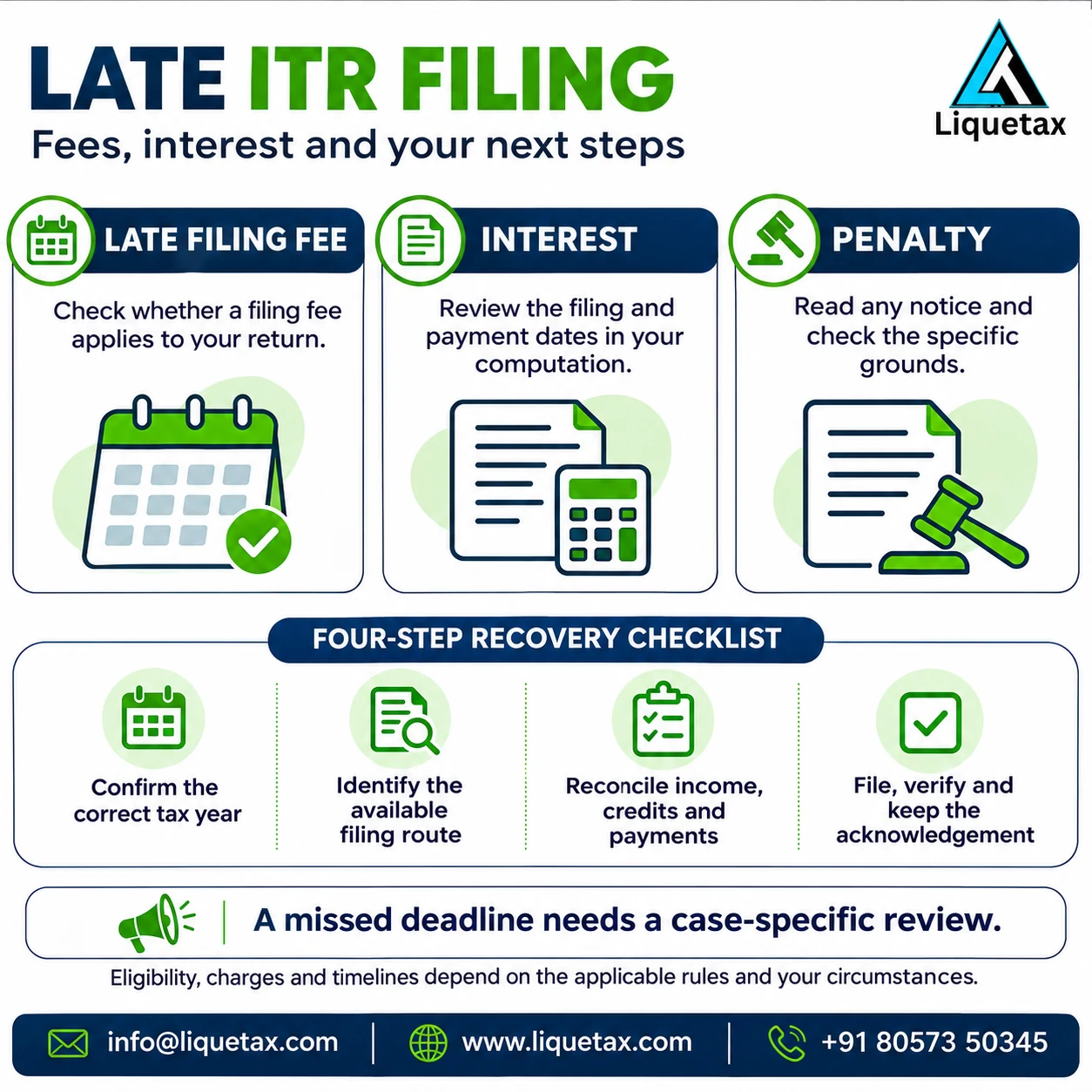
If you believe you missed an ITR deadline, focus first on facts that determine the next available action. Was a return required, what date applied to your category, has anything already been submitted, and is there a notice or completed assessment? Answering those questions prevents a rushed filing under the wrong provision.
Choose the correct income period
For income earned from 1 April 2025 to 31 March 2026, select Assessment Year (AY) 2026-27 and apply the Income-tax Act, 1961. Income earned from 1 April 2026 belongs to Tax Year 2026-27 under the Income-tax Act, 2025. These are different periods. A return or notice about an earlier year does not move to the new Act merely because you handle it after April 2026.
Confirm that the deadline was actually missed
Check the assessment year, taxpayer category and any current extension. A headline about a later audit-category date does not automatically cover a salary-only return, and an old July reminder may not describe every non-audit business case. Save the relevant official date information. If the return was submitted, check verification status and the acknowledgement rather than assuming an unfinished draft counts as a filing.
Preserve the records and make a short action list
Gather all income records, tax-credit statements, challans and any previous draft. Add current notices and portal messages. List what is missing and who can supply it, then contact the relevant employer, bank, broker or accountant. Do not delete an earlier computation or acknowledgement: the filing history may determine whether the next route is belated filing, revision, verification-related action or something else.
Check the available statutory window
An eligible first late return for AY 2026-27 ordinarily has a 31 December 2026 outer date or assessment completion, whichever is earlier. An existing valid return may instead have a revision route with different conditions and timing. If those windows are closed, updated-return or condonation questions require separate assessment. ITR-U cannot be treated as a universal late-refund route because it cannot create or increase a refund.
Calculate consequences before submission
Prepare the complete income and credit reconciliation and identify tax, applicable interest and fees separately. Review affected regime elections, losses and deductions instead of assuming every benefit is preserved or lost. The current section 234F amount, where applicable, is ₹5,000 with a ₹1,000 cap for total income not exceeding ₹5 lakh. Avoid relying on obsolete ₹10,000 figures or a guarantee that late filing prevents scrutiny.
Finish the selected action and monitor the result
Pay required amounts through the official service, review declarations and submit through the legally available route. Complete verification within the applicable period and save all evidence. If a notice-response deadline is also running, handle it explicitly; a return filing does not automatically answer every notice. Monitor the resulting intimation or order and keep unresolved credit corrections on your follow-up list.
Practical checklist
- Confirm the correct due date, extension and actual filing status.
- Save all acknowledgements, drafts, notices and verification records.
- Obtain missing income and credit documents with assigned follow-up dates.
- Check the available route and calculate its consequences before submission.
- Retain payment, filing and verification evidence and monitor later communications.
Worked example
Illustration: a taxpayer believes no return was filed, but the portal shows a submitted return awaiting verification. Another taxpayer has only a locally saved draft. Their recovery steps may differ, so both first inspect the actual portal record. Neither should automatically submit a second return under an arbitrary section. The correct route follows the genuine filing history, time limits and any applicable verification or condonation requirements.
Frequently asked questions
Should I immediately file a second return?
First check whether a return was already submitted, verified or processed. The next action depends on that history.
Does an extension reported online always cover me?
No. Read the official category and conditions before relying on a later date.
Can I wait for every missing credit correction indefinitely?
No. Track the legal window and assess the supported filing position while following up the discrepancy.
Will paying the late fee solve every issue?
No. Tax, interest, elections, losses, notices and other obligations require their own review.
What evidence shows the recovery action is complete?
Retain the applicable payment record, submitted return or response, acknowledgement and verification confirmation, then review the outcome.
Official references
- Income Tax Department: returns and updated returns
- Income Tax Department: current circulars and extensions
- Income Tax Department: penalties and fees
- Income Tax Department: e-verification manual
For help reviewing your documents and the correct next step, contact LIQUETAX. The scope and any professional fee should be agreed in writing after the facts are checked. This article provides general information; individual eligibility depends on the applicable law and records.