
- Choose the correct income period
- First establish the deadline and scope
- Early stage: request records and reveal gaps
- Middle stage: reconcile and decide
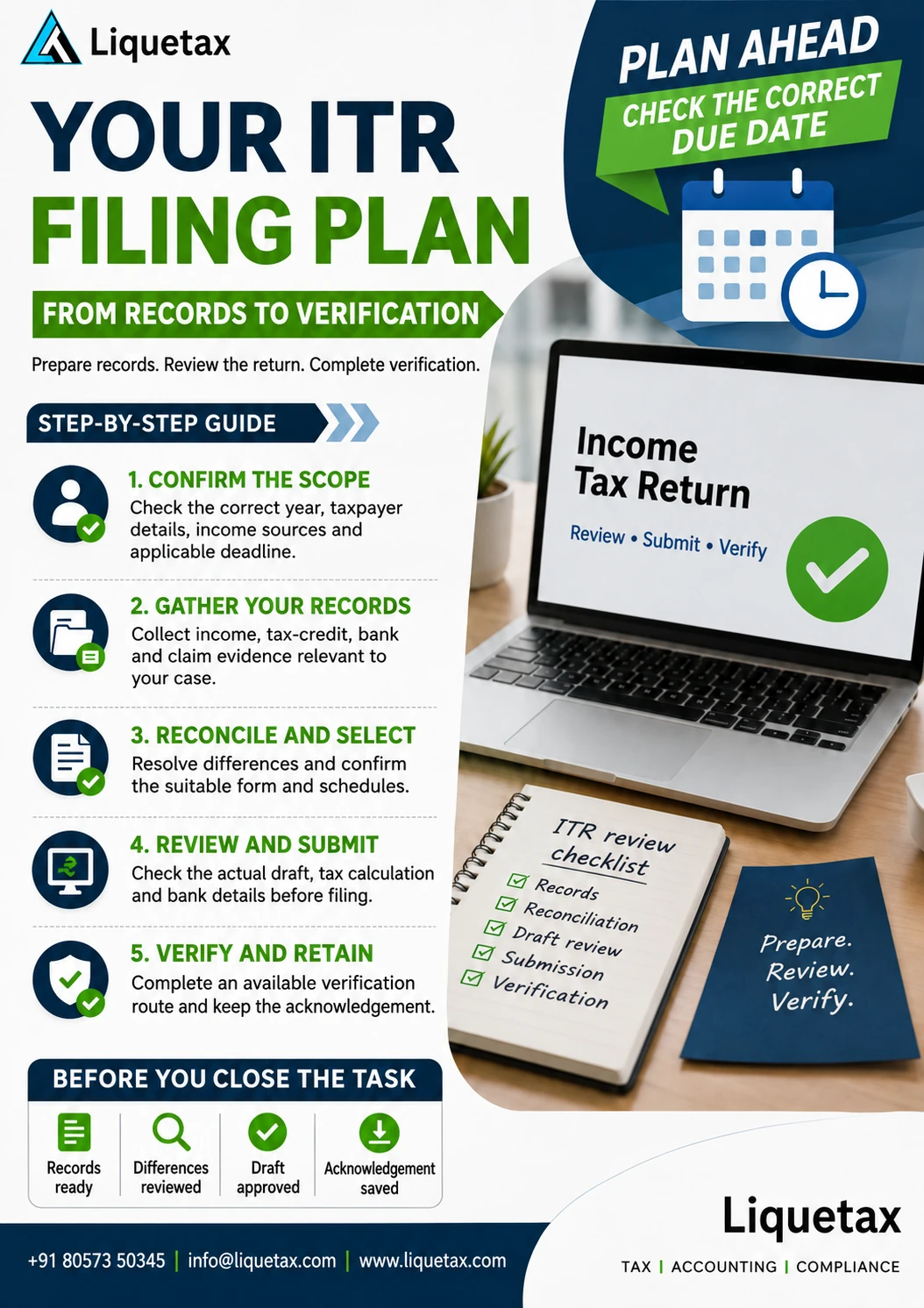
Working backwards from your actual filing deadline is more useful than repeatedly checking whether the portal is open. The plan below divides preparation into manageable stages without assuming everyone has the same due date. Adjust the lead time for audit, foreign disclosures, complex investments or unresolved tax-credit reporting.
Choose the correct income period
For income earned from 1 April 2025 to 31 March 2026, select Assessment Year (AY) 2026-27 and apply the Income-tax Act, 1961. Income earned from 1 April 2026 belongs to Tax Year 2026-27 under the Income-tax Act, 2025. These are different periods. A return or notice about an earlier year does not move to the new Act merely because you handle it after April 2026.
First establish the deadline and scope
Identify the assessment year, taxpayer category and any audit or transfer-pricing requirement. Check the latest valid extension and whether it covers your case. The return deadline, audit-report date, payment requirements and regime-election date may need separate entries. Write down which tasks are yours and which are assigned to an adviser or accountant so that document gathering does not fall between them.
Early stage: request records and reveal gaps
Ask every employer, bank, broker and relevant business contact for the records needed to explain the year. Create a missing-item list with an owner and follow-up date. Include closed accounts and job changes. A statement that “all documents are ready” should mean the complete income inventory was checked, not merely that PAN and the latest Form 16 were received.
Middle stage: reconcile and decide
Reconcile Form 26AS, AIS and tax payments with original evidence. Review the form, residency, income classification and valid regime choice before finalising the tax calculation. Resolve investment cost, property and deduction questions here. Where a deductor correction is pending, document it and assess the supported filing position; a promised correction is not the same as an updated tax-credit record.
Review stage: examine the actual draft
Review the return and computation, including assumptions and unresolved items. Confirm that bank details, addresses and declarations match the taxpayer’s facts. Compare the draft with previous records where relevant, but do not copy obsolete answers. If additional tax is payable, allow time to make the payment using the correct year and details and to confirm the challan treatment.
Submission and follow-through: close each task
Submit the approved return through the correct route and complete verification within the applicable period. Keep the filed copy and acknowledgement, then mark the filing task complete only when the necessary steps are evidenced. Retain a separate follow-up list for processing, credit corrections and notices. If the original deadline cannot be met, assess the available statutory route rather than assuming preparation work preserves timely status.
Practical checklist
- Record the actual due-date category and any official extension.
- Assign an owner and follow-up date to each missing record.
- Schedule a reconciliation review before the final submission day.
- Leave time for taxpayer approval, payment and verification.
- Save completion evidence and keep unresolved matters on a separate list.
Worked example
Illustration: a business expects its audit-category extension to apply but has not checked the relevant table. The first planning task is to confirm the category and audit-report date. Next, missing bank and customer confirmations are assigned to named owners. The plan makes dependencies visible; it does not assume the extension covers an unrelated individual’s return or automatically extends every other form or tax-payment obligation.
Frequently asked questions
Should I use the same timetable every year?
Review changes in income, form eligibility, audit requirements and official deadlines before reusing a prior plan.
Is starting preparation before the deadline enough?
No. Timely compliance depends on the required filing and verification steps, not merely starting the work.
Who should approve an adviser-prepared return?
The taxpayer should review the facts, declarations and material figures before authorising submission.
Can a pending certificate correction be ignored?
Keep it visible, follow up and assess the supported reporting position and any later action required.
What if I am already late?
Confirm the available belated or other statutory route and applicable consequences promptly; do not assume an extension without evidence.
Official references
- Income Tax Department: current return obligations and deadlines
- Income Tax Department: current circulars and extensions
- Income Tax Department: e-verification manual
- Income Tax Department: current return forms and utilities
For help reviewing your documents and the correct next step, contact LIQUETAX. The scope and any professional fee should be agreed in writing after the facts are checked. This article provides general information; individual eligibility depends on the applicable law and records.