
- Choose the correct income period
- Confirm that the deadline applies to you
- Use the belated-return window where available
- Calculate the fee without confusing it with tax
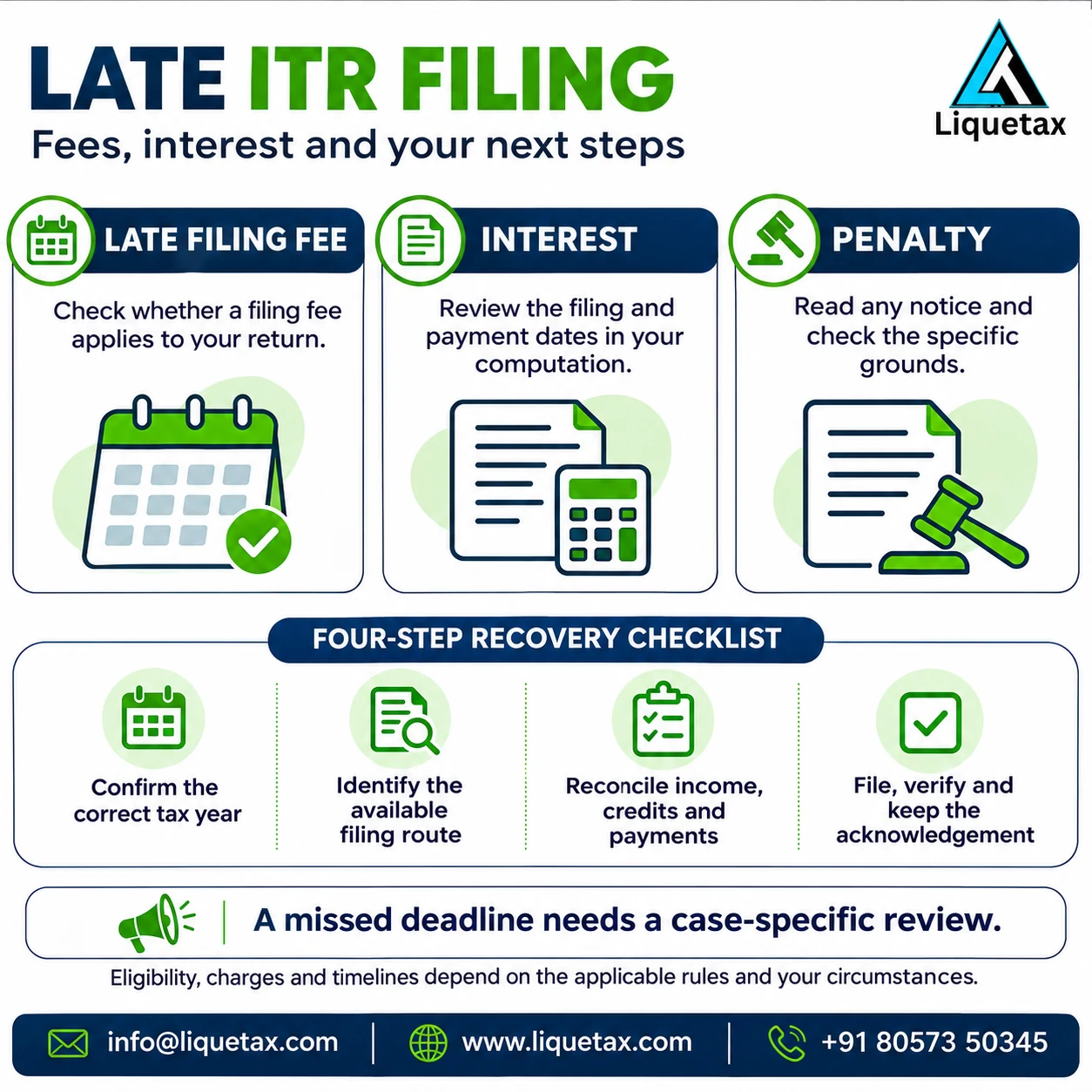
If a filing deadline has passed, first establish whether you were required to file and whether your particular due date was actually missed. Then choose the available statutory route using the assessment year and filing history. Delaying further does not improve the position, but panic-filing an inaccurate return can create a second problem.
Choose the correct income period
For income earned from 1 April 2025 to 31 March 2026, select Assessment Year (AY) 2026-27 and apply the Income-tax Act, 1961. Income earned from 1 April 2026 belongs to Tax Year 2026-27 under the Income-tax Act, 2025. These are different periods. A return or notice about an earlier year does not move to the new Act merely because you handle it after April 2026.
Confirm that the deadline applies to you
The correct original date depends on the taxpayer category, audit and other requirements and any valid extension. AY 2026-27 includes distinct July, August, audit and transfer-pricing categories. The September 2026 extension of specified audit-category returns to 21 November does not cover everybody. Read the relevant circular before concluding that a return is either timely or late.
Use the belated-return window where available
For AY 2026-27, an eligible belated return can ordinarily be furnished by 31 December 2026 or before completion of assessment, whichever is earlier. Prepare the same complete income, credit and deduction records required for a timely return. A belated return is not permission to omit income or use an ineligible simplified form. Submit it under the correct filing provision and complete verification.
Calculate the fee without confusing it with tax
Section 234F provides a late-filing fee where its conditions apply. The current amount is ₹5,000, restricted to ₹1,000 where total income does not exceed ₹5 lakh. Do not use the obsolete blanket ₹10,000 figure or assume every voluntary nil-tax return attracts the same fee. Tax, applicable interest and the fee are separate components and should appear distinctly in the computation.
Review interest, elections and losses
Section 234A can apply to delay in furnishing the return on the relevant unpaid tax amount. Sections 234B and 234C address advance-tax defaults separately. Whether a refund is expected does not replace that calculation. Late filing can also affect certain loss carry-forwards, deductions or regime elections, but not all losses and benefits follow one rule. Review each item rather than assuming everything is either preserved or lost.
Distinguish a revision from an updated return
A valid original or belated return containing an error may be revised within the applicable window. AY 2026-27 revision can extend to 31 March 2027, subject to assessment completion and applicable fees after December. ITR-U is a separate conditional route with a window up to 48 months from the relevant assessment-year end and additional tax. It cannot be used to create or increase a refund.
Preserve a clear record of remedial action
Save the liability calculation, challans, return acknowledgement and verification evidence. If the ordinary refund-claim window has expired, assess whether a statutory condonation process is available on the actual facts; do not assume a guaranteed two- or three-year refund entitlement. Notices and existing proceedings may change the available route, so retain them when seeking help.
Practical checklist
- Confirm the exact year, applicable due date and any extension.
- Check whether a return has already been filed or assessed.
- Reconcile all income, credits and eligible claims before computing late charges.
- Review loss carry-forwards and regime-election consequences separately.
- Pay applicable amounts through the official system and save proof of verification.
Worked example
Illustration: a taxpayer required to file has total income of ₹4.8 lakh and misses the applicable original deadline. The section 234F ceiling may be ₹1,000, not the ₹5,000 maximum used for higher income. Any actual tax and interest are calculated separately. The taxpayer still checks the correct form and belated deadline. This illustration does not assume that every person with ₹4.8 lakh of income has identical filing or tax circumstances.
Frequently asked questions
Is the late fee always ₹5,000?
No. The statutory conditions and the ₹1,000 cap for total income not exceeding ₹5 lakh must be considered.
Does no final tax mean no filing duty?
No. A rebate or tax credits can eliminate tax while a return remains required under the filing rules.
Can a belated return claim genuine excess TDS?
It can where otherwise eligible, but the correct timing, form and credit conditions still apply.
Are all losses lost after late filing?
No single rule covers every loss. Review the particular loss category and applicable carry-forward conditions.
Can ITR-U replace any missed return?
No. It has exclusions, additional-tax requirements and restrictions including the prohibition on creating or increasing refunds.
Official references
- Income Tax Department: returns and updated returns
- Income Tax Department: penalties and fees
- Finance Act 2026, enacted text
- AY 2026-27 ITR-3 validation rules
For help reviewing your documents and the correct next step, contact LIQUETAX. The scope and any professional fee should be agreed in writing after the facts are checked. This article provides general information; individual eligibility depends on the applicable law and records.