

- 1. Identify the product
Confirm the scheduled product and destination.
- 2. Prepare the exporter
Review IEC, business identity and authorisation.
- 3. Apply through DGFT
Use the current APEDA e-RCMC route.
- 4. Plan the shipment
Check quality, documents and buyer requirements.
Check whether APEDA covers your product
APEDA’s scheduled products include categories such as fruits and vegetables, cereal products, dairy products, confectionery, bakery products, honey, pickles and certain other agricultural or processed products. This is a starting point for checking scope, rather than a statement that every food item belongs to APEDA. Record the ingredients, processing, intended use and proposed classification before selecting the registration authority.
A trader buying packed products from a manufacturer should also explain who manufactures, who exports and whose name appears on invoices. A manufacturer exporting directly has a different operating file. If you plan several product lines, check each line separately. The correct authority and the additional procedure may differ even when the products travel in the same container.
Understand the current e-RCMC route
APEDA’s official notice directs exporters of scheduled products to apply for e-RCMC through the DGFT portal after obtaining an Importer Exporter Code. APEDA has used this route since 17 July 2023. An older instruction to submit every new registration solely through an APEDA website should therefore be checked against the current process.
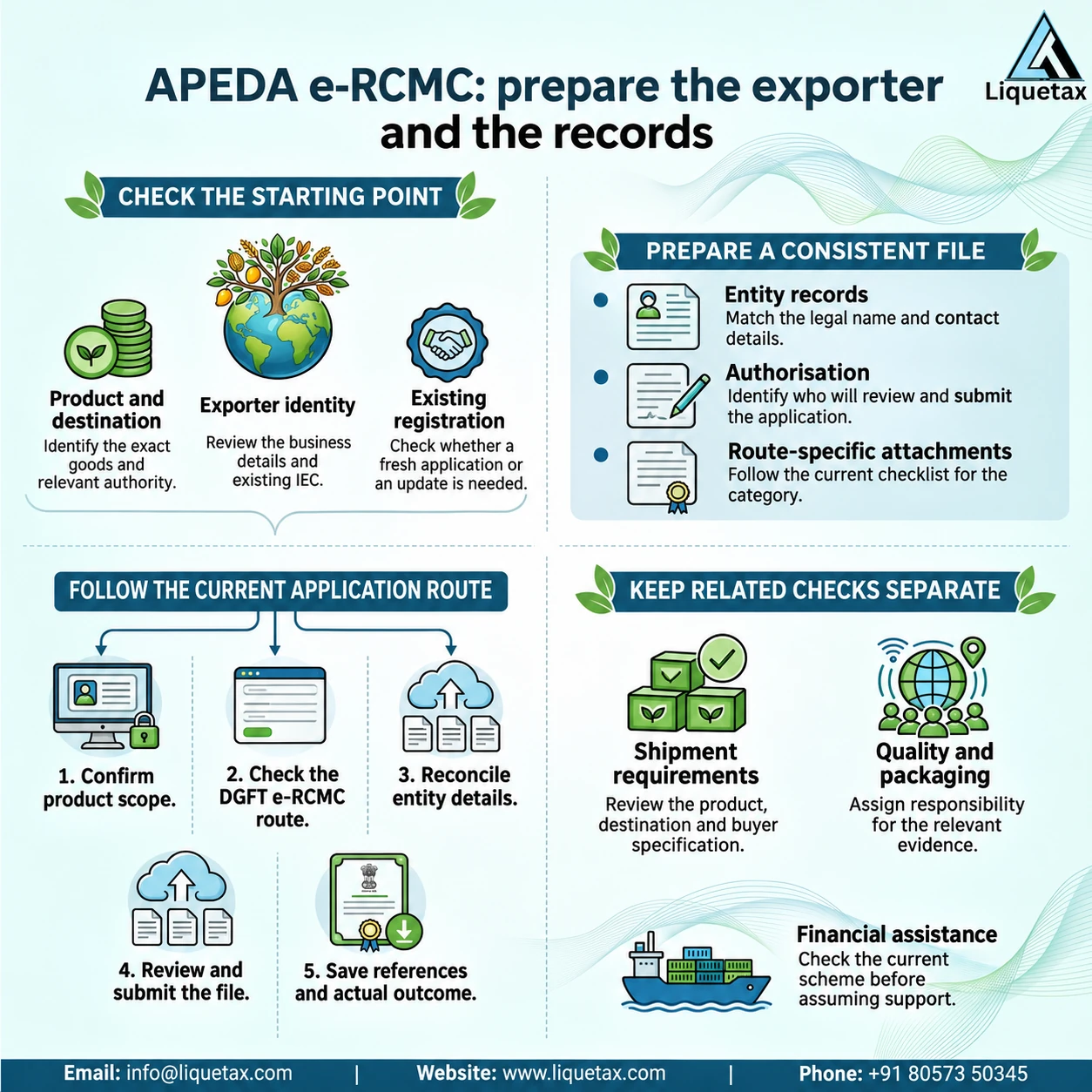
Before starting, compare the legal name, PAN-linked entity details, IEC and contact information. Check whether an RCMC already exists and whether you need a fresh application, amendment or another action. Use the live checklist for your category. Save the submitted application, payment evidence, acknowledgement and issued certificate so the business retains a complete record.
Use export information to ask better questions
APEDA’s functions include standards, packaging improvement, overseas marketing, industry statistics and training for scheduled products. Its website also provides trade information and product resources. These can help you prepare a more informed discussion with a buyer, laboratory, packhouse or logistics provider. Access to information is useful; its commercial value depends on how you apply it to your own product.
Turn an enquiry into a short written brief: product specification, pack size, quantity, delivery destination, intended customer and required certificates. Compare the buyer’s demands with the relevant official procedure before quoting. Check the buyer’s identity, payment terms and ability to import separately. Participation in a trade event or receiving an enquiry does not itself establish that a buyer is reliable.
Improve quality and packaging before dispatch
APEDA publishes packaging resources and product-specific export procedures. Current procedure listings include separate guidance for peanuts, rice to China and fresh table grapes to the European Union. This shows why a general registration guide cannot supply one universal laboratory test or certificate list. The required work depends on the product, destination and applicable procedure.
For your shipment, create a checklist covering the product specification, batch identification, packaging suitability, storage conditions and supporting records. Agree who arranges any required testing or inspection and when the results must be available. Ask the buyer to approve the commercial packaging specification in writing. A suitable carton or label for domestic sales should not be assumed suitable for an overseas order.
Check assistance under the current scheme
On 6 October 2026, APEDA listed Bharat Krishi Niryat Yojana for the 2026–27 to 2030–31 cycle. Its official circular says online applications will be accepted from 10 October 2026. As of this guide’s source check on 7 October, that opening date is still ahead. The earlier 2021–26 scheme should not be used as the current rate card.
Check the latest component guidelines and application instructions before making expenditure commitments. Establish applicant eligibility, eligible activity, approval sequence, evidence and the available window. Registration should not be described as an automatic subsidy approval. Build a business plan that can be assessed without an assumed reimbursement, and show any potential assistance separately until its eligibility and sanction are confirmed.
Keep other shipment requirements in the same plan
RCMC, IEC, food business requirements, customs documentation and destination controls answer different questions. Prepare an applicability review for your exact transaction. Depending on the goods, additional product procedures, facility recognition, traceability, testing or destination certificates may need attention. Confirm these with the relevant authorities and service providers before promising a dispatch date.
Prepare the commercial records as carefully as the registration file. Check the buyer’s purchase order, invoice description, quantities, currency, freight arrangement and payment terms. Agree who handles export documentation and bank follow-up. Keep a version of the final shipment file that the exporter can access, rather than relying on a courier message or a consultant’s private folder.
A useful preparation file for your first export
| Record | What to include | Practical purpose |
|---|---|---|
| Product brief | Ingredients, processing, pack sizes and intended destination. | Check authority scope and the applicable procedure. |
| Exporter identity | Entity records, existing IEC and any RCMC. | Avoid inconsistent or duplicate applications. |
| Buyer specification | Purchase terms and requested quality or packaging evidence. | Check requirements before quoting and production. |
| Shipment checklist | Assigned responsibilities for testing, documents and logistics. | Reduce missed tasks before dispatch. |
| Assistance review | Current component instructions and written eligibility notes. | Keep potential support separate from confirmed finance. |
Illustrative example
Illustrative example: a small Indian millet-snack business receives an overseas enquiry. It first confirms the relevant product category, exporter identity and IEC, then reviews APEDA e-RCMC. At the same time, it asks the buyer for the ingredient, label, shelf-life and packaging requirements. The registration and the shipment checks run as connected tasks, with a named person responsible for each.
The business compares testing, packaging, freight and professional costs before accepting the order. If assistance may be available, it checks the current scheme before spending. This approach makes the quotation easier to explain and helps the exporter identify work that remains incomplete. It does not promise acceptance by a buyer or importing authority.
Frequently asked questions
Does APEDA registration apply to every food exporter?
APEDA covers its scheduled products. Identify the exact goods and relevant registration authority instead of assuming that every food item requires APEDA registration.
Where should I apply for APEDA e-RCMC?
APEDA directs exporters of scheduled products to the DGFT e-RCMC route after obtaining IEC. Use the current portal checklist and check existing registrations first.
Does an APEDA certificate guarantee a subsidy?
No. Financial assistance depends on the current scheme, component eligibility, approval process and supporting evidence. Registration alone is not a sanction.
Does e-RCMC complete all export requirements?
No. Product, destination, quality, customs, banking and commercial requirements need a separate review for the actual shipment.
What should I prepare before a consultation?
Bring the product description, destination, buyer requirements, business identity, existing IEC or RCMC and any planned expenditure that you want reviewed for assistance eligibility.
Discuss your next step with LIQUETAX
Bring your product and proposed destination to LIQUETAX before choosing a registration package. Ask for a written explanation of the applicable registration, missing records and separate shipment checks. Confirm government charges, professional fees and any additional testing or documentation costs before authorising work.
Official references
Sources checked on 7 October 2026. Confirm the current form, product scope and instructions before filing.