
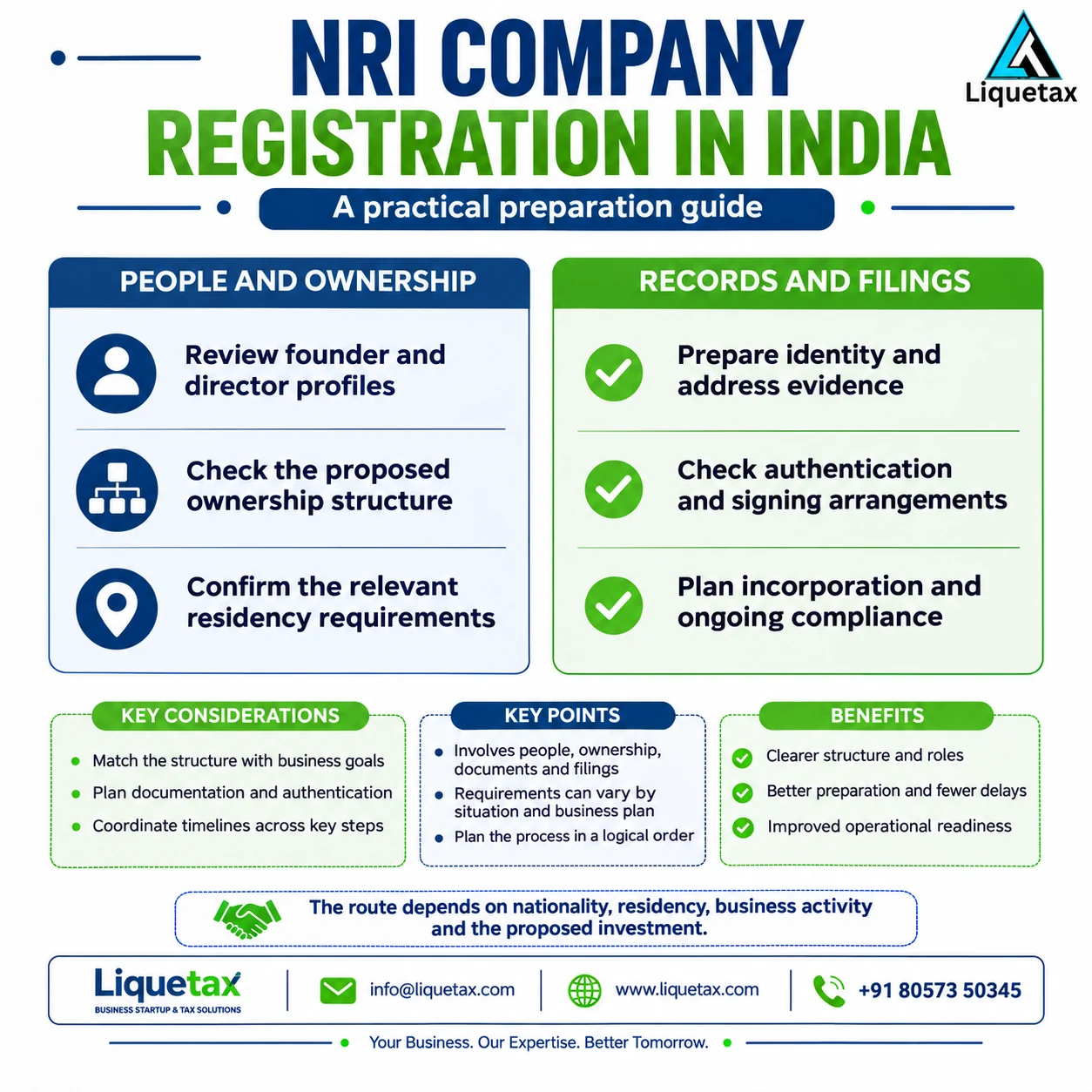
- Distinguish citizenship, residence and ownership
- Choose a structure and investment route
- Prepare overseas documents correctly
- Complete incorporation and funding separately
Distinguish citizenship, residence and ownership
An Indian citizen living abroad can participate in an Indian company, subject to company law and the foreign-investment rules applicable to the transaction. NRI is not simply a label established by being outside India for 182 days. FEMA residence and income-tax residence are separate legal tests, and citizenship is a different question again. Establish each person’s status before planning remittances or documents.
A private company normally needs at least two members and two directors. At least one director must meet the Companies Act residence requirement: staying in India for at least 182 days during the financial year, with the proportionate rule for a newly incorporated company. A resident shareholder is not automatically required merely because a resident director is required.
Choose a structure and investment route
An OPC is available to an eligible natural person who is an Indian citizen, including an NRI, subject to its rules. A private company may be more suitable when there are several owners or future equity investors. An LLP has a different ownership, management and foreign-investment framework. A branch or project office of a foreign entity is a separate route, not just another name for incorporating an Indian company.
Check the activity, sectoral cap, entry route, beneficial ownership and any country-related approval conditions. Repatriable investment and qualifying NRI or OCI non-repatriation investment can have different treatment. Do not assume that automatic-route eligibility means no conditions or no reporting. Discuss the proposed flow with the authorised dealer bank before funds move.
Prepare overseas documents correctly
Collect the applicant’s passport where required, identity details, residential evidence and signed consents. The authentication method depends on the country of execution and the applicable rules; notarisation, apostille, consular authentication and certified translation are not interchangeable requirements. Confirm the exact route before signing documents abroad.
For the Indian registered office, establish ownership or a valid right to use the premises, the required owner permission and recent utility evidence. Check spellings and addresses across documents. Incorporation filings use SPICe+ and linked forms; eligible first-director DIN applications can be included in that process. It is inaccurate to require every new director to first obtain DIN through a standalone DIR-3 application.
Complete incorporation and funding separately
Obtain the necessary digital signatures, reserve the name, settle the constitutional documents and submit the linked filings. After incorporation, complete bank onboarding and subscription arrangements. PAN and TAN are integrated with the incorporation process; bank KYC and foreign exchange compliance remain distinct operational steps.
Where a share issue is reportable as foreign investment, FC-GPR is generally due within 30 days of issue. The applicable remittance, allotment, valuation, return and other reporting obligations must be checked for the chosen route. Keep bank advice, investor KYC, allotment approvals and filing acknowledgements together. Incorporation itself does not prove that foreign-investment compliance has been completed.
Practical checklist
- Confirm citizenship, FEMA residence, tax residence and beneficial ownership separately.
- Identify the business activity and approval route before accepting overseas funds.
- Check the resident-director requirement and actual presence records.
- Confirm authentication and translation requirements in the country of signing.
- Agree a written post-incorporation funding and reporting checklist with the bank and adviser.
Illustrative example
An Indian citizen in Singapore wants to form a software company with another founder. They first compare OPC and private-company ownership needs, then document the resident director and decide whether the investment will be repatriable. They obtain the correct overseas authentication and keep the remittance and share-issue records separate from the incorporation certificate. No approval time or tax outcome is assumed.
Frequently asked questions
Can an NRI own all the equity?
It may be possible in a permitted activity and structure, but sector rules, beneficial ownership, the investment route and company membership requirements must all be checked.
Is physical presence always necessary?
Many incorporation steps can be completed remotely. Document execution, authentication, digital-signature verification and bank onboarding still have their own requirements.
Must every director be resident in India?
No. The company must satisfy the statutory resident-director requirement; other directors may be non-resident if otherwise eligible.
Does automatic route remove reporting?
No. It concerns the entry approval route. Reporting, pricing, instrument and other applicable conditions can remain.
Is a fixed incorporation fee appropriate?
Request an itemised quote reflecting capital, state charges, overseas authentication, professional scope and post-incorporation work. Generic price ranges can omit material items.
Official references and next step
- MCA: SPICe+ and linked filing FAQs
- India Code: Companies Act, 2013
- RBI: Foreign Investment in India directions
- MCA: OPC eligibility and conversion reforms
For help applying this checklist to your documents, contact LIQUETAX with the relevant facts and the support you need. Request a written scope and fee breakdown before work begins.