
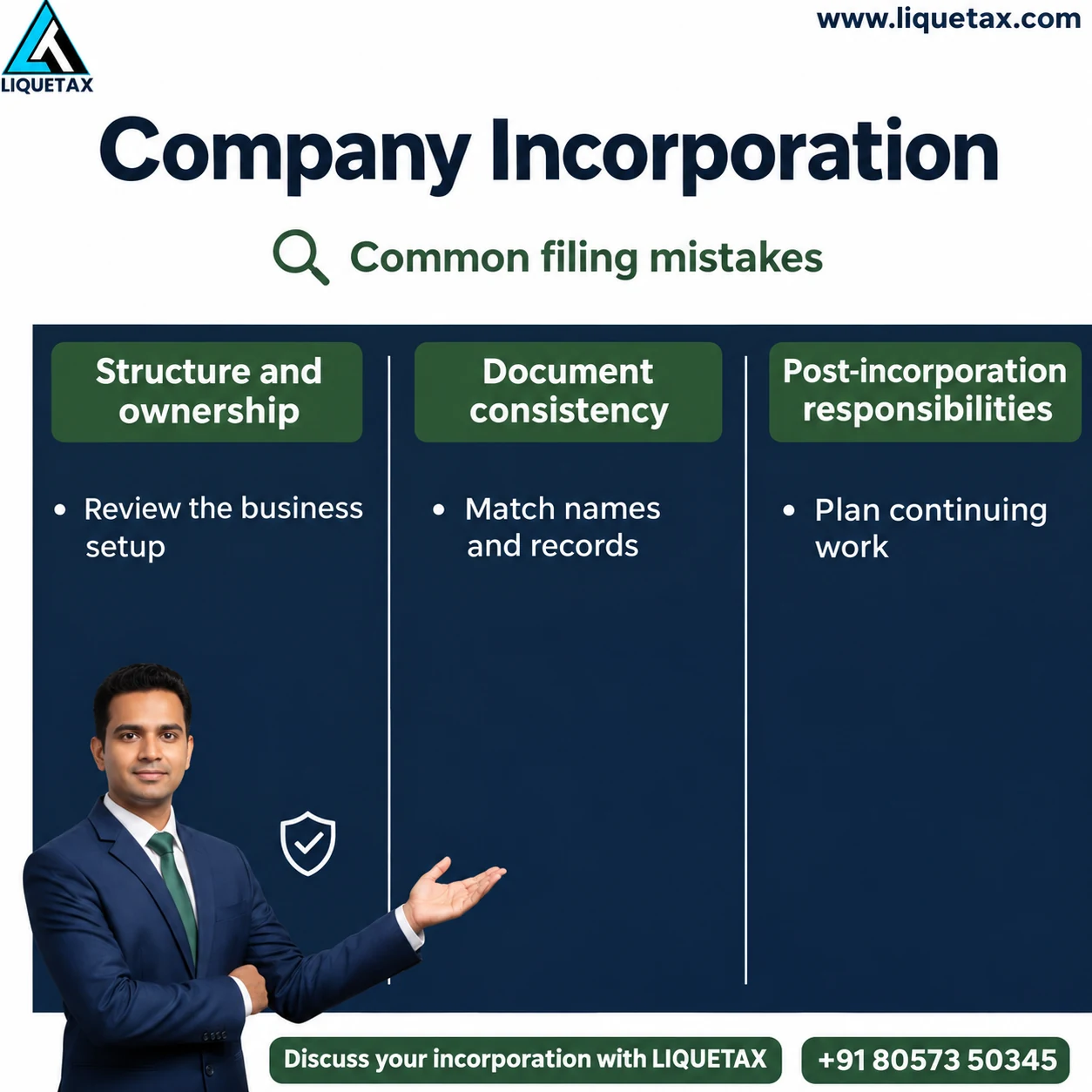
- Treat incorporation as a coordinated decision
- Reconcile names and personal information
- Make the capital and objects coherent
- Verify the office and signing workflow
Treat incorporation as a coordinated decision
A company application can look complete while the underlying decisions remain unclear. Agree the founders, directors, proposed activity, ownership and registered office before preparing forms. Different figures or names across a consent, the memorandum and the application can create a resubmission or a more serious ownership problem.
Choose the structure for the actual business. A private company may suit a business seeking equity investors, while other structures can suit different ownership and compliance needs. Avoid choosing solely because a registration package has the lowest initial price. Include ongoing accounting, audit and corporate filings in the decision.
Reconcile names and personal information
Search proposed names against company, LLP and trademark records. For a new company use SPICe+ Part A and the relevant linked incorporation process. Name reservation is not a trademark clearance certificate. Confirm the reservation expiry before arranging final signatures and filing.
Use legible identity and address evidence. Check spelling, date of birth, nationality and residential details across PAN, passports and declarations as applicable. Overseas execution may require a particular authentication route. An unsupported explanation typed into a form does not correct a contradictory identity document. Obtain the appropriate correction or supporting evidence first.
Make the capital and objects coherent
Distinguish authorised capital, issued shares and the subscription each founder undertakes to pay. Prepare a simple ownership table and obtain written agreement. Do not confuse capital subscribed by founders with a government fee or professional charge. Promising an investor shares later will require the relevant approvals and procedure.
The memorandum should describe the intended business and matters necessary to pursue it. The articles should support the proposed ownership and governance. Copying a document from an unrelated regulated business can create unnecessary questions. Incorporation does not grant licences for activities such as lending, food production or financial services.
Verify the office and signing workflow
The registered-office evidence should establish a real premises and the company’s right to use it. Match the address, owner’s details, permission and required recent utility evidence. A residential or shared premises is not automatically invalid, but its use and documentation must fit the applicable rules. A mail-forwarding description alone is insufficient.
Check that required digital signatures and MCA associations work before the filing deadline. Eligible DIN applications for first directors are part of SPICe+; do not blindly duplicate them through standalone forms. PAN and TAN are linked to incorporation. Keep the approved application, attachments, payment evidence and certificate together.
Prepare the first compliance steps
Create a handover list for bank onboarding, subscription receipts, registers, auditor appointment, meetings and applicable tax or operating registrations. For companies covered by section 10A, the commencement declaration in INC-20A has a 180-day limit and conditions that must be met before commencing business or borrowing. That rule is not a universal statement about every company form.
Record the particular deadlines and responsible people instead of treating the incorporation certificate as the end of the process. If an earlier filing contains an error, obtain advice on the proper correction route. Never recreate evidence with an earlier date simply to make a compliance file appear complete.
Practical checklist
- Approve one final ownership and capital table before anyone signs.
- Compare the name and address character by character across linked documents.
- Confirm the office owner’s authority and utility-document date.
- Keep director consents, eligibility checks and required signatures together.
- Assign the first-year compliance tasks before the incorporation handover closes.
Illustrative example
Three founders agree equal ownership verbally but one draft contains a different share allocation. A final comparison catches the mismatch before signing. The founders approve the corrected table, align the memorandum and application, and record who will manage subscription receipts after incorporation. The example shows why document consistency matters, without claiming any particular approval time.
Frequently asked questions
Are all new directors required to file DIR-3 first?
No. The integrated incorporation process can include eligible DIN applications for proposed first directors. Use the current instructions for the specific case.
Does incorporation include every business licence?
No. Review GST, local and sector-specific requirements separately against the actual activity and locations.
Can a home address be used?
It can be suitable if lawful use, owner permission and required evidence are available. Check the premises and applicable local restrictions.
Is INC-20A required for every entity?
No. Check whether the company falls within section 10A, including the share-capital and incorporation-date conditions. LLPs follow a different framework.
Can a professional guarantee approval?
No. A professional can review and prepare the application, but the authority controls scrutiny, queries and approval.
Official references and next step
- MCA: SPICe+ and linked filing FAQs
- MCA: incorporation document and address FAQs
- India Code: Companies Act, 2013
For help applying this checklist to your documents, contact LIQUETAX with the relevant facts and the support you need. Request a written scope and fee breakdown before work begins.