
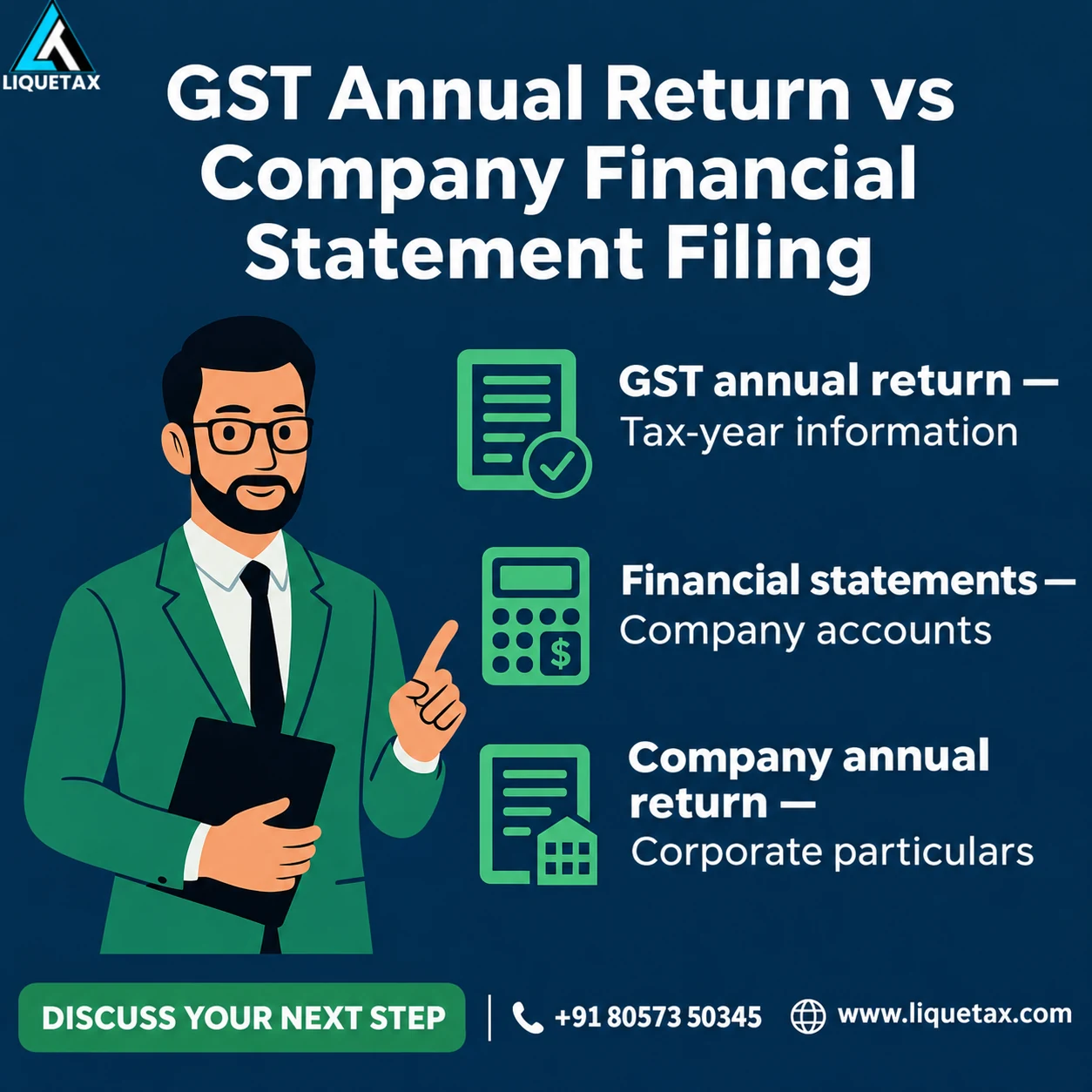
Three tasks are often confused
The phrase 'annual return' can refer to a GST return or a company-law annual return. GSTR-9 belongs to the GST track. The applicable AOC-4 variant belongs to company…
Explore this sectionCheck GST applicability for the actual financial year
Do not assume every GST registrant must file GSTR-9 regardless of turnover or category. Statutory exclusions and year-specific notifications can affect the obligation. For…
Explore this sectionUse the correct filing date basis
The GST annual-return track has its own year-end due-date framework and any applicable extensions. Company financial-statement filing ordinarily uses the AGM-based section 137…
Explore this sectionPrepare records that connect books, tax and corporate decisions
For GST work, organise applicable periodic returns, sales and purchase records, credit notes, input-tax-credit workings and documented differences between books and returns.…
Explore this sectionDo not use an automatic correction shortcut
GSTN states that GSTR-9 cannot be revised after filing. The correct response to an error depends on its nature, relevant year and applicable procedure. Do not assume every…
Explore this sectionConfirm charges and consequences separately
GST late-fee amounts and limits can depend on the year, turnover category and applicable notification. Tax interest, a filing late fee and a penalty are distinct. A single flat…
Explore this sectionAT A GLANCE
Three separate filing tracks
- STEP 1
GST annual return
Tax-year information
- STEP 2
Financial statements
Company accounts
- STEP 3
Company annual return
Corporate particulars
AT A GLANCE
Before correcting a filed record
- STEP 1
Identify the error
What fact or amount is wrong?
- STEP 2
Check the route
Use the applicable year and procedure
- STEP 3
Authorise and record
Keep advice, approvals and evidence
Three tasks are often confused
The phrase 'annual return' can refer to a GST return or a company-law annual return. GSTR-9 belongs to the GST track. The applicable AOC-4 variant belongs to company financial-statement filing. MGT-7 or MGT-7A is the separate company annual-return track. Completing one does not establish completion of the others.
GSTR-9 is an annual GST return, not the same document as the GSTR-9C reconciliation statement. Financial statements contain the accounts and required disclosures prepared under the applicable company and accounting framework. Keep these names clear in your engagement and completion register.
| Task | What it addresses | Where it is filed |
|---|---|---|
| Applicable GST annual return | Annual GST information for the relevant registered person and year | GST portal |
| Applicable AOC-4 variant | Company financial statements and required accompanying documents | MCA portal |
| MGT-7 or MGT-7A | Annual company particulars and prescribed corporate information | MCA portal |
Check GST applicability for the actual financial year
Do not assume every GST registrant must file GSTR-9 regardless of turnover or category. Statutory exclusions and year-specific notifications can affect the obligation. For example, CBIC Notification 14/2024 exempted eligible registered persons with aggregate turnover up to ₹2 crore for FY 2023-24. That historical notification does not by itself decide a later year's filing requirement.
Composition taxpayers use a different annual-return route: GSTN describes GSTR-4 as the annual return from FY 2019-20 onwards. Copying an old statement that current composition taxpayers file GSTR-9A can produce the wrong checklist. GSTR-9C has its own applicability and preparation requirements, which must be reviewed separately for the relevant year.
Record the GSTIN, taxpayer category, aggregate-turnover basis and financial year, together with the notification or rule used. The current GSTN FAQ for the year can help with portal and table preparation, but it does not replace an applicability decision based on the law and your facts.
Use the correct filing date basis
The GST annual-return track has its own year-end due-date framework and any applicable extensions. Company financial-statement filing ordinarily uses the AGM-based section 137 trigger, rather than one universal 30 October date. An OPC and other special categories can require separate treatment.
Before publishing or relying on a calendar date, identify the financial year, company or taxpayer category, actual meeting or statutory trigger and any official relief. An additional-fee concession is not a general right to extend a filing deadline by paying a fee. Keep the evidence behind the date alongside the reminder.
Prepare records that connect books, tax and corporate decisions
For GST work, organise applicable periodic returns, sales and purchase records, credit notes, input-tax-credit workings and documented differences between books and returns. Prepare the year-specific tables using the current portal guidance rather than assuming an old auto-population method still applies.
For company accounts, organise the final trial balance, supporting ledgers, financial statements, required reports and approval or adoption records. Cash-flow statement and other disclosure requirements vary by company category. The statutory auditor's work, company approvals and form submission are separate responsibilities that should be named in the scope.
- Use the same relevant reporting year in the working files and submission records.
- Resolve differences with explanations and evidence rather than altering figures merely to match.
- Keep final signed documents, portal submissions and working reconciliations together.
Do not use an automatic correction shortcut
GSTN states that GSTR-9 cannot be revised after filing. The correct response to an error depends on its nature, relevant year and applicable procedure. Do not assume every error can simply be carried into the next year's return; additional liability, an incorrect credit or a portal issue can need different action.
Company financial statements also cannot generally be revised merely by submitting another AOC-4 within 30 days. Section 131 provides a controlled voluntary-revision route, including Tribunal approval where its conditions apply. Reopening accounts, revising the accounts themselves and fixing a technical filing issue are different matters. Obtain the correct route before changing a signed or filed record.
Confirm charges and consequences separately
GST late-fee amounts and limits can depend on the year, turnover category and applicable notification. Tax interest, a filing late fee and a penalty are distinct. A single flat fee table cannot safely describe every case. Likewise, normal MCA fees, additional filing fees and statutory consequences must be assessed separately.
Avoid treating non-filing as an automatic statement that every credit is blocked, a director is disqualified or the company is struck off. Those outcomes depend on the applicable provision and actual facts. Identify an existing notice or default specifically so the professional can assess it without relying on a general website warning.
Request a filing-gap review before paying for a package
Share the financial year, GST category, company category, available accounts and earlier acknowledgements with LIQUETAX. Ask for a list of required, completed and unresolved tasks. The proposal should distinguish GST annual-return work, any reconciliation statement, company accounts and corporate annual filings.
A clear scope lets you compare professional charges, document responsibilities and included follow-up. It also helps you see whether audit, correction, notice response or ongoing bookkeeping is separate work. Keep the final decision and submission authorisation with the appropriate responsible people.
Allocate GST, financial statements and annual returns to separate owners
A company may need information from the same accounts for several filings, but the deliverables are different. Ask the team to label each task with its authority, reporting period, return or form and responsible person. GST registration does not make a proprietorship subject to company annual-return filing, and incorporation does not settle which GST annual obligations apply.
For example, where sales totals differ between the books and GST workings, keep a documented reconciliation for the relevant period. Do not edit the corporate accounts merely to force agreement with a filed tax figure. Identify the reason, assess the available correction route and retain the reviewer’s conclusion with the filing pack.
What to prepare before you contact us
- Relevant GSTIN, registration category, financial year and turnover working.
- Applicable GST returns, invoices, credit notes and reconciliation records.
- Company category, final accounts and supporting ledgers.
- Required audit, Board and member or adoption records.
- Earlier portal submissions, acknowledgements, receipts and notices.
- Official year-specific applicability and relief references used in the assessment.
Start with your requirement and current stage. We will agree the document-sharing method before you send confidential records. Keep passwords, OTPs and digital-signature credentials with the authorised person.
Your next steps
Separate tracks
Identify GST return, company accounts and company annual return.
Check applicability
Confirm category, year and official exemptions or rules.
Reconcile records
Explain differences and finalise required documents.
Confirm dates
Use correct triggers and applicable relief.
Submit and hand over
Keep evidence and assess remaining follow-up.
Your questions, answered
Is GSTR-9 the same as the company's annual return?
No. GSTR-9 belongs to GST compliance. MGT-7 or MGT-7A is the company annual return; financial-statement filing is a further separate task.
Must all GST taxpayers file GSTR-9?
No. Confirm the taxpayer category, relevant financial year, statutory exclusions and applicable notifications. A prior-year exemption does not automatically settle the next year's obligation.
Can GSTR-9 be revised after filing?
GSTN states that a filed GSTR-9 cannot be revised. Assess the actual error and applicable correction or payment route before taking action.
Can filed financial statements be changed by uploading AOC-4 again within 30 days?
Do not assume that route is available. Revision of the accounts can require the section 131 process and Tribunal approval where applicable; technical filing corrections need their own assessment.
Official references for this guide
AI-assisted editorial research checked on 7 October 2026. The applicable route, rule and charges depend on your facts. For individual professional advice, have your facts and documents assessed before filing. No named professional review is claimed.
- CBIC Notification 14/2024: FY 2023-24 annual-return exemption, historical example only ↗
- GSTN: composition taxpayer annual return in GSTR-4 from FY 2019-20 ↗
- GSTN: year-specific GSTR-9 and GSTR-9C preparation FAQ for FY 2024-25 ↗
- GSTN: filed GSTR-9 cannot be revised; historical screenshots and other details must not be treated as current-year rules ↗
- MCA: Companies Act, 2013, financial-statement filing under section 137 ↗
- India Code: Companies Act, 2013, voluntary revision under section 131 ↗