
- Finish decisions before starting the filing clock
- Understand the integrated process
- Allow for queries and corrections
- Plan the business launch independently
Separate preparation from official processing
The time needed to register a company depends on when its facts and documents become ready, the relevant filing route and the authority’s scrutiny. A promise that every company will be incorporated in a fixed number of days is not reliable. Ask which steps an estimate includes and what assumptions it makes about complete documents and no resubmissions.
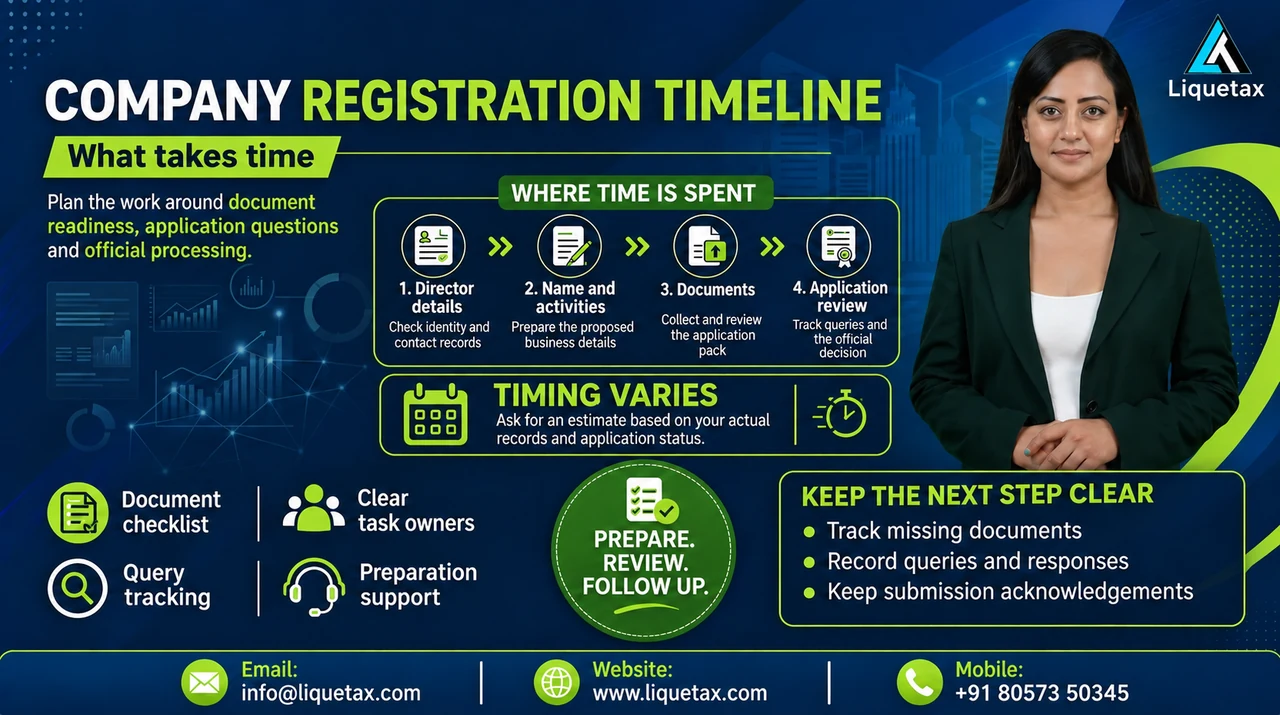
Use milestones instead of a single countdown: founder decisions, identity and office evidence, signatures, name reservation, final incorporation submission, official response and post-incorporation handover. The incorporation certificate is one milestone. Bank activation, tax registrations and sector permissions can have separate timelines.
Finish decisions before starting the filing clock
Agree the subscribers, proposed directors, business objects, share allocation and registered-office state. Resolve spelling or address differences in identity documents. If founders are overseas, check execution, authentication and translation requirements before arranging signatures. Couriering a document signed in the wrong manner can add more delay than the online form itself.
Confirm that the office owner can provide the required permission and current utility evidence. If the premises is shared, establish the provider’s authority and document chain early. Check the availability of each required signatory and the correct digital-signature setup. A nominally complete folder can still be unusable if its signers or permissions are missing.
Understand the integrated process
New companies generally use SPICe+ Part A for name reservation and Part B with linked forms for incorporation. Eligible DIN allotments for proposed first directors and PAN/TAN services are integrated; they should not automatically be shown as sequential standalone applications that each add a fixed number of days.
A name can raise similarity, restricted-word or object-clause issues. Search before filing and track the approval’s reservation period. Prepare the linked memorandum, articles and declarations consistently. If a reserved name is approaching expiry, check the available extension or fresh-application route rather than assuming the clock stops while documents are collected.
Allow for queries and corrections
Official scrutiny can result in a request for additional information or resubmission. Read the entire remark and identify every affected field and attachment. A correction to the company name, subscriber or share table may require changes across several linked documents. Respond within the stated period and save the revised version.
A service provider can commit to its own preparation and response times but cannot guarantee the regulator’s decision. Portal interruptions and payment reconciliation can also affect the process. Keep acknowledgement numbers and use official support channels where necessary; avoid submitting duplicate applications simply because a status has not refreshed immediately.
Plan the business launch independently
After incorporation, complete bank onboarding and the actual subscription-payment steps. Review applicable commencement conditions, statutory appointments, registers and local or sector requirements before starting relevant operations. A company that must file INC-20A should plan the required evidence and deadline from the start.
If a customer contract, grant or investment depends on incorporation by a date, build a realistic buffer and disclose the dependency. Do not promise delivery dates based only on an advertised fastest-case registration story. Review progress at each milestone and record the reason for any change so the founders can adjust their plans.
Practical checklist
- Approve founder, ownership, activity and office decisions before requesting a deadline.
- Check document consistency and overseas execution requirements early.
- Confirm required digital signatures and the availability of signatories.
- Record name-reservation expiry and resubmission deadlines.
- Separate certificate issuance from banking, commencement and operating licences.
Illustrative example
A founder expects to begin invoicing immediately after receiving the certificate. The project plan instead identifies bank KYC, payment of subscriptions and applicable commencement steps as separate dependencies. The founder adjusts the launch schedule before committing to a customer. This example explains planning and does not claim that any case finishes within a particular number of days.
Frequently asked questions
Can incorporation be guaranteed in 48 hours?
No general guarantee is appropriate. Document readiness, scrutiny and official processing differ between cases.
Are LLPs and OPCs always faster?
No. Their routes and documents differ, but the facts and any queries determine the actual time.
What commonly delays an application?
Unresolved founder decisions, inconsistent identity or office evidence, signature problems, name issues and incomplete responses to official queries can cause avoidable delay.
Does PAN require a separate waiting period?
PAN and TAN are integrated with company incorporation services. Do not assume every case requires a fresh standalone application after the certificate.
What should a useful estimate show?
Preparation responsibilities, required documents, assumptions, official dependencies and separate post-incorporation milestones. An estimate should be revised when those facts change.
Official references and next step
- MCA: SPICe+ and linked filing FAQs
- MCA: incorporation document and address FAQs
- MCA: current forms, notices and help
For help applying this checklist to your documents, contact LIQUETAX with the relevant facts and the support you need. Request a written scope and fee breakdown before work begins.