
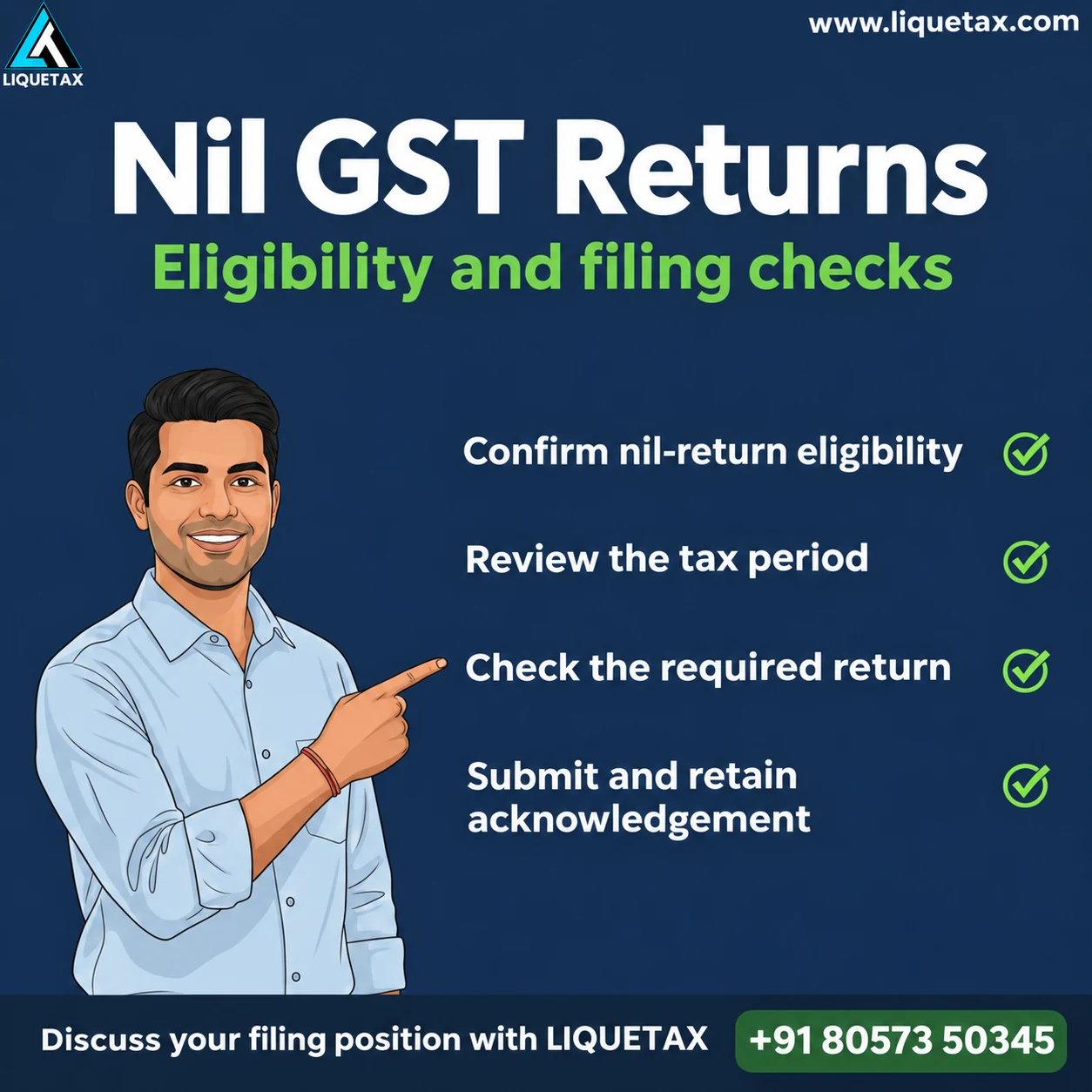
- Understand which return you are filing
- Apply the portal’s nil GSTR-3B conditions
- Check records outside the sales register
- Follow a controlled filing process
No sales does not automatically mean every GST return is nil. A business may have purchases, reverse-charge liability, credit adjustments, interest or late fees even while it earns no revenue. Check each return separately for the tax period. The nil filing option is a declaration about the return’s contents, not a convenient way to postpone bookkeeping.
Understand which return you are filing
GSTR-1 reports outward-supply information while GSTR-3B reports summary liabilities and input tax credit. A nil GSTR-1 does not, by itself, prove nil GSTR-3B eligibility. Composition taxpayers follow a different return and payment framework; they should not apply the regular-taxpayer nil workflow. Confirm your registration status and filing frequency before using a saved checklist from another period.
Apply the portal’s nil GSTR-3B conditions
The GST Portal’s current manual requires no relevant outward or inward supply and no tax liability, and its nil workflow checks auto-populated GSTR-1/IFF and GSTR-2B data, manual entries, and outstanding interest or late fees. Review those conditions on the portal for your period. Do not remove genuine information merely to make the nil option available. A normal return can have zero net cash tax without being a nil return.
Check records outside the sales register
Review bank charges, rent, professional services, imports of services, credit notes and reverse-charge transactions. Check whether earlier-period adjustments or credit reversals belong in the current return. Even a dormant business may incur taxable purchases or compliance liabilities. Reconcile the available portal statements with books and invoices, and document why a purchase or adjustment is included, deferred or ineligible.
Follow a controlled filing process
Log in at the official GST portal, select the financial year and correct period, and open the relevant return dashboard. Preview the draft, confirm that the nil conditions are genuinely met and complete the authorised verification using the available method. Save the filed return and ARN. A saved draft or successful login is not proof that the return was filed.
Check deadlines and charges by form and period
The applicable date depends on the return, filing frequency, taxpayer category and any notified extension. Do not apply a single monthly date to QRMP or composition obligations. Nil status does not automatically waive late fees. Equally, a generic table claiming interest on every late fee or a fixed maximum for all returns is unreliable. Use the applicable notification and portal calculation for the particular period.
Close the period and monitor future obligations
Retain a short nil-eligibility working paper with the sales and purchase review. A registration that remains active can carry filing duties despite no trading activity. If the business has permanently stopped, assess the correct cancellation and final-return obligations separately. Stopping returns without addressing registration status can create avoidable compliance issues. A cancellation application is not itself proof that all earlier obligations are discharged.
Practical checklist
- Confirm GSTIN, registration category, frequency and the exact tax period.
- Review both sales and purchases, including services and reverse charge.
- Check GSTR-2B, adjustments, interest and late-fee liabilities.
- Preview the correct form and record why nil eligibility is satisfied.
- Download the filed return and ARN and retain a period-specific checklist.
Worked example
Illustration: a registered consultant has no customer invoices in a month but pays for a software service and receives a supplier invoice. The consultant should examine the inward supply and any related credit or reverse-charge position before selecting nil GSTR-3B. The absence of sales is only one fact. Depending on the correct treatment, a normal return may be required even where there is no net cash payment.
Frequently asked questions
Can I file nil because no GST is payable in cash?
Not necessarily. Credit, supply and adjustment information may still require a normal return.
Does nil GSTR-1 prove nil GSTR-3B?
No. The forms report different information and their conditions must be checked separately.
Are nil returns free of late fees?
Not automatically. Applicable charges and any relief depend on the form, period and notification.
What proves successful filing?
Keep the portal’s filed status, ARN and downloaded filed return. A draft alone is insufficient.
Can I stop filing when business stops?
Check cancellation and outstanding obligations. An active registration can continue to require returns even without sales.
Official references
- GST Portal: filing a nil GSTR-3B
- GST Portal: GSTR-2B FAQs
- India Code: Central Goods and Services Tax Act
For help reviewing your documents and the correct next step, contact LIQUETAX. The scope and any professional fee should be agreed in writing after the facts are checked. This article provides general information; individual eligibility depends on the applicable law and records.