
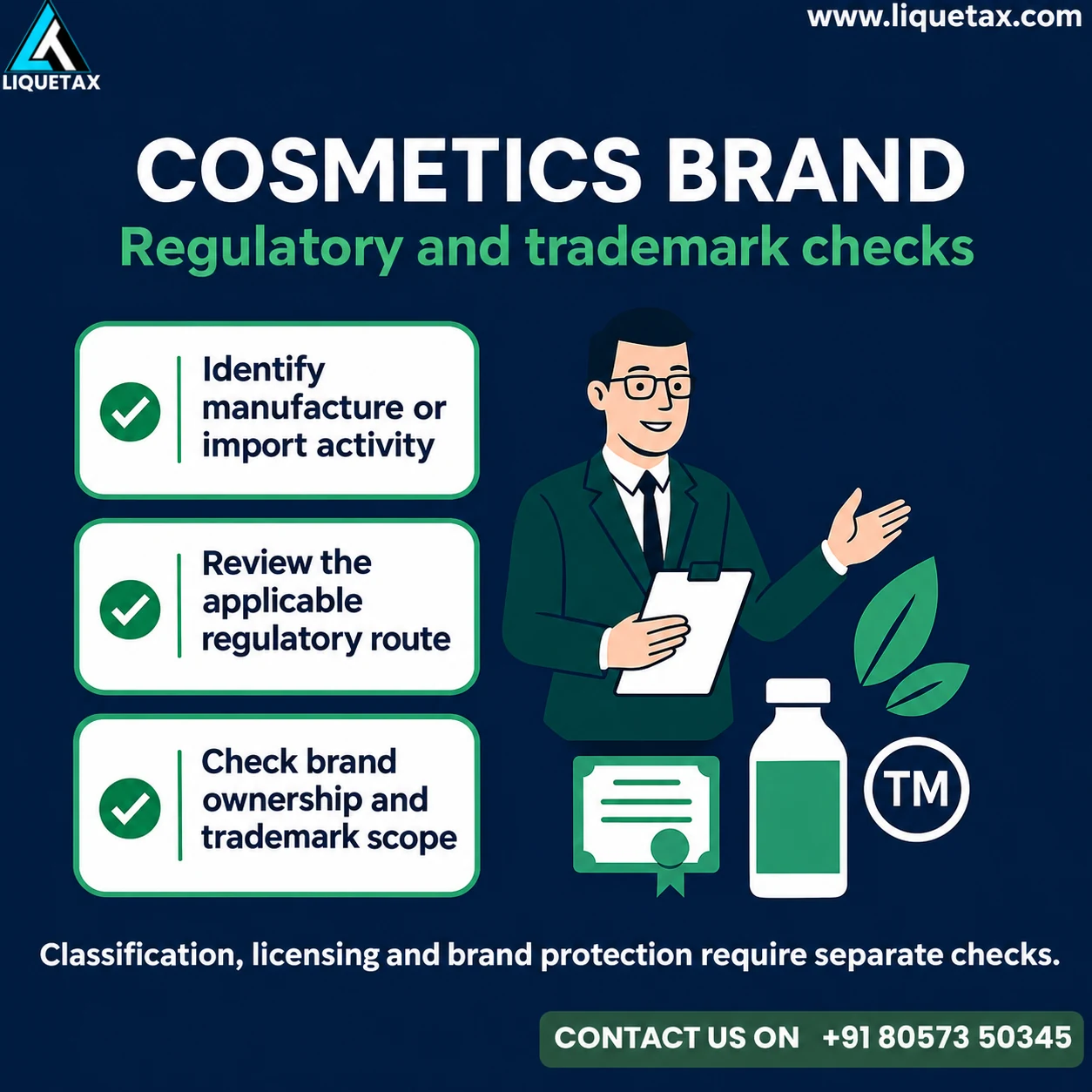
- Separate the product permission from brand protection
- Identify who manufactures and who imports
- Prepare product and facility evidence
- Review labels and claims before printing stock
Separate the product permission from brand protection
A cosmetics launch has at least two different questions: whether the product may be manufactured or imported under the applicable regulatory framework, and whether the business can use and protect its brand. A trademark application does not answer the first question, while a cosmetic licence or registration does not clear the brand name.
Begin with a product list, ingredients, intended use, claims, manufacturing location and proposed supply chain. Classify the product accurately before choosing an application route. A label describing a product as cosmetic does not settle classification if its ingredients or therapeutic claims indicate another regulated category.
Identify who manufactures and who imports
CDSCO’s guidance distinguishes manufacture regulated by State Licensing Authorities from import registration handled by the Central Licensing Authority. The Cosmetics Rules, 2020 provide the relevant framework. Do not use a generic instruction that every domestic cosmetics brand must obtain the same CDSCO import registration.
Where a contract manufacturer is used, verify the applicable licence, products and premises and document each party’s responsibilities. The brand owner should understand what the manufacturer is authorised to make and how quality, complaints, changes and recalls are handled.
Prepare product and facility evidence
For the applicable route, assemble the legal-entity details, manufacturer information, product composition, specifications, labels, authorisations and other required evidence. Imported products can involve overseas manufacturing and free-sale or equivalent documentation according to the current requirements.
Ensure that product names, variants, manufacturers and addresses agree across the application. Review safety and quality requirements using competent technical advice. Do not substitute a marketing brochure or an ISO certificate for product evidence required under the cosmetic rules.
Review labels and claims before printing stock
Check the declarations and standards applicable to the actual product and pack. Identify the responsible manufacturer or importer correctly and review batch, date, quantity, ingredient and other required information. Keep artwork approval records so that a late design change does not remove a mandatory declaration.
Avoid unsubstantiated therapeutic, safety or regulatory-approval claims. A permission for a specified cosmetic is not an endorsement of every advertising statement. If a claim changes how the product may be classified, resolve that issue before launch rather than after a complaint.
Clear the brand and file accurately
Search the intended word and logo through the official trademark resources, including similar sounding marks and relevant goods or services. Establish the correct owner and check the designer’s rights in the artwork. Describe the actual offering and prepare truthful use evidence where a historical use claim is made.
Save the application record and monitor examination and later stages. Do not use a registered symbol before the relevant registration supports it. Indian trademark protection is territorial and does not replace a separate review for export markets.
Maintain a controlled launch checklist
For illustration, a skincare business importing one range while commissioning another locally should maintain separate regulatory records for each route, then a common brand-ownership file. The fact that the labels use one brand does not make the permissions interchangeable.
Verify the issued permission’s scope, conditions and retention or update requirements. Check the current official fee schedule for the actual categories and transactions. Obtain a written professional scope rather than relying on an invented per-product package or guaranteed processing date.
Practical review before you proceed
Keep a versioned application folder containing the legal-entity details, scope decision, official checklist, supporting evidence, signed declarations, payment receipts and correspondence. Assign responsibility for checking messages and responding to queries. Before submission, compare the final preview with original records and verify that every declaration is supportable. After approval, read the conditions and record expiry, retention, update and reporting tasks where applicable. If a product, premises, owner or activity changes, review the permission before relying on the old document for a materially different operation.
Frequently asked questions
Does every Indian cosmetic need CDSCO import registration?
No. Domestic manufacture and imported cosmetics follow different regulatory routes. CDSCO identifies state licensing for manufacture and central registration for imports. Classify the activity and product before choosing the form.
Does a trademark allow me to manufacture cosmetics?
No. Trademark rights concern branding. Manufacturing or importing the product still requires the applicable regulatory permissions and compliance with product, facility, quality and labelling requirements.
Can a contract manufacturer’s licence simply be borrowed?
Do not treat it as a transferable document for any operation. Verify the licensed premises and scope, the actual manufacturing arrangement and each party’s responsibilities. Obtain the permissions and agreements appropriate to the arrangement.
Can I print labels before regulatory review?
It is commercially risky to print large quantities before checking the product route, mandatory declarations and claims. Approve and retain the final artwork after those checks so that packaging is consistent with the authorised product.
Is an ISO certificate enough product evidence?
No. Management-system certification does not replace the evidence, licence or registration required by cosmetics law. Review the specific product standards, technical documents and regulatory permissions independently.
Official sources and next step
Checked on 9 October 2026. Use the official material below for the applicable form, current conditions and case-specific instructions.
- CDSCO cosmetics regulatory overview
- Cosmetics Rules, 2020
- Trade Marks Act, 1999
- IP India public trademark search
Contact LIQUETAX with your records and the issue you need resolved. Request a written scope and fee quote before work begins; approval remains with the relevant authority.