
- Authenticate and preserve the document
- Identify the legal issue and response deadline
- Reconcile the facts before drafting arguments
- Write a focused and complete reply
A GST notice should be handled as a specific legal communication, not as proof that every alleged amount is payable. First establish what the document asks you to do and by when. A request for information, scrutiny communication, show-cause notice and final order are different stages. The response must match that stage and the underlying transaction records.
Authenticate and preserve the document
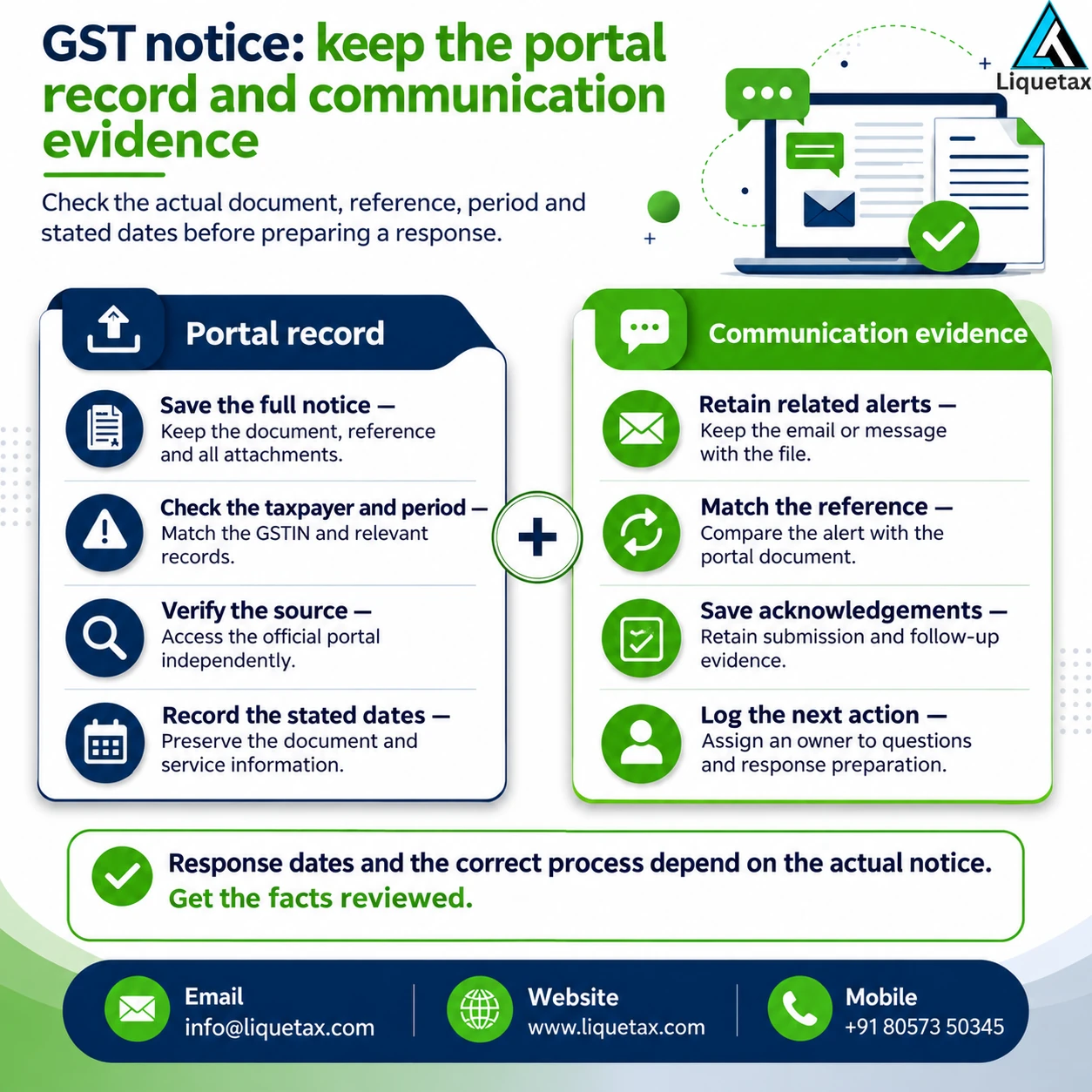
Access the official GST portal independently and open Services, then User Services, then View Notices and Orders. The official February 2026 update merged the earlier additional-notices view into this area. Check GSTIN, period, issuing authority, reference number and attachments. Preserve the full document and date of service. Verify any applicable DIN or authenticity requirement through the relevant authority’s official process; do not pay through bank details or links in an unsolicited message.
Identify the legal issue and response deadline
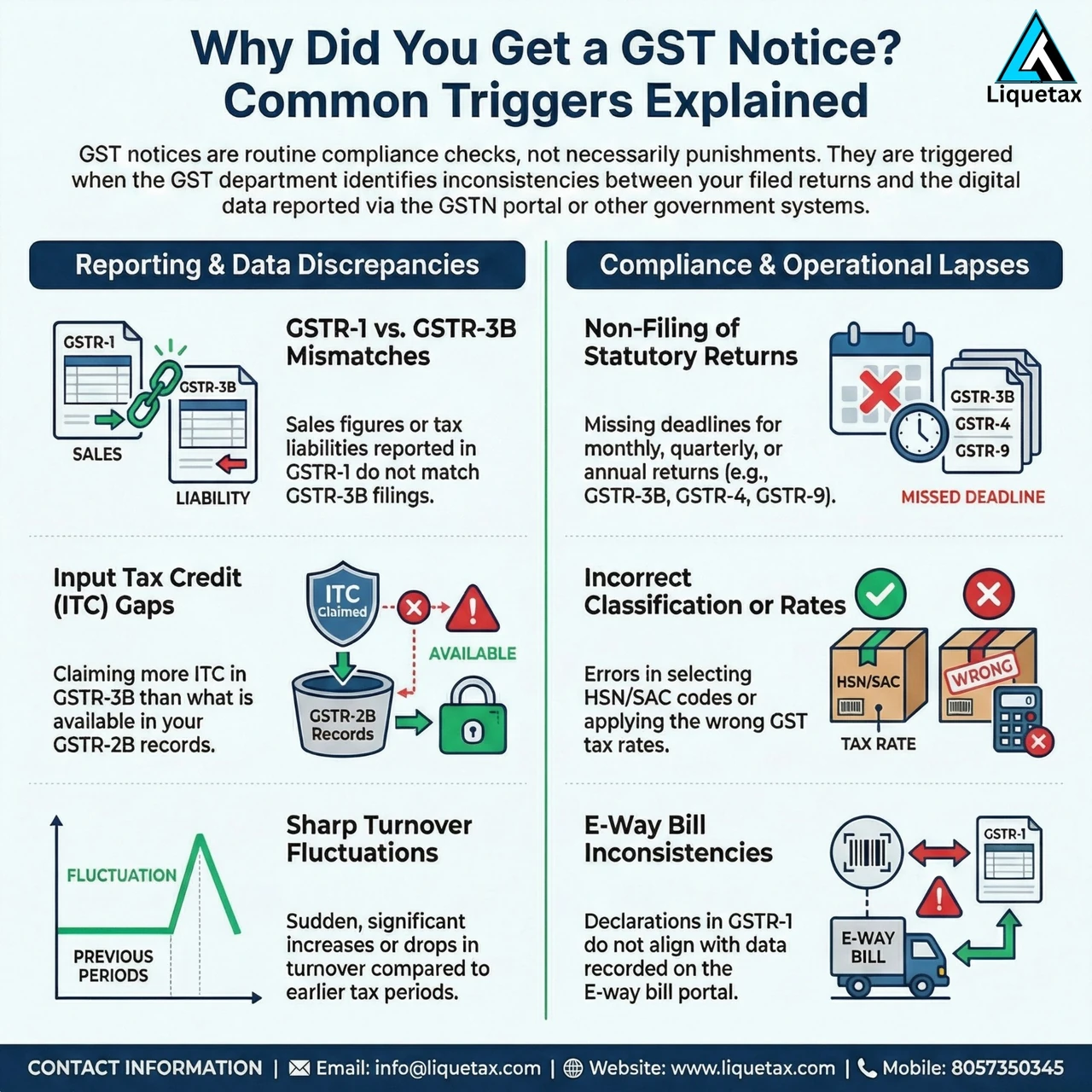
Read the cited section, form, tax period, allegation and computation. Common issues include differences between returns, input tax credit, registration details or non-filing. Note the response deadline and any hearing date separately. A summary such as DRC-01 should be read with the substantive notice and supporting material. The applicable demand provisions can differ by financial year; do not copy an old template without checking them.
Reconcile the facts before drafting arguments
Create an issue-by-issue table: allegation, amount, relevant records, explanation and proposed action. For an ITC difference, compare purchase books, invoices, GSTR-2B, GSTR-3B and reversals. For turnover, compare sales records, credit notes, GSTR-1 and GSTR-3B. Investigate timing differences without assuming all differences are harmless. An unsupported assertion that the portal is wrong is weaker than a clear reconciliation with document references.
Write a focused and complete reply
Answer each question in the order raised. Explain agreed facts, disputed amounts and the evidence supporting your position. Number annexures, use readable files and check size restrictions before the deadline. If more time is necessary, seek an extension through the proper channel with reasons; do not assume a request automatically grants extra time. Keep proof of submission and any acknowledgement.
Distinguish payment from acceptance and appeal
Where an amount is genuinely due, assess the correct payment route and legal consequences before making an entry. A voluntary payment does not automatically close every proceeding. Conversely, disputing a notice does not suspend every statutory deadline. A final order may require a separate appeal or other remedy; a grievance or informal email is not a substitute for that remedy. Obtain case-specific help for material disputes.
Avoid invented penalties and outcomes
There is no single ₹10,000 or ₹25,000 charge for every late response. Interest, penalty, limitation and available relief depend on the statutory provision and facts. Do not use made-up client success stories or assume that a professional can guarantee withdrawal of a demand. The useful outcome is a timely, evidence-backed response and a documented next step.
Practical checklist
- Save the entire notice, attachments, service date and portal reference.
- Record the response and hearing deadlines in a monitored calendar.
- Reconcile each alleged difference against books and filed returns.
- Index invoices, ledgers and explanations with clear annexure numbers.
- Save the submitted reply and follow the actual order or next communication.
Worked example
Illustration: a notice compares annual turnover in GSTR-1 with GSTR-3B. The business finds a credit note reported in different periods. It prepares a month-by-month bridge, attaches the credit note and relevant returns, and explains the timing. The explanation still needs to be considered by the authority. This is a method for preparing a response, not a promise that the difference will be accepted or that no tax is due.
Frequently asked questions
Should I pay the entire notice immediately?
First identify whether it is an allegation, intimation or final demand and verify the calculation. Obtain advice where the position is uncertain.
Can I ignore a small mismatch?
No. Review the communication and respond as required, even where the explanation may be straightforward.
Does asking for more time extend the deadline?
Not automatically. Track whether the competent authority actually grants the request.
Is a portal grievance a statutory reply?
Usually it serves a different purpose. Use the response or appeal procedure required by the document and law.
Can anyone guarantee a notice will be withdrawn?
No. A response can present facts and legal grounds, but the authority decides the proceeding.
Official references
- CGST Delhi: February 2026 notice-navigation update
- India Code: Central Goods and Services Tax Act
- GST Portal: GSTR-2B FAQs
For help reviewing your documents and the correct next step, contact LIQUETAX. The scope and any professional fee should be agreed in writing after the facts are checked. This article provides general information; individual eligibility depends on the applicable law and records.