
- Two address questions need different evidence
- Prepare registered-office evidence carefully
- Consider residential and shared premises
- Review individual address details separately
Two address questions need different evidence
Incorporation records identify both the people forming the company and the place where the company will receive official communications. A director’s residential proof establishes personal information. Registered-office evidence establishes the premises and the company’s right to use it. One document does not automatically satisfy both purposes.
Make separate folders for individuals and the office. Check the current form requirements for each subscriber’s nationality, role and execution location. A blanket rule that every document must be less than two months old is inaccurate; the required document type and recency depend on the particular field and instructions.
Prepare registered-office evidence carefully
The registered office must be a real place capable of receiving and acknowledging communications. Establish the ownership or occupancy chain and the permission to use it. Depending on the arrangement, relevant records include ownership evidence, a lease or rent agreement, owner authorization and a recent utility document. MCA incorporation guidance refers to utility evidence no older than two months.
Match the premises details across the application and attachments: unit or flat, floor, building, street, locality, district and PIN code. If the bill or title shows an older owner, an incomplete address or a different numbering system, obtain legitimate supporting evidence. Do not alter a utility bill to remove an inconsistency.
Consider residential and shared premises
A residential address is not automatically unsuitable. Check the legal right to use it, lease restrictions, local rules and the practical handling of official mail. A family member’s ownership does not remove the need for the appropriate permission. The company’s registration should not be described as permission for every activity at the premises.
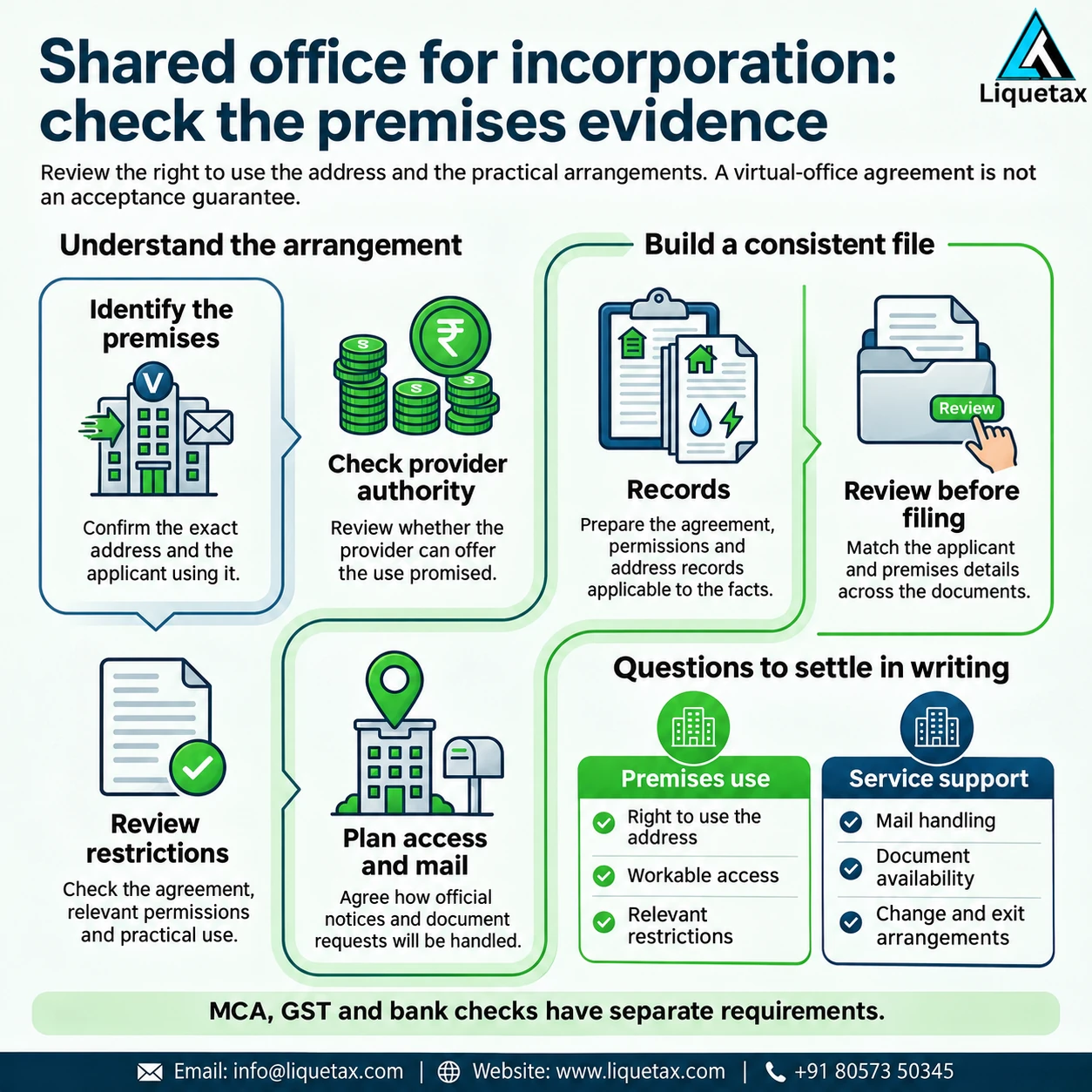
For a shared or virtual office, verify that the provider has authority to offer the use promised. The agreement should identify the premises and applicant, provide workable access and clarify notices and document support. A service agreement labelled virtual office is not itself an automatic acceptance guarantee for MCA, GST or a bank.
Review individual address details separately
Use the personal residential documents accepted for the relevant person and form. Ensure the name is consistent with identity records and the complete address can be reconciled. Where an applicant lives abroad, confirm the required authentication and translation. Arrange those steps before the final signing date rather than after receiving a query.
If a person has moved, determine the correct current information and the legitimate evidence needed to support it. Do not use an old address merely because the scan is convenient. Handle identity documents securely, share them only with the people carrying out the filing and retain the final submitted version for the corporate record.
Keep the office working after approval
A certificate does not end the duty to maintain an accessible registered office. Agree who receives notices, how quickly they are escalated and where originals are retained. Track the occupancy agreement and renewal dates. Ensure the business can meet applicable display, record and verification requirements.
If the office moves, review the corporate approvals and filings appropriate to the type of move and update related registrations where required. A move between states has a different process from a simple move within the same locality. Keep evidence of both the change and the point at which the new address becomes effective.
Practical checklist
- Separate director or subscriber residence evidence from office occupancy evidence.
- Check exact address spelling, unit details and PIN code across the office records.
- Confirm the owner or provider has authority to permit use.
- Check the utility date against the intended filing date.
- Document notice receipt, access, renewals and the process for a future move.
Illustrative example
A company plans to use a shared office. The service provider’s invoice shows a building address but no unit, while its lease identifies a particular suite. The founders obtain a consistent agreement and supporting documents before filing. This illustrates how to reconcile a real occupancy arrangement; it is not an assurance that every shared address qualifies.
Frequently asked questions
Can an office utility bill prove a director’s residence?
Not automatically. Each field requires the evidence applicable to that person or premises. Keep the two address purposes distinct.
Can a home become a registered office?
It may be possible with lawful use, proper permission, required evidence and functioning notice arrangements. Check restrictions relevant to the property and activity.
How recent should office utility evidence be?
MCA guidance specifies a document not older than two months. Verify the current form instructions before submission.
What if names differ across documents?
Establish the legitimate ownership or identity chain and obtain appropriate supporting evidence. Do not edit official documents to manufacture consistency.
Does approval mean the address can be abandoned?
No. The company must maintain its registered office and complete the required process when it changes. Unmonitored mail can create avoidable compliance risk.
Official references and next step
- MCA: incorporation document and address FAQs
- MCA: SPICe+ and linked filing FAQs
- India Code: Companies Act, 2013
For help applying this checklist to your documents, contact LIQUETAX with the relevant facts and the support you need. Request a written scope and fee breakdown before work begins.