
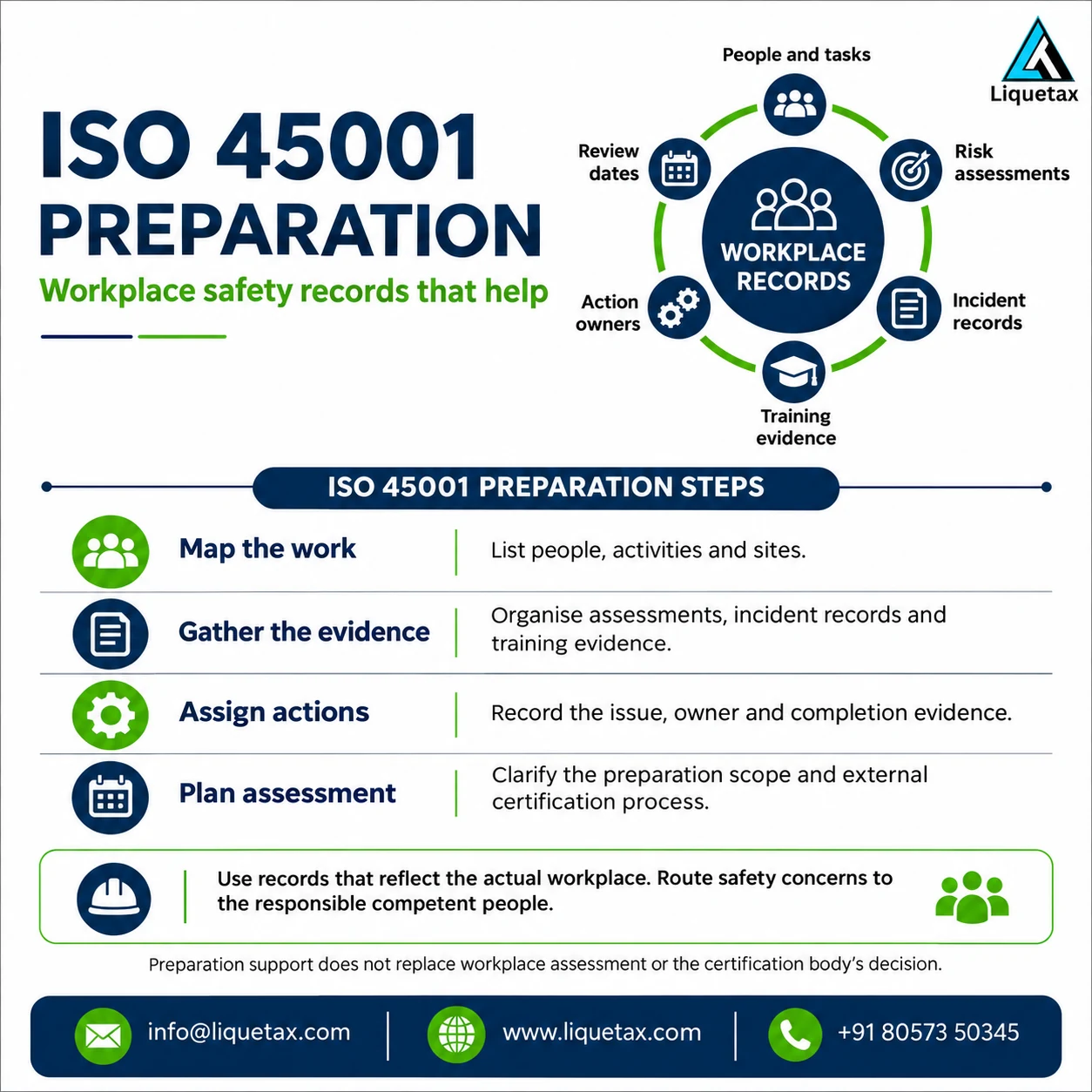
- Map workList people, tasks and sites.
- Review recordsGather assessments and incident evidence.
- Assign actionsName owners and completion evidence.
- Plan assessmentConfirm independent certification scope.
A workplace-safety project starts with the people doing the work and the risks they face. ISO 45001 preparation should help management organise a usable system, while the actual safety assessment and applicable obligations reflect the workplace. Buying a certificate is not a substitute for dealing with an unsafe situation.
Clarify the requirement before choosing support
Check the current ISO 45001 catalogue and the exact requirement in your customer contract or tender. Record which entity, activities and sites are covered. If you already have a certificate, provide the real document and outstanding assessment findings. Ask the certification body to confirm the intended assessment arrangements. This guide does not assign a universal audit duration, certificate cost or mandatory certification rule to every Indian business.
Bring the people and work into the discussion
Map employees, contractor work and relevant visitors to the activities they perform. Discuss routine work as well as maintenance, cleaning, loading and other tasks that may be missed in a desk-based checklist. Ask workers where procedures are unclear or difficult to follow. The purpose is to identify questions that a competent workplace assessment should resolve, not to label a site safe from a remote document review.
Organise a workplace-specific evidence pack
Gather existing risk assessments, incident and near-miss records, training evidence, equipment inspection records, emergency arrangements and applicable operating documents. Connect each record to the task, location and responsible person. Mark uncertain or missing items openly. A signed attendance sheet alone does not establish that a person understood the work instruction, and a generic emergency plan should not be copied without checking the actual layout and arrangements.
Handle urgent issues through the right people
If a walkthrough identifies a potentially unsafe condition, route it promptly to the responsible manager and competent safety personnel. Do not wait for an article review or certification project to resolve an immediate operating issue. Agree how actions are prioritised, who checks completion and which evidence closes the issue. This is a preparation workflow; it does not prescribe technical controls for a particular machine, chemical or workplace hazard.
Give management a short action register
For each finding, record the issue, the action agreed, the owner, the completion target and the evidence required. Keep the register current when circumstances change. A supervisor should be able to explain what remains open without searching through multiple folders. Review recurring issues rather than counting completed tasks alone. Discuss resourcing and worker feedback so the written system reflects the way the business actually operates.
Separate the engagement from the certification decision
LIQUETAX can coordinate the agreed preparation, record organisation and readiness questions. Specialist technical assessment, legal applicability and external certification need clearly stated responsibilities. Request itemised costs for the preparation scope, external audit and any separate work. A fixed online package should not obscure additional sites, complex operations or incomplete evidence. The independent body makes its own certification decision and a buyer decides whether the resulting scope meets its requirement.
Keep the handover useful after the project
Retain the approved scope, evidence index, action register and assessment findings. Assign owners for subsequent incidents, operational changes and unresolved items. Before making a public certification claim, check the actual certificate and the issuing body’s verification route. Review the plan when you introduce a new activity or location. The practical goal is an accountable workplace system whose documents remain connected to real work.
Questions before you act
Is a certificate proof that every task is safe?
No. The actual workplace still needs appropriate operating controls, competent assessment and continuing attention to issues and applicable obligations.
Can a small business start with a focused scope?
Discuss the real activities and locations with the preparation team and certification body. Keep the resulting scope clear; do not hide excluded operations behind a broad marketing claim.
Test the safety process on a real task
Select one routine job and one less frequent task, such as equipment maintenance or unloading. Ask the people doing the work to explain the hazards, controls, supervision and response if conditions change. Record gaps and the person responsible for resolving them. A signed attendance sheet is not enough to show that a worker understood a safety instruction.
Bring contractor arrangements, near-miss reports, inspections and outstanding corrective actions into the preparation review. Keep the external assessment scope clear, including sites and activities. ISO preparation should help organise the evidence of safe working; it does not replace applicable labour, factory or other legal responsibilities.
Official references and their limits
- ISO: ISO 45001:2018 catalogue ↗
Public description, 2024 amendment and draft successor status checked on 27 September 2026. Not a clause-by-clause audit or workplace legal assessment.
- ISO: Certification and accreditation explained ↗
Explains independent certification and verification routes; does not certify LIQUETAX or any particular certificate.
Older guidance must be read with subsequent changes. Reachability of a reference is not proof that it answers your particular case.
Continue with the relevant question
Prepare your next step
Read the related service guide →
Ask LIQUETAX about your requirement →
Share a short description first. Use an agreed secure channel for identity documents, bank details and tax records. Never send passwords or OTPs in a general enquiry.