
- Choose the correct income period
- Begin with ownership and commercial needs
- Compare applicable entity tax for the correct year
- Model how owners receive money
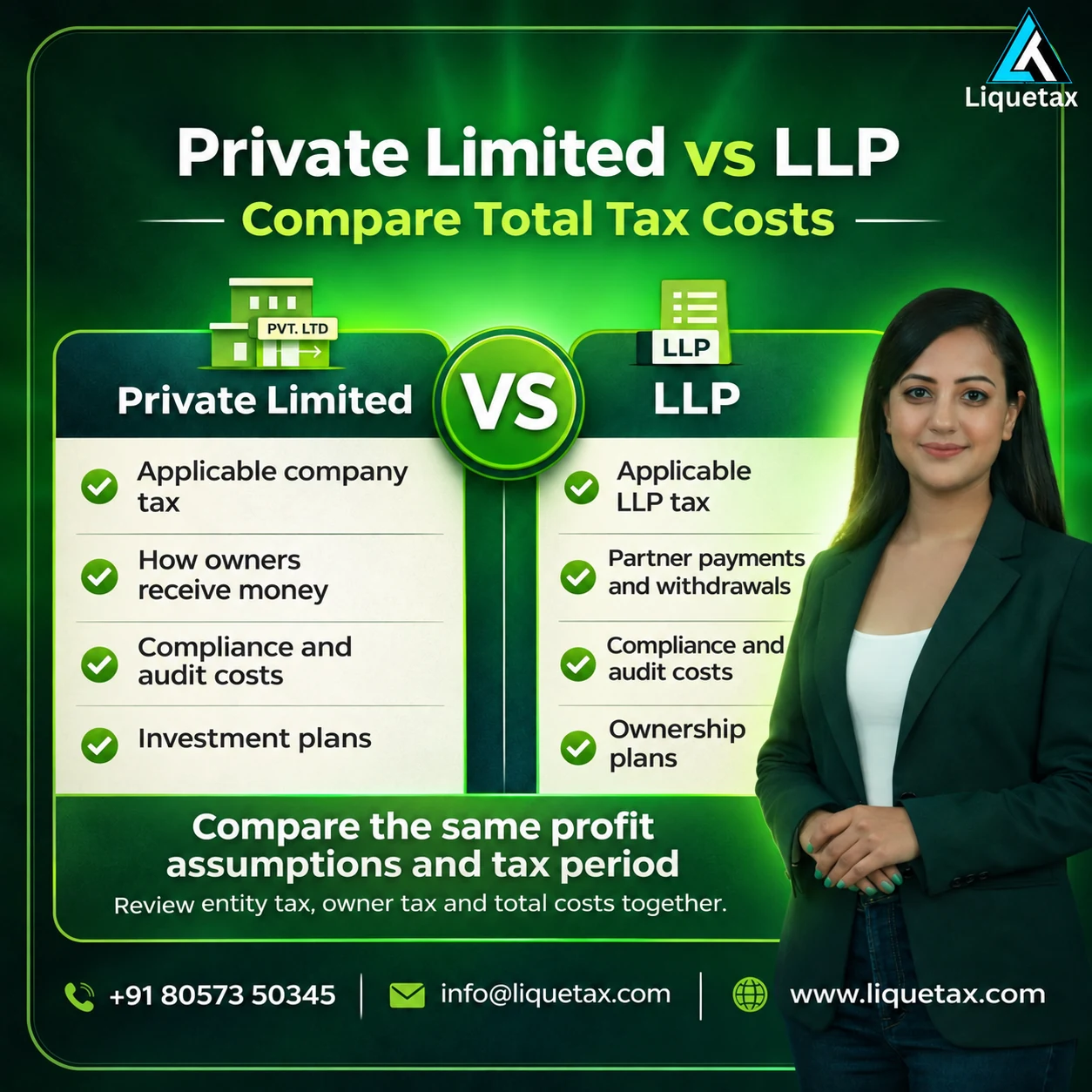
A private limited company and an LLP are separate legal structures with different ownership and compliance rules. Neither is automatically the lowest-tax choice for every profit level. Compare the business’s tax, the owners’ tax on taking money out, available relief, compliance costs and commercial needs using the same realistic assumptions.
Choose the correct income period
For income earned from 1 April 2025 to 31 March 2026, select Assessment Year (AY) 2026-27 and apply the Income-tax Act, 1961. Income earned from 1 April 2026 belongs to Tax Year 2026-27 under the Income-tax Act, 2025. These are different periods. A return or notice about an earlier year does not move to the new Act merely because you handle it after April 2026.
Begin with ownership and commercial needs
A company uses shares and company-law governance, while an LLP is organised through its partners and LLP agreement. Investor expectations, employee equity plans, transfer arrangements, continuity and regulatory requirements may influence the choice. Tax is one input. Do not select an entity solely because a generic article claims that profits below or above ₹15 lakh always favour one structure.
Compare applicable entity tax for the correct year
For AY 2026-27, an LLP is generally taxed at a 30% base rate, with applicable surcharge and cess. Domestic companies may fall under ordinary company rates or a conditional concessional regime. Section 115BAA offers a 22% base rate with its conditions and required election; it is not a 22% all-inclusive rate. Add the applicable surcharge and cess and account for deductions or relief given up.
Model how owners receive money
Company dividends and remuneration, and LLP partner profit share, interest and remuneration, have different treatment. A partner’s share of assessed firm profit is generally treated differently from remuneration or interest. Do not claim that LLP profit is simply taxed at each partner’s personal slab instead of entity tax. Test deductibility, contractual authority, statutory limits and withholding separately before comparing after-tax cash received by owners.
Include compliance and audit requirements
A company has company-law accounts and statutory-audit obligations alongside tax and ROC filings. LLP accounts, annual filings and audit conditions follow the LLP framework, while income-tax audit is a separate question. Avoid an oversimplified “no audit below one figure” statement without checking every applicable test. Budget realistic professional and filing costs from the actual scope; no invented registration package is assumed here.
Check elections, losses and future changes
A concessional corporate election can affect deductions, loss utilisation and later choices. A restructuring or conversion may raise tax, stamp-duty and procedural issues; it is not automatically tax-neutral. Prepare more than one profit and withdrawal scenario, including retained profits, owner remuneration and distributions. Review investor and lender requirements before treating a short-term tax difference as a reason to change legal structure.
Practical checklist
- Write a common revenue, expense, profit and owner-withdrawal forecast.
- Calculate entity tax including surcharge, cess and applicable relief.
- Calculate owner-level consequences of each planned payment.
- Check audit, annual filing, withholding and election requirements.
- Compare commercial suitability and total recurring costs before deciding.
Worked example
Illustration: two founders expect the same business profit but one plan retains most earnings for expansion while another distributes almost everything. A company’s lower conditional base rate does not by itself establish which plan leaves more money with the founders. The comparison must add owner-level tax and compliance costs to entity tax. Actual figures require the chosen regime, payment type and each recipient’s circumstances; this article does not provide a universal break-even amount.
Frequently asked questions
Is LLP profit taxed only in the partners’ hands?
No. The LLP is a separate taxpayer. Profit share and partner remuneration or interest require their own treatment.
Is 22% the complete company tax under 115BAA?
No. Conditions, the election, surcharge and cess must be included in the calculation.
Can every small company avoid audit?
Do not confuse company-law statutory audit with income-tax audit thresholds. They are separate obligations.
Is an LLP always cheaper to maintain?
Actual costs depend on activity, size, transactions and applicable filings. Obtain a scope-specific estimate.
Can I convert later without tax consequences?
Conversion can have tax and procedural conditions. Review them before acting rather than assuming automatic neutrality.
Official references
- Income Tax Department: partnership firm and LLP
- Income Tax Department: domestic company AY 2026-27
- Ministry of Corporate Affairs
- Finance Act 2026, enacted text
For help reviewing your documents and the correct next step, contact LIQUETAX. The scope and any professional fee should be agreed in writing after the facts are checked. This article provides general information; individual eligibility depends on the applicable law and records.