

- Confirm that dormant status was actually granted
- Prepare the annual MSC-3 return
- Track continuing and event-based duties
- Control transactions and governance
Confirm that dormant status was actually granted
A company with no sales is not automatically a dormant company. Check the MCA status and the order or certificate granting dormant status following the applicable process. Keep the MSC-1 application and MSC-2 evidence with the corporate file. An active company cannot adopt dormant-company filing treatment merely because its founders stopped operating.
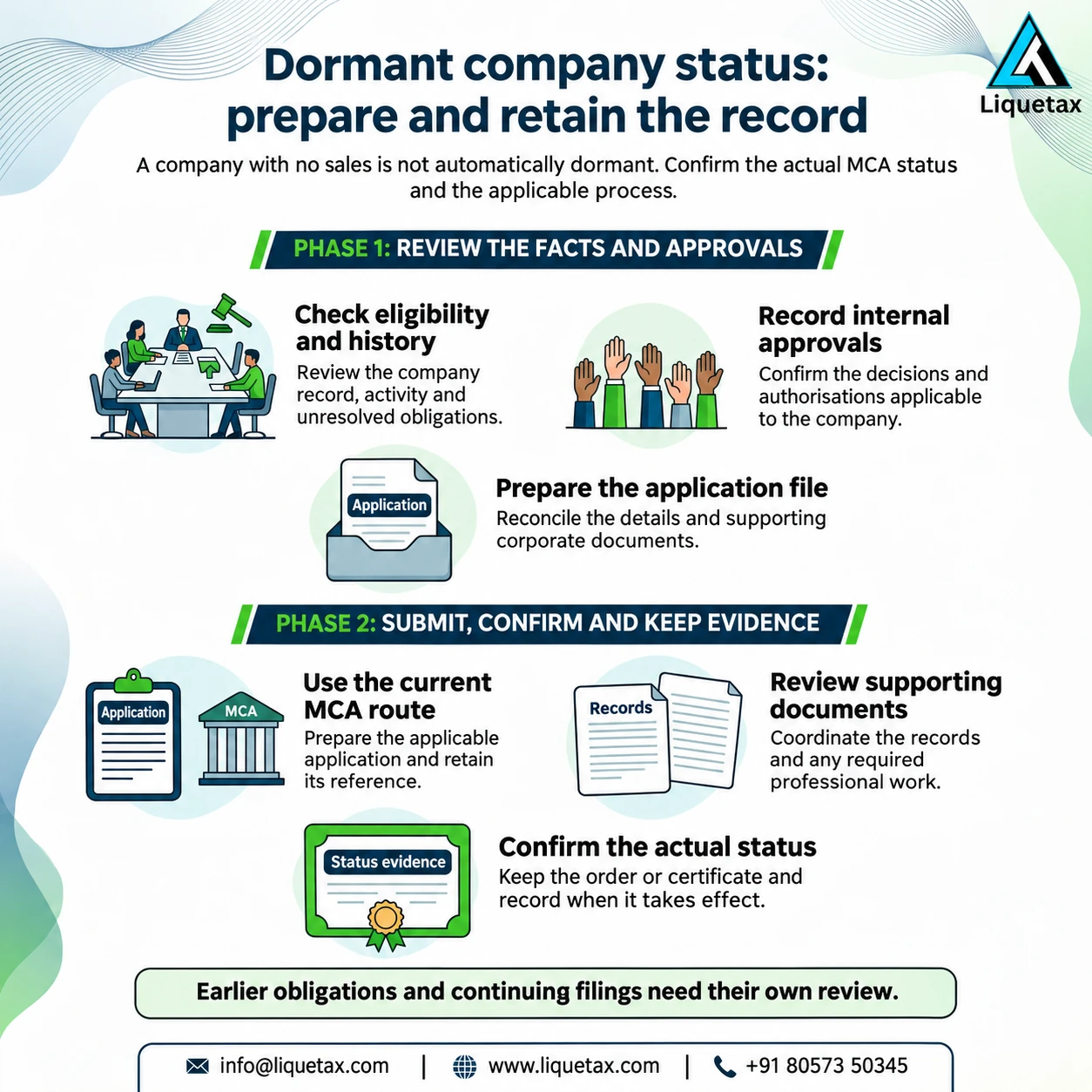
Record when the status took effect and which periods precede it. Unresolved filings or liabilities from earlier active periods do not disappear because the company later becomes dormant. Review the eligibility assumptions periodically, especially if assets, loans, directors or the intended future project change.
Prepare the annual MSC-3 return
The Companies (Miscellaneous) Rules require the dormant-company return in MSC-3 within 30 days of the end of each financial year, together with the prescribed annual fee. The return includes the financial position duly audited by a chartered accountant in practice. For a 31 March year end, the ordinary 30-day calculation reaches 30 April.
Prepare the underlying accounts and supporting records early enough for audit and signature. Check director details, capital, meetings and other required fields against the actual corporate records. A dormant company still has transactions such as permitted maintenance costs or statutory payments that must be recorded accurately; a nil-turnover label is not an accounting system.
Track continuing and event-based duties
Maintain the prescribed number of directors, registered-office access, books and records. The dormant-company rules specifically preserve applicable returns for allotment and changes in directors. Review other event-based filings whenever an address, capital or other material fact changes. Do not assume that a single annual form authorizes ignoring every other obligation.
For general annual-return or financial-statement forms, assess the exact period, formal status and applicable filing provisions with the current MCA requirements. Do not copy blanket October or November dates from a generic calendar or treat an ungranted dormant application as a filing exemption. Document the applicability decision, including any active periods and pending returns.
Control transactions and governance
Dormancy is tied to the statutory concept of no significant accounting transaction, with specified exclusions such as relevant statutory payments and certain maintenance or legal-compliance transactions. It is not a rule that every payment or every legally required allotment is forbidden. Equally, ordinary trading cannot be described as maintenance simply to preserve dormant status.
Apply the relevant meeting concessions and maintain minutes and approvals. Check the actual director KYC position under the revised framework effective in 2026 rather than assuming the old annual calendar still applies to everyone. Keep a list of transactions that require escalation before they are entered into.
Plan reactivation and the time limit
When the company is ready to become active, use the MSC-4 route with the required supporting return and documents. Resolve outstanding compliance and obtain the applicable active-status confirmation. The rules also address situations where a dormant company begins functioning or undertakes significant accounting transactions; do not wait for the next annual return to assess the consequence.
Dormancy should not be described as unlimited. The rules provide for action where dormant status continues for five consecutive years. Review the timeline well before that point and decide whether to reactivate or pursue an appropriate closure route. Retain all records needed to explain the company’s dormant period to future directors, auditors and counterparties.
Practical checklist
- Confirm the formal dormant grant and its effective date.
- Prepare audited financial-position information and MSC-3 within the applicable 30-day period.
- Review active-period arrears and each other form’s applicability separately.
- Maintain directors, office access, records and required event-based filings.
- Track significant transactions and the five-year dormancy horizon before reactivation or closure.
Illustrative example
A company holds intellectual property for a future project and has formal dormant status. It records maintenance payments and prepares MSC-3, then plans to begin customer work the following year. Before signing trading contracts it reviews reactivation and outstanding compliance. The example shows controlled planning rather than treating inactivity as an indefinite exemption.
Frequently asked questions
Does zero turnover automatically create dormant status?
No. Formal status and the applicable process are required. An active company’s obligations cannot be replaced by assumption.
When is MSC-3 due?
The ordinary rule is within 30 days from the financial-year end, subject to any valid applicable relief. Record the actual calculation.
Can a dormant company make any payments?
Certain statutory and maintenance transactions are excluded from significant accounting transactions. Review the legal category of each transaction rather than using a blanket ban or permission.
Can dormancy continue forever?
Do not assume so. The rules address companies remaining dormant for five consecutive years. Plan before that horizon.
How does the company restart?
Use the applicable MSC-4 reactivation process, supporting documents and compliance review. Assess the status consequences before resuming ordinary operations.
Official references and next step
- India Code: Companies Act, 2013
- MCA: dormant-company annual return MSC-3
- MCA: dormant-company rules
- MCA: director KYC changes effective March 2026
For help applying this checklist to your documents, contact LIQUETAX with the relevant facts and the support you need. Request a written scope and fee breakdown before work begins.