
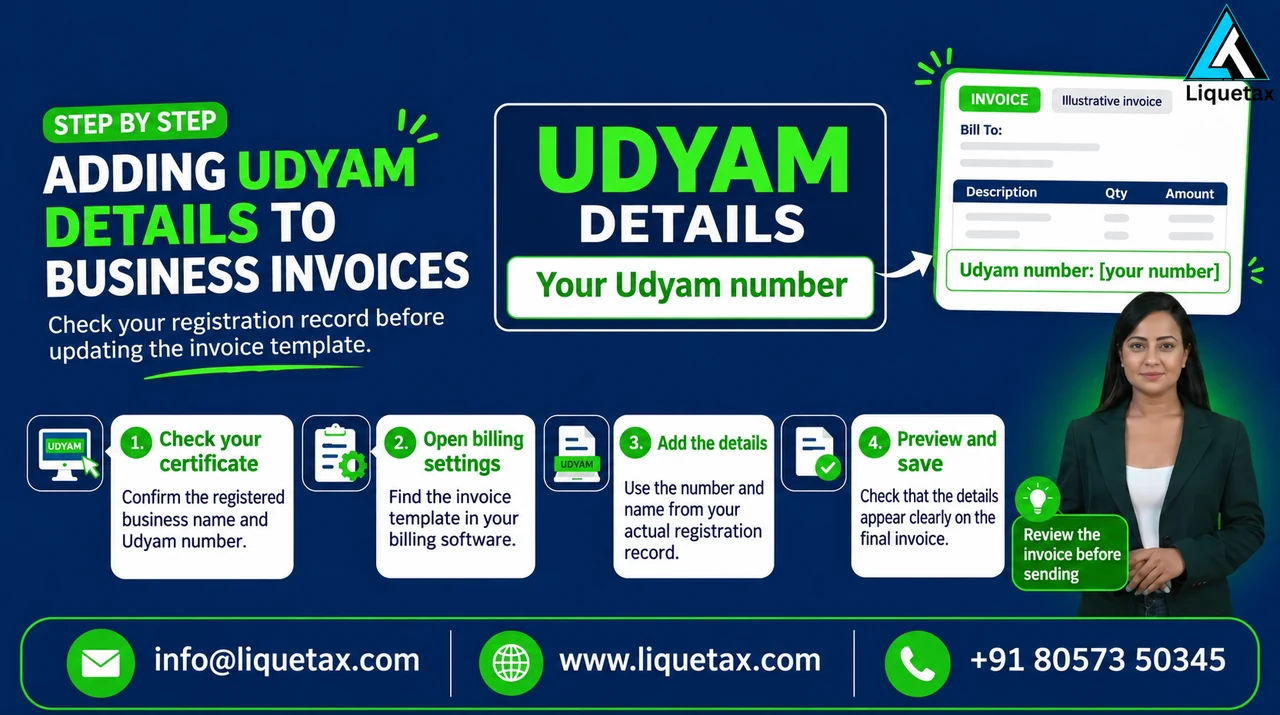
- Verify the registration before editing the template
- Use current classification thresholds
- Add a clear, accurate supplier detail
- Preserve all applicable tax-invoice information
Verify the registration before editing the template
Displaying Udyam details can help customers identify an enterprise’s MSME status and route its records internally. It should be done accurately, with the legal name and registration number matching the official record. A line on an invoice does not itself create eligibility for every MSME benefit.
Use the official Udyam portal to verify the record and current classification. Keep the certificate or verification evidence in the supplier-registration folder. Do not reproduce an old Udyog Aadhaar number as if it were the current Udyam registration without checking the business’s position.
Use current classification thresholds
The official portal now states investment and turnover limits of 2.5 crore and 10 crore rupees for micro enterprises, 25 crore and 100 crore for small enterprises, and 125 crore and 500 crore for medium enterprises. The two criteria and current classification rules must be considered together.
Older invoice guides showing micro limits of 1 crore and 5 crore are outdated. Do not decide the category from one month’s turnover or manually change the certificate wording. Review the official record and update process when the business information or classification changes.
Add a clear, accurate supplier detail
Place the Udyam Registration Number in an identifiable supplier-details or notes area, using the exact number and legal identity. If category information is included, ensure it is current. Avoid claims such as government-approved supplier or guaranteed tax exemption that the registration does not establish.
Use one controlled template and document who authorised the change. Send the certificate or verification information to customers through their vendor-update process where useful. A visible number on future invoices may not update an existing customer’s supplier master automatically.
Preserve all applicable tax-invoice information
Udyam details do not replace the particulars required under GST invoice rules. Keep the applicable supplier and recipient information, GSTINs, serial number, date, description, classification, value, tax and place-of-supply details. The requirements depend on the transaction and relevant rules.
Do not change tax rates or stop charging GST merely because the business has Udyam registration. Likewise, a non-GST document should not be labelled a GST tax invoice without the appropriate basis. Test the revised template on actual transaction types before using it widely.
Document payment terms and eligibility separately
Delayed-payment protection under the MSMED framework concerns qualifying micro and small suppliers and has statutory conditions. It is not a universal benefit for every medium enterprise or every invoice bearing a number. The agreed payment date, acceptance or deemed acceptance, objections and supplier eligibility can matter.
Keep purchase orders, written payment terms, delivery evidence and acceptance records. If payment is disputed, assess the transaction before relying on a blanket forty-five-days-from-invoice statement. The Samadhaan mechanism is relevant to eligible delayed-payment cases; recovery is not automatic merely because a claim is submitted.
Use a simple rollout checklist
For illustration, a small engineering supplier can verify its Udyam record, update the template, send the information to repeat customers and retain delivery evidence with each invoice. Review a sample after the change to confirm that the number prints correctly and tax fields remain intact.
Do not rewrite old invoices silently or create a new registration number whenever the business crosses a threshold. Follow the official update and classification framework, and obtain advice where ownership, constitution or eligibility changes affect the records.
Practical review before you proceed
Keep a versioned application folder containing the legal-entity details, scope decision, official checklist, supporting evidence, signed declarations, payment receipts and correspondence. Assign responsibility for checking messages and responding to queries. Before submission, compare the final preview with original records and verify that every declaration is supportable. After approval, read the conditions and record expiry, retention, update and reporting tasks where applicable. If a product, premises, owner or activity changes, review the permission before relying on the old document for a materially different operation.
Frequently asked questions
Does Udyam replace a GSTIN?
No. Udyam identifies the MSME registration, while GSTIN relates to GST registration. Keep the information required for the actual invoice and tax position; displaying one does not substitute for the other.
Does every invoice have to display Udyam under GST Rule 46?
Do not infer that requirement from a generic blog. GST invoice particulars and Udyam information are separate. Check any applicable legal, contractual or buyer requirements before describing display as universally mandatory.
Do medium enterprises get the same delayed-payment protection?
The relevant MSMED delayed-payment provisions are directed at qualifying micro and small suppliers. Review eligibility and the actual transaction rather than assuming every business classified as an MSME has the same entitlement.
Should I change the number when the category changes?
Do not invent or manually replace the registration identity. Follow the official Udyam update and classification process and verify the current record. A category change and a change of legal entity are different situations.
What evidence matters when a customer pays late?
Retain the contract or purchase order, payment terms, invoice, delivery and acceptance evidence, correspondence and registration details. These help establish the transaction and applicable timeline more reliably than an invoice footer alone.
Official sources and next step
Checked on 9 October 2026. Use the official material below for the applicable form, current conditions and case-specific instructions.
Contact LIQUETAX with your records and the issue you need resolved. Request a written scope and fee quote before work begins; approval remains with the relevant authority.