
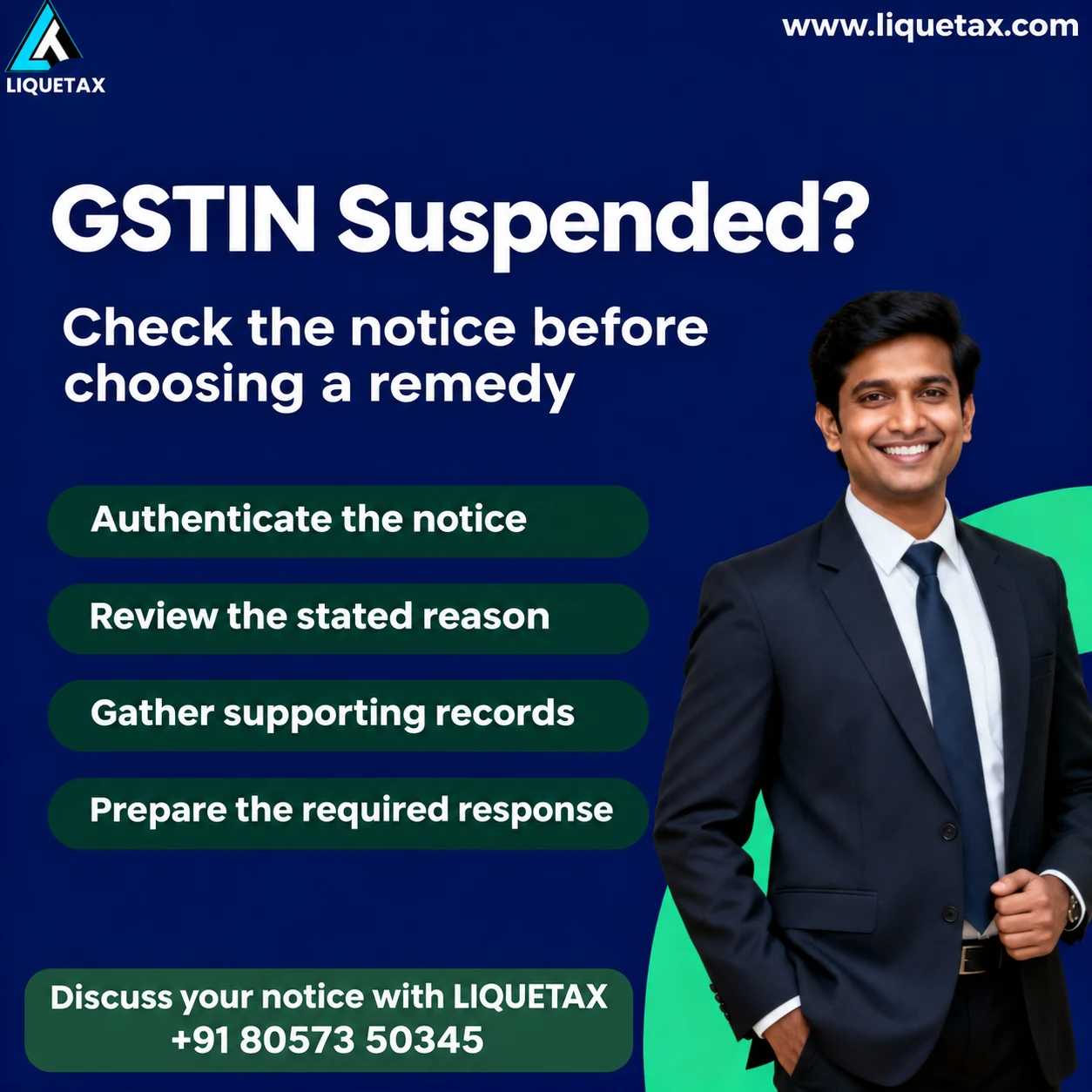
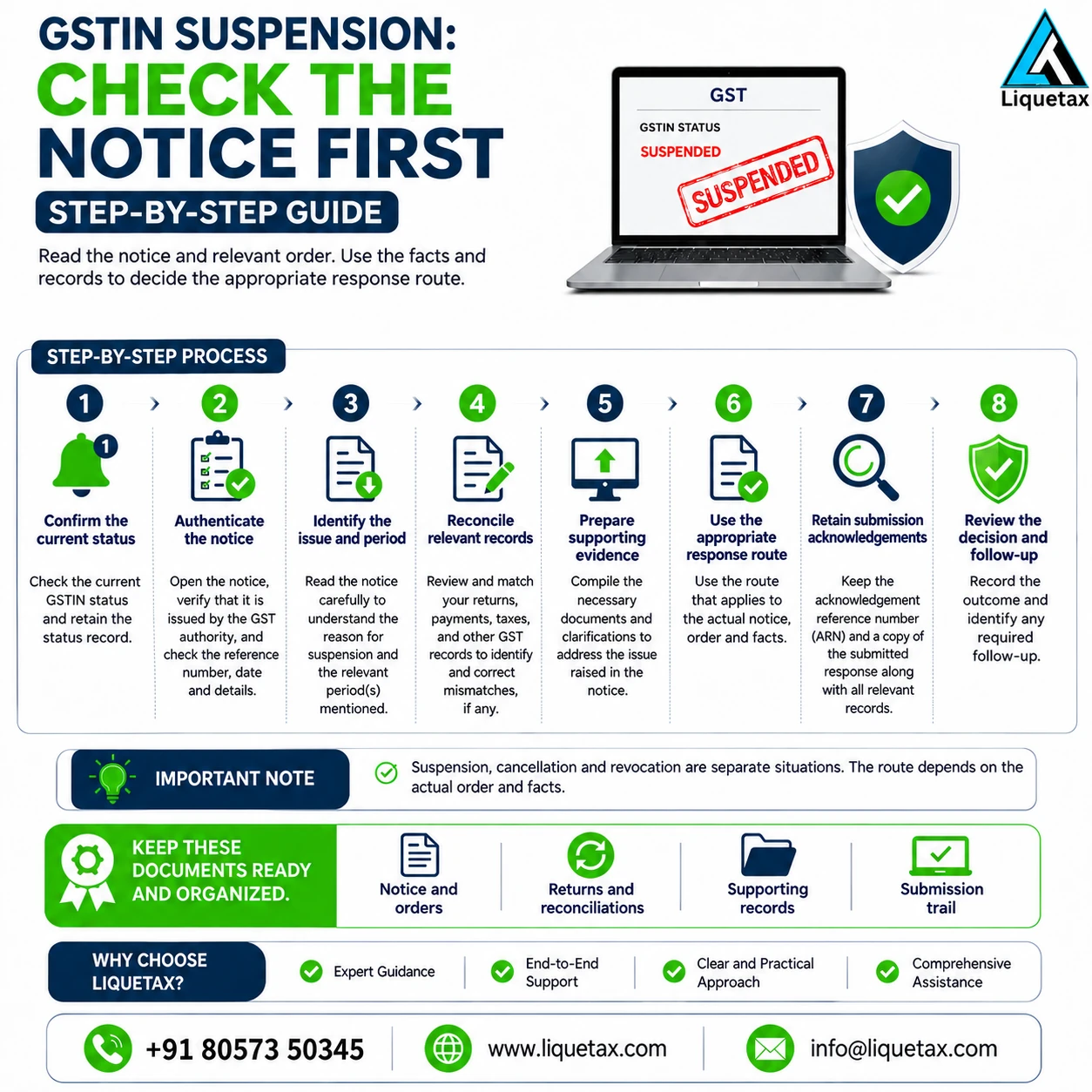
- 1. Save the record
Download the notice, order and portal status with dates.
- 2. Identify the route
Distinguish suspension, proposed cancellation and a final cancellation order.
- 3. Reconcile facts
Match returns, books, invoices and payments to each concern.
- 4. Respond and track
Submit through the specified route and retain the acknowledgement.
Confirm what has happened to the GSTIN
Log in through the official GST portal and download the complete communication, including annexures. Record the GSTIN, notice or order reference, service date, reasons, period covered and required response. Check whether the record concerns suspension pending cancellation proceedings, a show-cause notice or a cancellation order. These stages call for different actions even when a customer describes all of them as an inactive GST number.
Preserve email and SMS alerts as supporting records, but use the full portal document to understand the requirement. Identify who receives official communications and who has access to the account. If a deadline is close, flag it immediately to the person advising on the response rather than waiting to assemble a perfect folder before mentioning the notice.
Separate suspension from cancellation revocation
Rule 21A concerns suspension of registration. Rule 23 concerns an eligible application to revoke a cancellation made by the proper officer on the officer’s own motion. It provides a ninety-day application period from service of the cancellation order, subject to its conditions. An authorised extension of up to a further one hundred and eighty days requires sufficient cause and a recorded decision; it is not automatic. This is not a universal thirty-day reactivation rule counted from a suspension message.
Follow the period and procedure in the actual communication and the applicable current rule. A REG-31 anomaly intimation, a cancellation show-cause notice and an order cancelling registration are not interchangeable. Ask whether a reply, pending-return correction, revocation application, appeal or another step is legally available on your facts. Do not assume that a fresh GST registration removes an earlier default or liability.
Control invoicing and customer communication
Rule 21A restricts taxable supplies during suspension and explains the implications for tax invoicing and charging tax. Have the exact position reviewed before issuing further GST tax invoices or treating new supplies as routine. An accounting system that still prints the GSTIN does not establish permission to use it. Keep the sales team and accounts team informed of the status and the instructions they should follow.
Prepare a factual update for affected customers: the status recorded on the portal, the matter being addressed and the contact person for documents. Avoid promising a restoration date or advising customers about input credit without assessing the transaction and period. Keep a list of open orders, advances, dispatched goods and disputed invoices so the business and its adviser can review the consequences consistently.
Build evidence around the specific reason
For a return-filing concern, prepare a period-wise filing register with acknowledgements, challans and outstanding amounts. For a turnover or input-credit mismatch, reconcile the books with relevant returns and transaction records. Explain timing differences, amendments, credit notes and transactions needing correction. A spreadsheet total without invoices or a clear reconciliation trail will be difficult to defend.
For an address or constitution issue, collect the current registration particulars and genuine supporting records. Check whether a required amendment was filed and preserve its acknowledgement. Divide the response file into the department’s concern, your explanation, the supporting annexure and any action completed. Where a statement cannot yet be supported, record the gap and seek advice rather than creating a convenient document.
Submit a focused reply and preserve the trail
Answer each point in the communication in a numbered format. Identify the period and amount, describe the factual position and cite the annexure that supports it. If a correction or payment is relevant, attach its evidence and explain how it relates to the issue. A long narrative about the business’s good intentions does not replace the requested information.
Use the official response route or the channel specified by the authority. Retain the submitted reply, attachments, application reference and acknowledgement together. Check for later queries, hearing information and the decision. If additional time is needed, obtain advice about whether an extension is available and how to request it; submitting a request does not itself grant extra time.
Check the decision and repair the underlying process
Read the written outcome and confirm the portal status instead of assuming that uploading a reply has restored registration. For eligible cancellation revocation involving non-filing, the GSTN guidance describes return and payment conditions. Review these with the applicable rule and periods. Keep any required follow-up filings, amendment or reconciliation work on a separate task list with a responsible person.
After the immediate matter is resolved, fix the communication and compliance process that allowed the problem to grow. Maintain a return calendar, periodic reconciliations and a register of portal notices. Review authorised-signatory details when staff or advisers change. A documented owner for each task helps the business respond promptly without relying on someone remembering an old email.
A practical GST suspension response folder
| Record | Question it helps answer |
|---|---|
| Complete communication and service date | What action and response period apply? |
| Period-wise return register | Which returns are filed, missing or corrected? |
| Books and invoice reconciliation | What explains the stated difference? |
| Payment and challan evidence | Which amounts were actually paid and for which period? |
| Premises and amendment records | Are registration details current and supportable? |
| Submitted reply and decision | What was sent and what did the authority decide? |
Illustrative example
Illustrative example: a trader receives an anomaly notice comparing returns with sales records. The useful first step is a period-wise reconciliation and a reply to the identified difference. Filing a cancellation-revocation application merely because the status says suspended may address the wrong stage.
Frequently asked questions
Is suspension the same as cancellation?
No. Suspension can apply while cancellation proceedings are pending. A final cancellation order and its available remedies need a separate review.
Can I file a generic thirty-day reactivation application?
Do not assume that route applies. Identify the notice or order first; cancellation revocation under Rule 23 has its own conditions and period.
Can I keep issuing GST tax invoices while suspended?
Rule 21A restricts taxable supplies during suspension. Obtain a review of the applicable restrictions before issuing invoices or charging tax.
Will filing overdue returns automatically solve every case?
No. Returns and payments may be relevant, but an address issue, mismatch or other concern may need a separate explanation and decision.
Can restoration be promised within a fixed number of days?
No. The outcome and timing depend on the proceedings, evidence and authority. Track the written decision and portal status.
Bring the notice, not just a status screenshot
For a LIQUETAX preparation conversation, bring the full communication, service date, return register and the relevant reconciliation. Ask for the available response route, required evidence and filing responsibilities in writing. Government amounts and assistance fees should be shown separately before you authorise work.
Book a preparation conversationOfficial references
- CBIC: CGST Rule 21A, suspension of registration
- CBIC: CGST Rule 23, revocation of cancellation
- GSTN: revocation of cancelled registration FAQs
Check the relevant authority, current forms and the facts of your case before acting. This source-checked educational guide does not record a professional endorsement or promise an approval, penalty waiver or processing time.