
- Choose the correct income period
- Use the correct new-regime slabs
- Understand the rebate without calling all income exempt
- Compare deductions that actually exist
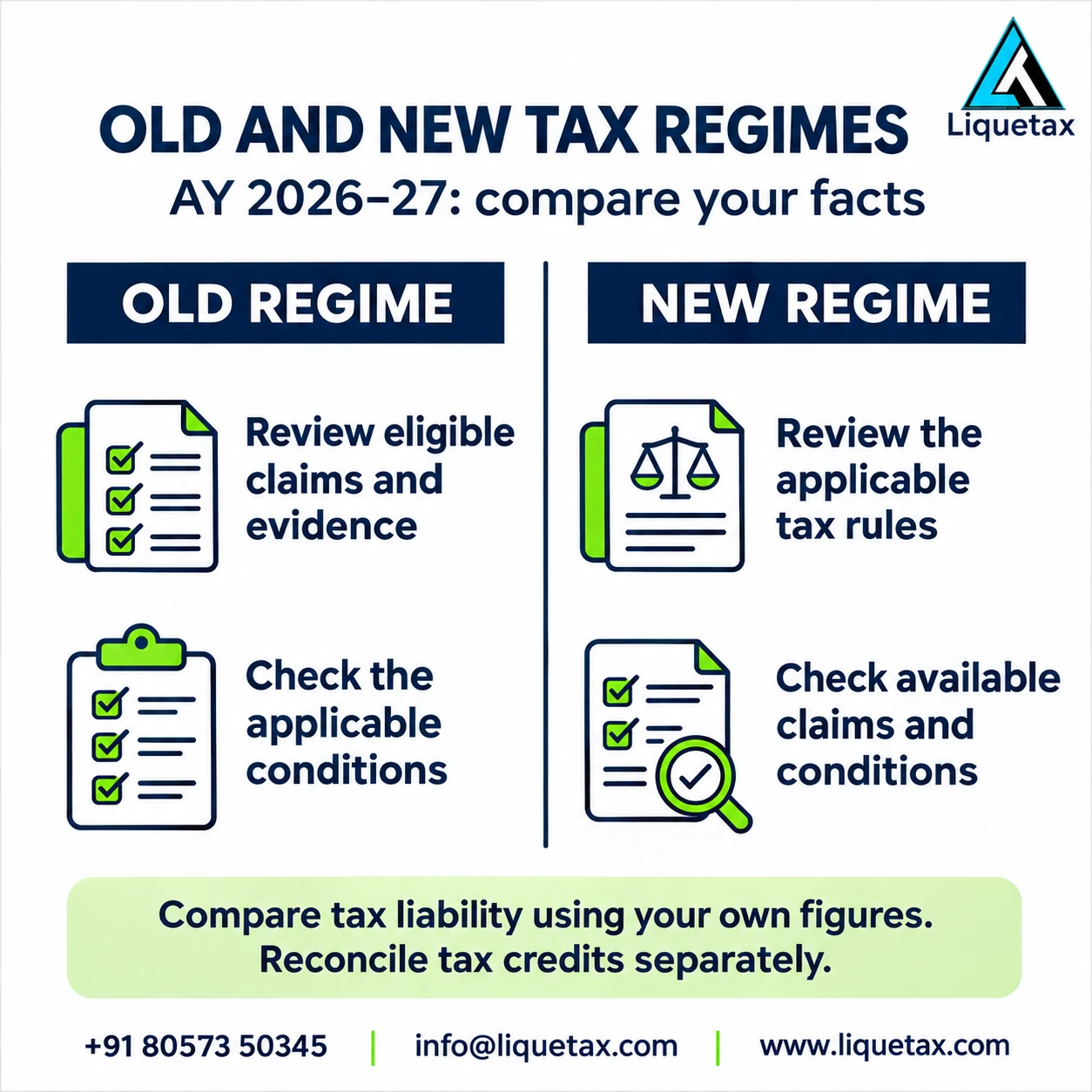
The better regime is the one producing the correct lower liability for your complete facts, within the available election rules. A refund comparison alone can be misleading because refund also depends on how much tax was already deducted or paid. Use AY 2026-27 rules for FY 2025-26 income and show both computations side by side.
Choose the correct income period
For income earned from 1 April 2025 to 31 March 2026, select Assessment Year (AY) 2026-27 and apply the Income-tax Act, 1961. Income earned from 1 April 2026 belongs to Tax Year 2026-27 under the Income-tax Act, 2025. These are different periods. A return or notice about an earlier year does not move to the new Act merely because you handle it after April 2026.
Use the correct new-regime slabs
For AY 2026-27, new-regime slabs are nil up to ₹4 lakh, then 5% for ₹4–8 lakh, 10% for ₹8–12 lakh, 15% for ₹12–16 lakh, 20% for ₹16–20 lakh, 25% for ₹20–24 lakh and 30% above ₹24 lakh. These are slab rates, not one rate on the entire income. Add applicable surcharge and 4% health and education cess after considering relief. Older ₹3–6 lakh tables are unsuitable for this year.
Understand the rebate without calling all income exempt
An eligible resident individual under the new regime can receive section 87A rebate up to ₹60,000 where total income does not exceed ₹12 lakh, with applicable marginal-relief provisions above that level. The rebate is constrained by tax at the prescribed normal rates; special-rate income needs separate treatment. Do not describe ₹12 lakh as the universal filing threshold or assume every taxpayer qualifies.
Compare deductions that actually exist
The salary standard deduction is generally ₹75,000 under the new regime and ₹50,000 under the old regime, limited by applicable salary rules. Old-regime claims may include genuine HRA, eligible housing-loan interest and deductions such as 80C or 80D. The new regime permits specified items but restricts many common claims. Ordinary business expenses are not all abolished merely because an eligible business taxpayer uses the new regime.
Respect the election rules
A non-business taxpayer generally chooses the eligible option in a timely return for the year. Eligible taxpayers with business or professional income face Form 10-IEA and switching conditions. An employer’s payroll intimation is not a substitute for the required return election or form. Check filing dates and past options before assuming you can freely change regimes in a belated return.
Build a complete comparison
List salary, property income, business income, capital gains, other sources, losses and eligible deductions. Compute each regime’s taxable income, normal-rate and special-rate tax, rebate, surcharge and cess. Then compare genuine credits separately to estimate balance payable or possible refund. There is no universal deduction threshold that makes the old regime better at every salary, age, residence and income mix.
Practical checklist
- Use current-year slabs and confirm residence and age where relevant.
- Separate normal-rate income from special-rate items.
- Include only supported claims permitted by each regime.
- Check election timing, past choices and any Form 10-IEA requirement.
- Compare final liability first and tax credits/refund second.
Worked example
Illustration: a resident employee has salary of ₹10 lakh, no other income and no special-rate income. Under the new regime, an eligible ₹75,000 standard deduction leaves ₹9.25 lakh, and the applicable rebate can eliminate normal tax. Under the old regime, the result depends on actual eligible claims. This example is deliberately limited; adding capital gains, other income or changing residence can change the answer and should trigger a fresh computation.
Frequently asked questions
Is the new regime always better?
No. Compute both where an election is legally available, using all income, relief and real eligible claims.
Does everyone need Form 10-IEA?
No. It concerns eligible taxpayers with business or professional income exercising the relevant regime option.
Are there no deductions at all in the new regime?
That is incorrect. Specified deductions remain available, while many commonly advertised old-regime claims are restricted.
Does a bigger refund prove a better regime?
No. Compare final liability independently of withholding and tax payments.
Can special-rate gains receive the full rebate?
The rebate has statutory limits involving normal-rate tax. Calculate special-rate income separately rather than treating all income as tax-free.
Official references
- Income Tax Department: AY 2026-27 salary tax guidance
- Income Tax Department: salary deductions and allowances
- Finance Act 2026, enacted text
- Income Tax Department: current return obligations and deadlines
For help reviewing your documents and the correct next step, contact LIQUETAX. The scope and any professional fee should be agreed in writing after the facts are checked. This article provides general information; individual eligibility depends on the applicable law and records.