
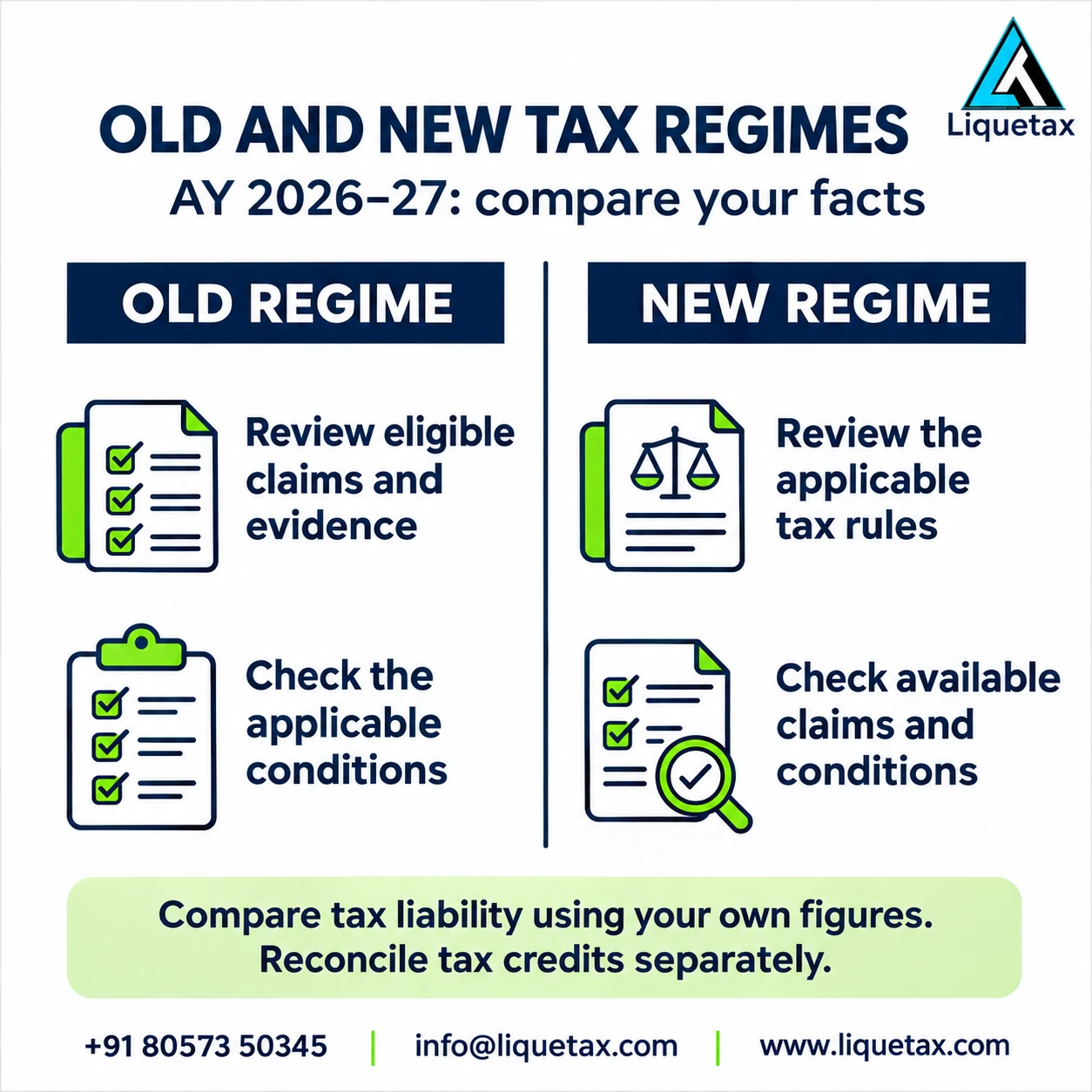
- Choose the correct income period
- Define the salary and assumptions
- Work through the new-regime example
- Work through the old-regime example
A salary figure is a starting point for comparing tax regimes, not enough information for a final recommendation. The example below uses ₹10 lakh of annual salary for AY 2026-27 and makes its assumptions explicit. Your actual choice should be checked against Form 16, other income, eligible claims and the rules for exercising the option.
Choose the correct income period
For income earned from 1 April 2025 to 31 March 2026, select Assessment Year (AY) 2026-27 and apply the Income-tax Act, 1961. Income earned from 1 April 2026 belongs to Tax Year 2026-27 under the Income-tax Act, 2025. These are different periods. A return or notice about an earlier year does not move to the new Act merely because you handle it after April 2026.
Define the salary and assumptions
Assume a resident individual below 60 with ₹10 lakh salary before the standard deduction, no other income, no special-rate gains and no additional deductions or exemptions in the comparison. CTC is not necessarily taxable salary: employer contributions, reimbursements and benefits require classification. If your offer letter says ₹10 lakh CTC, do not automatically enter that number as taxable salary in this example or in the return.
Work through the new-regime example
An eligible ₹75,000 standard deduction leaves ₹9.25 lakh. Using the AY 2026-27 slabs, tax before rebate is ₹20,000 on the ₹4–8 lakh band plus ₹12,500 on the next ₹1.25 lakh, totalling ₹32,500. On these limited assumptions, the resident individual’s applicable section 87A rebate eliminates that normal tax. The example has no special-rate income and should not be stretched to situations where rebate restrictions produce a different result.
Work through the old-regime example
With only an eligible ₹50,000 standard deduction, taxable income is ₹9.5 lakh. For the stated below 60 assumptions, basic tax is ₹12,500 on ₹2.5–5 lakh plus ₹90,000 on ₹5–9.5 lakh: ₹1,02,500. Adding 4% cess gives ₹1,06,600. Genuine HRA, housing-loan or Chapter VI-A claims could change the old-regime computation, so this is not the result for every employee with the same salary.
Change one input at a time
Add actual eligible HRA, loan interest and deductions to the old-regime worksheet, and permitted claims to the new-regime worksheet. Then add bank interest, rent, capital gains and other income to both as required. Special-rate gains, residence, age and employer NPS contributions can change the comparison. Avoid a universal statement that “deductions above ₹3.75 lakh” always make one regime better.
Choose liability before comparing refunds
The new regime is default. Check how and when you can validly choose the old regime, and whether business income creates additional Form 10-IEA and switching conditions. An employer’s withholding choice and the final return election are related but not identical. Compare final liabilities first. A refund depends on genuine TDS and other credits, so two employees with identical tax can still receive different refunds.
Practical checklist
- Convert CTC and payslips into the correct taxable-salary figure.
- Record age, residence and every source of other income.
- Use actual eligible HRA and deductions with supporting records.
- Calculate normal-rate and special-rate income separately.
- Check election timing before authorising the chosen return computation.
Worked example
Illustration extension: if the same employee receives additional bank interest, the original ₹9.25 lakh taxable-income figure is no longer complete. If the employee sells an investment at a special tax rate, the rebate treatment also needs a separate calculation. Updating the worksheet is more reliable than assuming that a salary-based “zero tax” headline covers every transaction during the year.
Frequently asked questions
Is ₹10 lakh CTC the same as taxable salary?
No. Review the components and applicable treatment before using a salary figure in a tax comparison.
Is the example a guaranteed refund?
No. It compares liability under limited facts. Refund depends on genuine credits and processing.
Can HRA change the old-regime result?
Yes, where the exemption is eligible and supported. Calculate it from actual salary, rent and location facts.
Does every ₹10 lakh earner get the same rebate?
No. Residence, total income and special-rate items can change eligibility or the amount available.
Can I switch after the deadline without restriction?
Do not assume so. The election rules and any business-income conditions need to be checked.
Official references
- Income Tax Department: AY 2026-27 salary tax guidance
- Income Tax Department: salary deductions and allowances
- Income Tax Department: current return obligations and deadlines
- Finance Act 2026, enacted text
For help reviewing your documents and the correct next step, contact LIQUETAX. The scope and any professional fee should be agreed in writing after the facts are checked. This article provides general information; individual eligibility depends on the applicable law and records.