
- Confirm the year and regime first
- 1. Salary standard deduction
- 2. House Rent Allowance exemption
- 3. The combined 80C investment and payment limit
Confirm the year and regime first
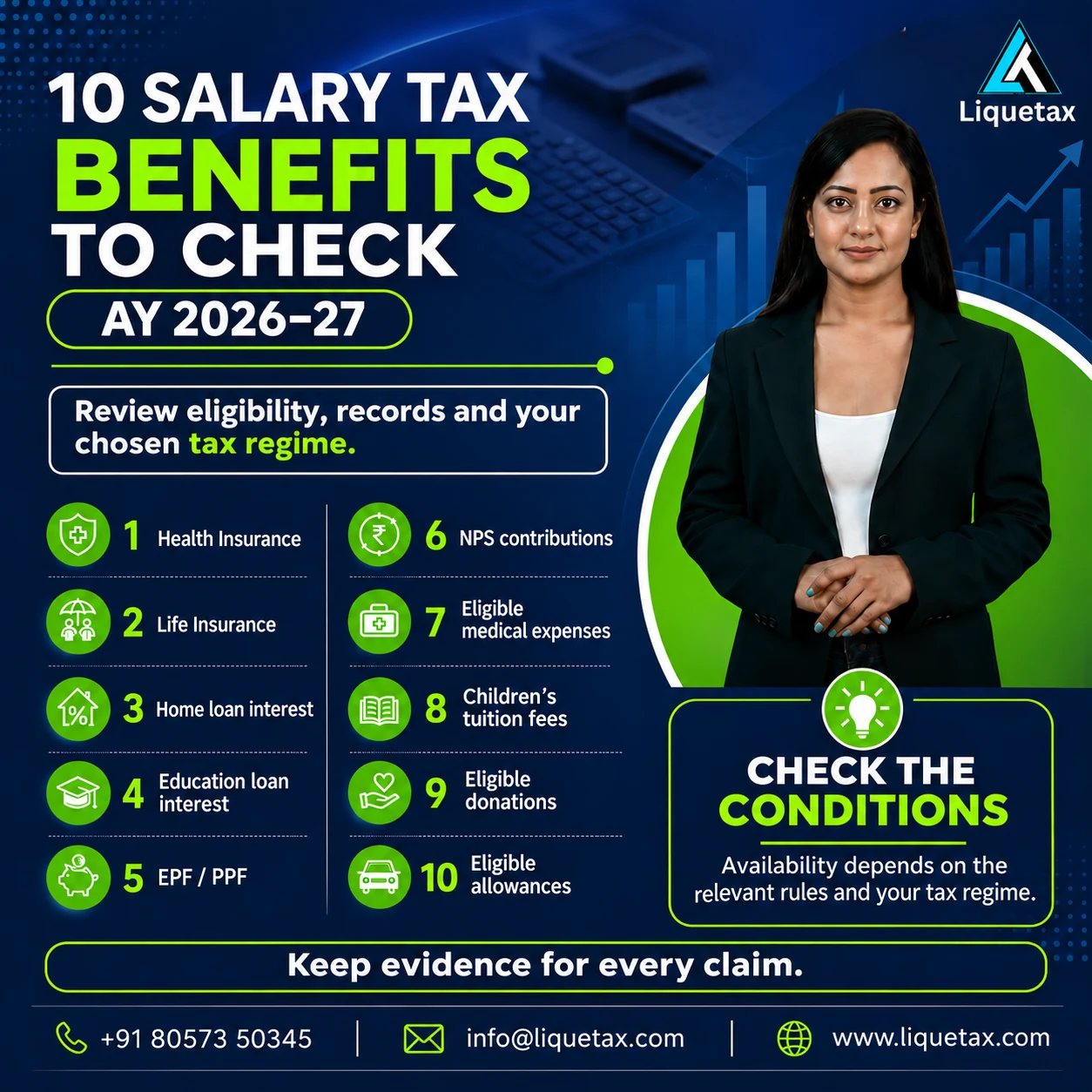
This checklist concerns FY 2025-26, reported in AY 2026-27 under the Income-tax Act, 1961. Income from April 2026 belongs to the 2025 Act tax-year framework. Do not apply this year’s section numbers and limits automatically to every future return.
The new regime is the default. Eligible taxpayers can use the old regime subject to the applicable option and timing rules. Compare the complete tax calculations: having more deductions does not necessarily make the old regime cheaper. The benefits below are alternatives to check, not amounts everyone may claim together.
1. Salary standard deduction
For this year, the standard deduction is up to 50,000 rupees under the old regime and 75,000 under the new regime, limited to the eligible salary amount. Review the combined salary computation if you changed employers; it is not a separate full deduction for every Form 16.
2. House Rent Allowance exemption
HRA relief is an old-regime exemption with its own calculation, not a deduction of all rent paid. Check actual HRA, eligible salary, location and rent paid. Keep the rental and payment evidence and required landlord details. A fabricated rent receipt does not create eligibility.
3. The combined 80C investment and payment limit
Eligible provident-fund contributions, insurance, tuition or other specified payments may fall within the combined 1.5-lakh-rupee limit involving sections 80C, 80CCC and 80CCD(1), subject to conditions. Review existing payroll contributions before buying another product solely to fill a perceived gap. This is ordinarily an old-regime benefit.
4. Health insurance under 80D
Under the old regime, eligible health insurance and specified medical-related expenditure can qualify within the applicable limits. Self/family and parents require separate checks, including age and payment conditions. Keep the policy and payment evidence; a preventive check-up allowance is not an extra unlimited deduction.
5. Additional own pension contribution under 80CCD(1B)
An eligible own contribution can support an additional deduction up to 50,000 rupees under the old regime, subject to the provision. Keep the pension-account record and distinguish contributions already claimed elsewhere. The same payment must not be counted twice merely because two section labels appear in the return.
6. Employer pension contribution under 80CCD(2)
Eligible employer contributions have a separate deduction and can be relevant under both regimes. The applicable salary-based limit depends on the employer and regime, so do not copy the limit for your own contribution. Reconcile the employer’s contribution with Form 16 and the pension-account statement.
7. Housing-loan interest
Interest under section 24(b) is assessed in the house-property computation. Property use, ownership, purpose and borrowing conditions affect the claim. Self-occupied interest relief is not available under the new regime; let-out property has different treatment. Keep the lender’s certificate and check loss-set-off restrictions rather than claiming all interest against salary.
8. Higher-education loan interest under 80E
The old-regime provision concerns eligible interest, not the entire loan instalment. Check the lender, purpose, qualifying person and permitted claim period. Obtain an interest statement separating principal and interest, and do not assume a general personal loan used for study necessarily qualifies.
9. Eligible donations under 80G
Check the recipient’s approval, the donation category, payment mode, applicable percentage and qualifying limit. Keep the receipt and required donation-certificate details. Under the old regime, eligible donations may qualify; neither every charity payment nor every rupee donated produces an equal deduction. New-regime taxpayers cannot generally claim this benefit.
10. Savings or deposit interest relief
Under the old regime, section 80TTA can provide up to 10,000 rupees for eligible savings-account interest; it does not cover ordinary fixed-deposit interest. Resident senior citizens should review section 80TTB instead, with its eligible-deposit scope and 50,000-rupee limit. Declare the interest income before applying the appropriate deduction.
Reconcile the claims before filing
Build a claim sheet showing the provision, qualifying payment, evidence, regime and amount actually allowed. For illustration, an employee with two jobs should combine salary and credits, review the single annual limits and compare both regimes using only supported claims. Submit the correct return rather than treating employer approval as a final tax determination.
Practical review before you proceed
Keep a dated working file with the relevant return, computation, acknowledgement, tax-credit statements, bank evidence and documents supporting the disputed figure or claim. Record the assessment or tax year on every working paper to avoid mixing periods. Save the final response and submission acknowledgement, and assign a follow-up date for the official account. If professional help is needed, share the complete document through a secure channel and agree the scope, deadline and fee in writing before work begins.
Frequently asked questions
Can I claim all ten benefits under the new regime?
No. Most personal deductions and HRA relief in this checklist relate to the old regime. Standard deduction and eligible employer pension contributions have different treatment. Compare the complete calculations and applicable option rules.
Can I buy an investment now and deduct it for FY 2025-26?
A later purchase does not ordinarily become a payment of an earlier financial year. Check the relevant provision and period; do not backdate receipts or include a transaction merely because the return is being filed now.
What if the employer did not include an eligible claim?
Review whether the claim is legally available in the return and supported by evidence, taking account of the chosen regime and filing conditions. Employer payroll treatment does not by itself determine final eligibility.
Do two employers mean two full standard deductions?
No. Review salary together in the annual return and apply the permitted deduction to the combined eligible salary computation. Reconcile both Forms 16, tax credits and any duplicated allowance treatment.
Does this list apply unchanged to income after April 2026?
No. This article is specifically for FY 2025-26 and AY 2026-27. Income from April 2026 uses the 2025 Act framework, so verify the applicable provisions, forms and current guidance for that period.
Official sources and next step
Checked on 9 October 2026. Use the official material below for the applicable form, current conditions and case-specific instructions.
- Income Tax Department: salaried individuals AY 2026-27
- Income Tax Department: salary deductions and allowances
- Income Tax Department: various deductions
- Income Tax Department: old and new regime FAQs
- Income Tax Department: scope of the 2025 Act
Contact LIQUETAX with your records and the issue you need resolved. Request a written scope and fee quote before work begins; approval remains with the relevant authority.