
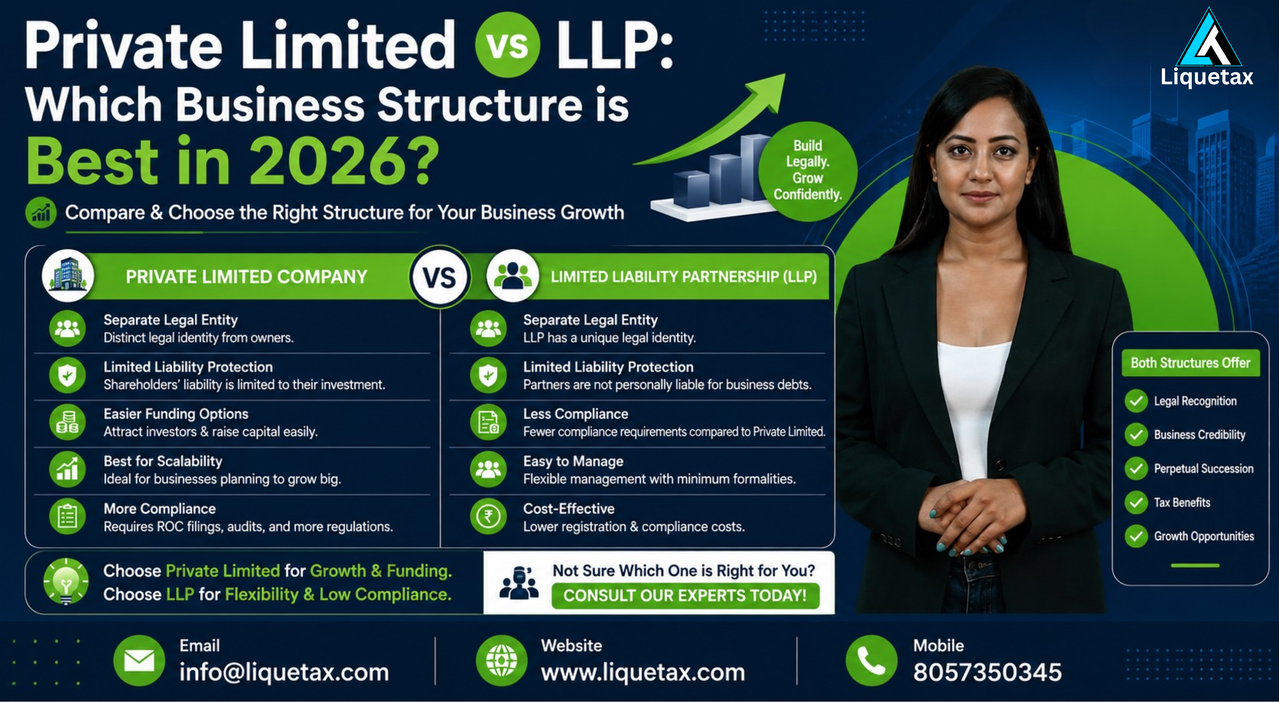
⚡ Pvt Ltd: Fundraising
Best for startups seeking venture capital and equity funding.
📄 LLP: Flexibility
Ideal for professionals and small businesses with less compliance.
💰 Cost Comparison
LLP registration is slightly cheaper, but both have affordable fees.
🔐 Limited Liability
Both structures protect personal assets from business liabilities.
 ▶ Tap to play
Introduction: Private Limited vs LLP in India 2026
Choosing the right business structure is one of the most important decisions for any entrepreneur. In India, Private Limited Company and Limited Liability Partnership (LLP) are two of the most popular structures. Both offer limited liability and separate legal identity, but they differ in compliance, fundraising, and management. This guide compares Private Limited vs LLP to help you decide which is best for your business in 2026.
What is Private Limited Company and LLP?
- Private Limited Company: A company with limited liability, minimum 2 members and 2 directors. It can issue shares, raise equity, and is governed by the Companies Act, 2013.
- LLP (Limited Liability Partnership): A partnership where partners have limited liability. It is governed by the LLP Act, 2008, and is suitable for professionals and small businesses.
Why Choosing the Right Structure Matters
- Limited liability: Both protect personal assets.
- Fundraising: Pvt Ltd can raise equity funding from VCs and angel investors. LLP cannot issue shares.
- Compliance: LLP has lesser compliance compared to Pvt Ltd.
- Credibility: Both structures are recognized and trusted by banks and clients.
- Taxation: Pvt Ltd taxed as a company; LLP taxed as a partnership (no dividend tax).
Eligibility & Requirements
- Private Limited: Minimum 2 directors (at least 1 resident), minimum 2 members, no maximum limit.
- LLP: Minimum 2 partners (individuals or corporate), at least 2 designated partners (one resident).
- Name approval: Unique name required for both.
- Registered office: Physical address in India for both.
- DSC & DIN/DPIN: Directors need DIN for Pvt Ltd; partners need DPIN for LLP.
Step-by-Step Registration Process
For Private Limited:
- Obtain DSC for directors.
- Apply for DIN via SPICe+.
- Name approval via RUN or SPICe+.
- File SPICe+ with MOA, AOA, and documents.
- Pay government fees.
- Receive Certificate of Incorporation.
For LLP:
- Obtain DSC for designated partners.
- Apply for DPIN (Designated Partner Identification Number).
- Name approval via RUN-LLP.
- File FiLLiP form with LLP agreement.
- Pay fees.
- Receive Certificate of Incorporation.
Documents Required
- For both: PAN, Aadhaar, address proof of directors/partners, registered office proof (rent agreement/utility bill).
- For Pvt Ltd: MOA, AOA, declaration by directors.
- For LLP: LLP agreement, consent of partners.
Government Fees (2026)
- Private Limited: ₹2,000 – ₹15,000 (based on authorized capital).
- LLP: ₹2,000 – ₹10,000 (based on contribution).
- Additional: Stamp duty (varies by state) and professional fees.
How Liquetax Can Help You Choose & Register
- Expert consultation: We help you decide between Pvt Ltd and LLP based on your business goals.
- End-to-end registration: From DSC and DIN/DPIN to final incorporation.
- SPICe+ / FiLLiP filing: We ensure accurate filing to avoid rejections.
- Post-registration support: GST registration, annual compliance, and tax planning.
- Affordable pricing: Transparent fees with no hidden costs.
With Liquetax, you can register your company or LLP without hassle and focus on growing your business.
FAQs: Private Limited vs LLP
For startups aiming to raise venture capital or equity funding, Private Limited is better. For small businesses and professionals, LLP is more flexible with less compliance.
Yes, an LLP can be converted into a Private Limited Company under the Companies Act, subject to certain conditions and approvals.
Private Limited requires board meetings, annual general meetings, and filing of annual returns and financial statements. LLP requires fewer compliances, mainly annual return and statement of accounts.
Yes, foreign nationals can be directors in a Private Limited and partners in an LLP, subject to RBI and FEMA guidelines.
Confused Between Pvt Ltd & LLP? Let's Talk!
Get expert advice from Liquetax to choose the right structure and register your business smoothly.