
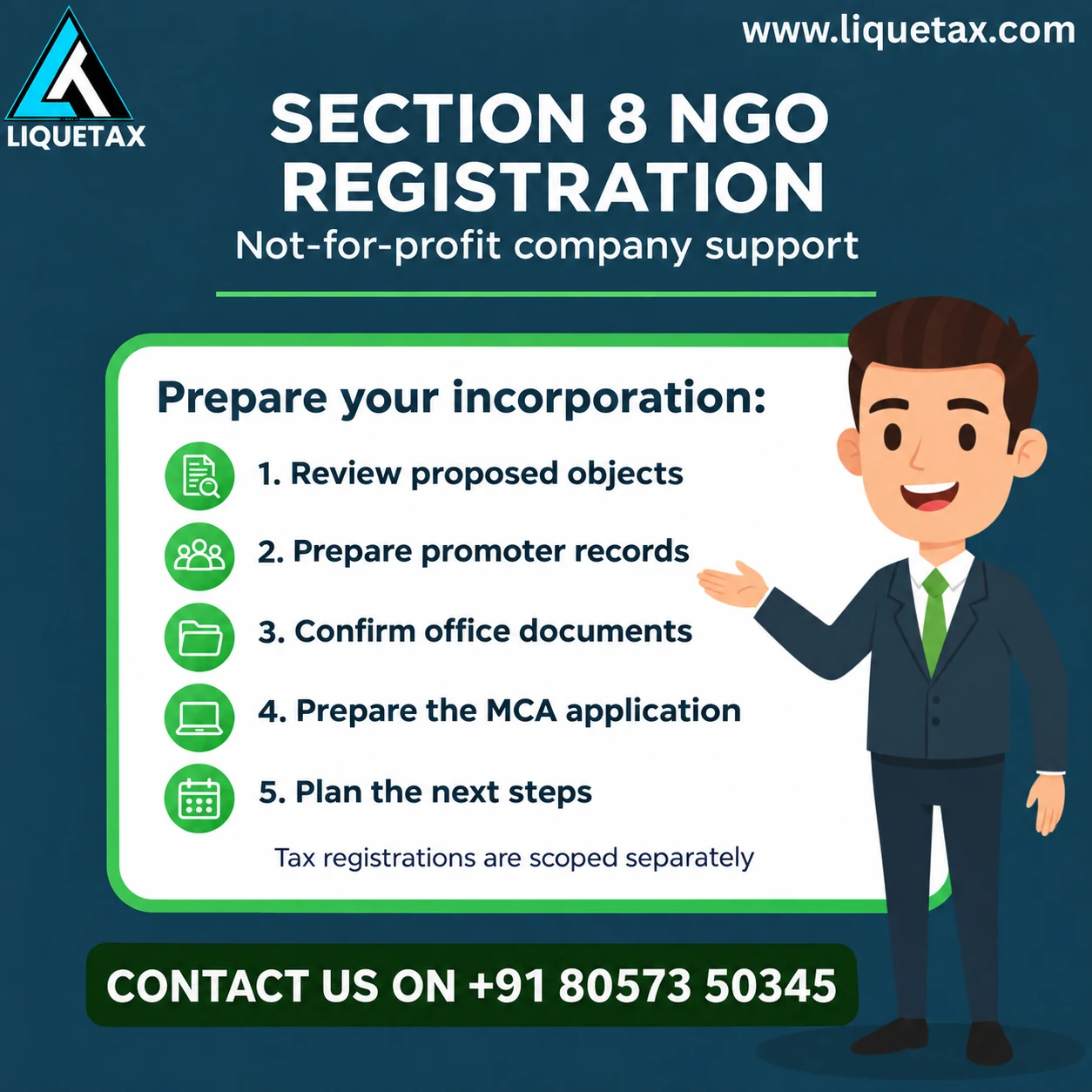
- Define the nonprofit purpose precisely
- Decide members, directors and governance
- Prepare the incorporation documents
- Review costs and follow the application
Define the nonprofit purpose precisely
A Section 8 company is formed for permitted objects such as education, research, social welfare, charity and other purposes described in the Companies Act. It applies income and profits to those objects and prohibits dividends to members. A broad social mission needs to become a clear operating plan and appropriate constitutional clauses.
Describe the activities, beneficiaries, locations and proposed funding. Explain how the organisation will spend its resources and govern itself. Section 8 status does not authorize every regulated activity simply because it has a social objective. Microfinance, schools, healthcare and other activities may require separate permissions.
Decide members, directors and governance
Choose whether the company will be constituted in the private or public form and confirm the corresponding member and director requirements. Identify the people who will take decisions and who will supervise finances. Check eligibility, consents, identity evidence and the resident-director requirement.
Draft rules for appointments, meetings, spending approvals, conflicts of interest and succession. Founders should understand that the organisation’s assets are devoted to its objects, rather than treated as personal wealth. Reasonable compensation for genuine work must be documented and comply with applicable restrictions; it is different from distributing surplus to members.
Prepare the incorporation documents
Reserve an appropriate name through the relevant MCA process and align it with the proposed objects. Prepare the memorandum, articles, required declarations and financial or activity projections called for by the current instructions. The Section 8 route uses the applicable SPICe+ and linked filings; check the current electronic forms and any attachment exceptions.
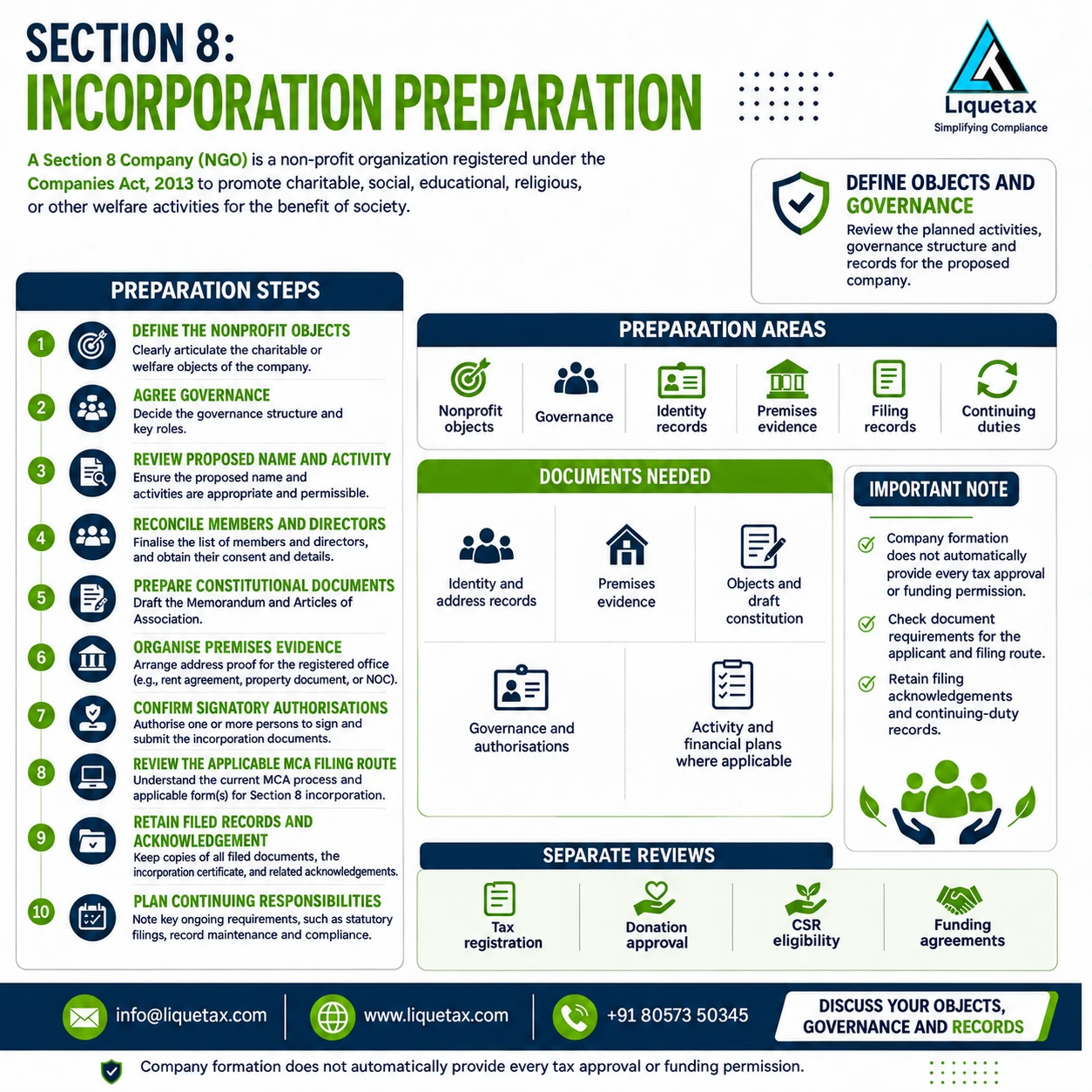
Collect the prescribed identity and residential evidence for subscribers and directors, and registered-office documents establishing a lawful right to use the premises. Owner permission and recent utility evidence should match the proposed name and full address. Overseas or corporate subscribers may need additional authentication or authorization. Do not copy another organisation’s signatures or financial projections.
Review costs and follow the application
Government fees and state stamp duty depend on the form, capital or other applicable basis and current concessions. Obtain the current calculation. Digital signatures, document preparation and professional assistance are distinct charges. A single nationwide fee range can mislead, especially where a package excludes drafting or post-incorporation work.
After submission, monitor the application reference and respond fully to queries within the given time. Keep every revised document consistent. The authority decides approval; a professional cannot guarantee a fixed number of days. Preserve the final incorporation and licensing records, submitted forms, constitutional documents and receipts after approval.
Plan separate tax and funding work
Section 8 incorporation does not itself confer income-tax exemption or deduction for donors. Current NPO applications under the Income-tax Act 2025 use the relevant section 332 registration and section 354 approval framework. Provisional and regular applications have different eligibility and timing. Existing approvals and earlier tax periods need transition-specific review.
CSR funding eligibility and implementing-agency registration, NGO Darpan requirements for relevant purposes, and FCRA registration or prior permission are separate matters. Before advertising a benefit or receiving restricted funds, confirm the applicable status. Set up a bank account, accounting controls, donation records, audit and filing calendar so the company can substantiate its activities.
Practical checklist
- Write specific permitted objects and a realistic activity and funding plan.
- Choose the private or public constitution and confirm the governing people.
- Prepare consistent constitutional documents, declarations and office evidence.
- Obtain an itemised quote and track official queries and receipts.
- Assess tax, CSR, Darpan and FCRA requirements separately after and alongside incorporation.
Illustrative example
An education initiative plans to charge modest programme fees and receive donations. Its founders explain how all surplus will support the objects, establish spending controls and incorporate under the suitable Section 8 route. They then assess the required tax approvals before promising any deduction to donors. This is an illustration, not a claim of a particular approval or completion time.
Frequently asked questions
Can a Section 8 company earn revenue?
Yes, within its permitted objects and legal framework. Income and surplus must be applied appropriately, and dividends to members are prohibited.
Is every Section 8 company tax-exempt?
No. The applicable tax registration, conditions, activities and tax period determine relief. Incorporation alone is insufficient.
Can founders receive salaries?
Payment for genuine work needs appropriate authorization, reasonableness and compliance with relevant restrictions. It must not disguise a private distribution of surplus.
Is foreign funding automatically allowed?
No. Assess FCRA and other applicable requirements before receipt. Domestic incorporation does not replace foreign-contribution permission.
What should a registration quote include?
List official charges, stamp duty, signatures, drafting, filing support, exclusions and post-incorporation tasks separately so the total is meaningful.
Official references and next step
- India Code: Companies Act, 2013
- MCA: SPICe+ and linked filing FAQs
- Income Tax Department: provisional NPO registration and approval
- Income Tax Department: regular NPO registration and donation approval
- Ministry of Home Affairs: FCRA portal and guidance
For help applying this checklist to your documents, contact LIQUETAX with the relevant facts and the support you need. Request a written scope and fee breakdown before work begins.