
- 1. Collect the evidence
Gather income records, tax certificates, AIS, Form 26AS and payment challans.
- 2. Reconcile the return
Explain mismatches and review form eligibility and deductions for the period.
- 3. Verify and nominate
Complete return verification and check the validated refund bank account.
- 4. Review the outcome
Read the processing communication before choosing a correction or reissue route.
Set the filing period and form correctly
Keep FY 2025-26 and AY 2026-27 distinct when opening statements or selecting the return. These returns remain within the Income-tax Act, 1961 framework; do not mix the newer tax-year terminology into the wrong filing period. The form must fit all income and disclosure conditions, not simply the form used last year. Business income, asset sales or overseas information can change the assessment needed.
Make a complete income list before relying on prefilled figures. Include records from every relevant employer, bank, investment account and other activity. A missing bank statement cannot be cured by assuming AIS contains everything. The Income Tax Department expressly says AIS may not display every transaction and the taxpayer remains responsible for complete and accurate reporting.
Compare tax credits with supporting records
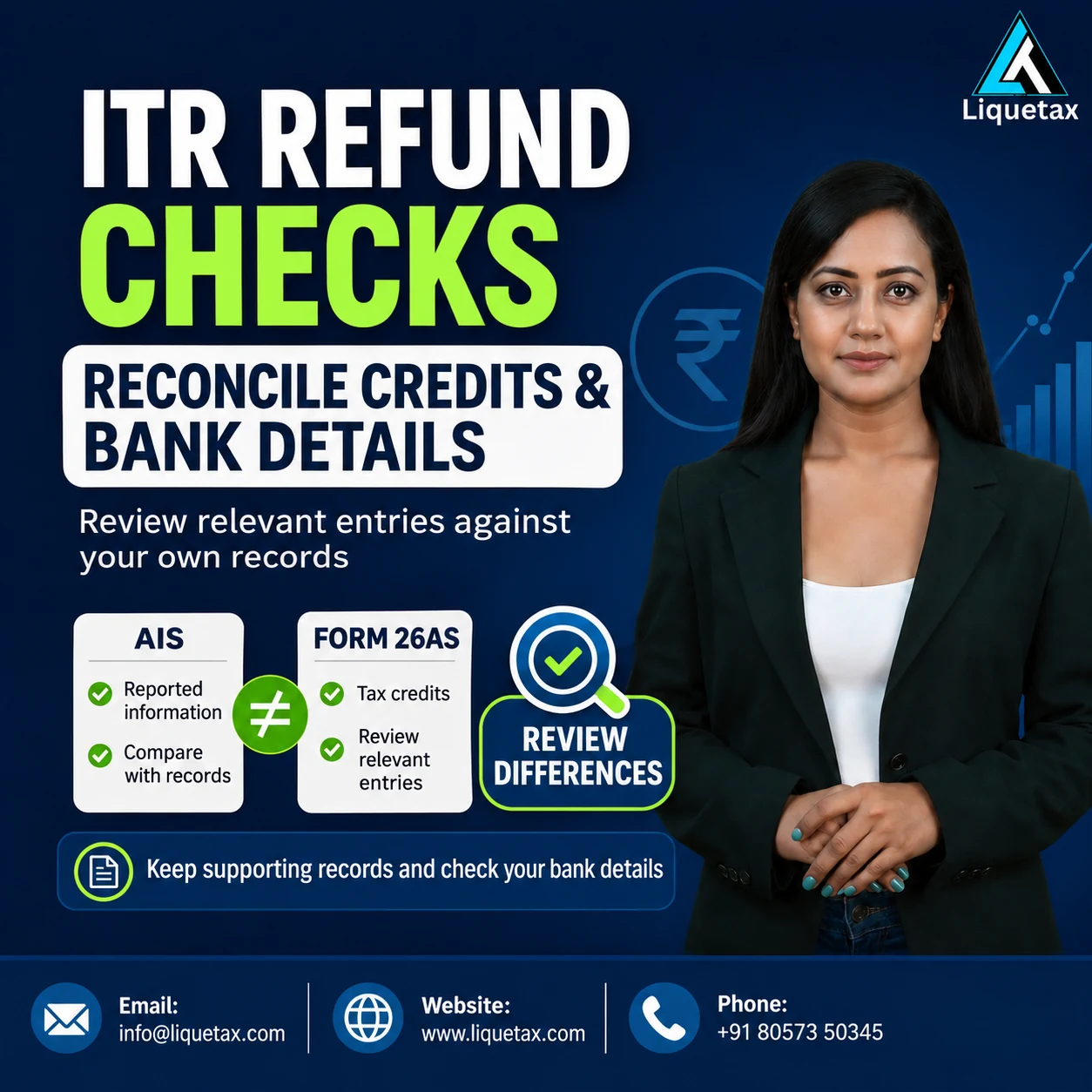
Download AIS and Form 26AS for the relevant period and compare them with Form 16, Form 16A and tax-payment challans as applicable. AIS provides broader information and a feedback facility; Form 26AS displays TDS and TCS information. A tax deduction appearing on a payslip is worth checking against the reported credit. Record the deductor, income amount, credit amount and the difference rather than sending an unexplained screenshot.
If a reporting error appears, contact the reporting party with the specific evidence and consider the available AIS feedback process. Keep the acknowledgement and any correction confirmation. Do not manufacture a tax credit to make the refund match an expectation. A response to AIS information and a correction to the filed return are separate actions, so check what each actually resolves.
Review deductions without treating every receipt as eligible
Ask which regime and deduction rules apply to your facts and filing period. A payment receipt alone does not establish eligibility, and an employer’s payroll estimate does not replace your return calculation. Have unusual deductions or claims reviewed with the supporting record, beneficiary details and payment evidence. Keep the working that explains what was allowed and what was excluded.
Read the tax computation before approving the return. Check income totals, tax paid and the refund claimed rather than only the final figure. If a preparer is helping, request the complete draft and explain any income omitted from the documents you first shared. Review professional fees separately from taxes, interest or statutory late charges. There is no general government ITR filing charge of ₹2,500 triggered simply by income exceeding ₹5 lakh.
Check verification and the refund bank account
Submission and verification are separate stages. Follow the current verification instructions that apply to your return and retain the successful acknowledgement. Do not assume uploading a file completed every step. Check the filed-return status after verification, especially if you used a method requiring a later action. Avoid sharing portal passwords or verification codes casually with people outside the authorised filing arrangement.
The My Bank Account service lets taxpayers pre-validate an account and nominate a validated account for a refund. Confirm the account is active, the PAN linkage and IFSC are correct, and validation succeeded. If it failed, read the reason and correct the relevant bank or portal details. A failed payment can delay receipt without changing the lawful refund calculation. That distinction helps choose the right response.
Read the communication before correcting anything
If the processed refund differs from your claim, compare the processing communication with the filed return and credit working. Identify the exact adjustment and the available response route. A revised return, rectification request and refund reissue solve different problems and have different conditions. Do not choose one simply because an online article calls it the quickest way to obtain the full refund.
If the return is still processing, check the portal status and any outstanding action before resubmitting information. If a refund failed, use the applicable reissue procedure after fixing the bank issue. Keep a dated log of the communication, action taken and acknowledgement. Avoid repeated duplicate requests or any expectation of a fixed credit date; processing and payment depend on the case and the department’s outcome.
Keep these records ready
| Check | Evidence | What it distinguishes |
|---|---|---|
| Period and return form | Income list and form eligibility review | Correct filing basis |
| Income and reported information | Statements, AIS and explanatory notes | Missing or duplicate information |
| Tax credits | Form 26AS, certificates and challans | Credit mismatch |
| Verification | Filed-return acknowledgement and status | Incomplete filing step |
| Bank and processing result | Validation status and processing communication | Payment problem versus adjustment |
Illustrative example
Illustrative example: a Bengaluru employee changes jobs during FY 2025-26. He gathers both employers’ records, compares the total income and TDS with the relevant statements, checks eligible deductions, and nominates an active validated bank account. If processing later changes the refund, his working helps identify the difference. This example illustrates preparation and does not predict an individual refund.
Frequently asked questions
Does a refund figure in my draft mean it is approved?
No. It is the refund claimed by the return calculation. Processing may determine a different amount, and a determined refund still needs successful payment to reach your nominated account.
Can AIS replace my own income records?
No. AIS contains information available to the department and may omit other transactions. Review your statements and records as well, and report complete and accurate information for the return.
Will a wrong bank account reduce the legal refund amount?
A bank validation or payment problem can stop or delay credit. It is different from a change in the tax computation. Read the return and refund status to identify which problem occurred.
Is ₹2,500 a standard government fee for higher-income ITR filing?
No. That is not a general government filing fee triggered by crossing ₹5 lakh income. Taxes, interest, statutory late charges and an adviser’s professional fee are different components and should be explained separately.
Should I revise the return whenever the refund is delayed?
No. Check the status and communication first. Revision, rectification and refund reissue have different purposes and eligibility conditions. Choose the route that addresses the identified error or payment failure.
Discuss the next step with LIQUETAX
Bring the relevant income records, filed or draft return, AIS, Form 26AS, challans and any processing communication. Ask LIQUETAX to explain the reconciliation and proposed action before you authorise it. A written review scope and separate fee breakdown make the service easier to assess.
Book a consultationOfficial references
- Income Tax Department: AIS scope and feedback
- Income Tax Department: bank validation and nomination
- Income Tax Department: AY 2026-27 return framework
- Income Tax Department: submission and verification workflow
Check the current authority instructions for your activity, location and filing period. This educational guide explains preparation; individual facts can change the applicable work.