
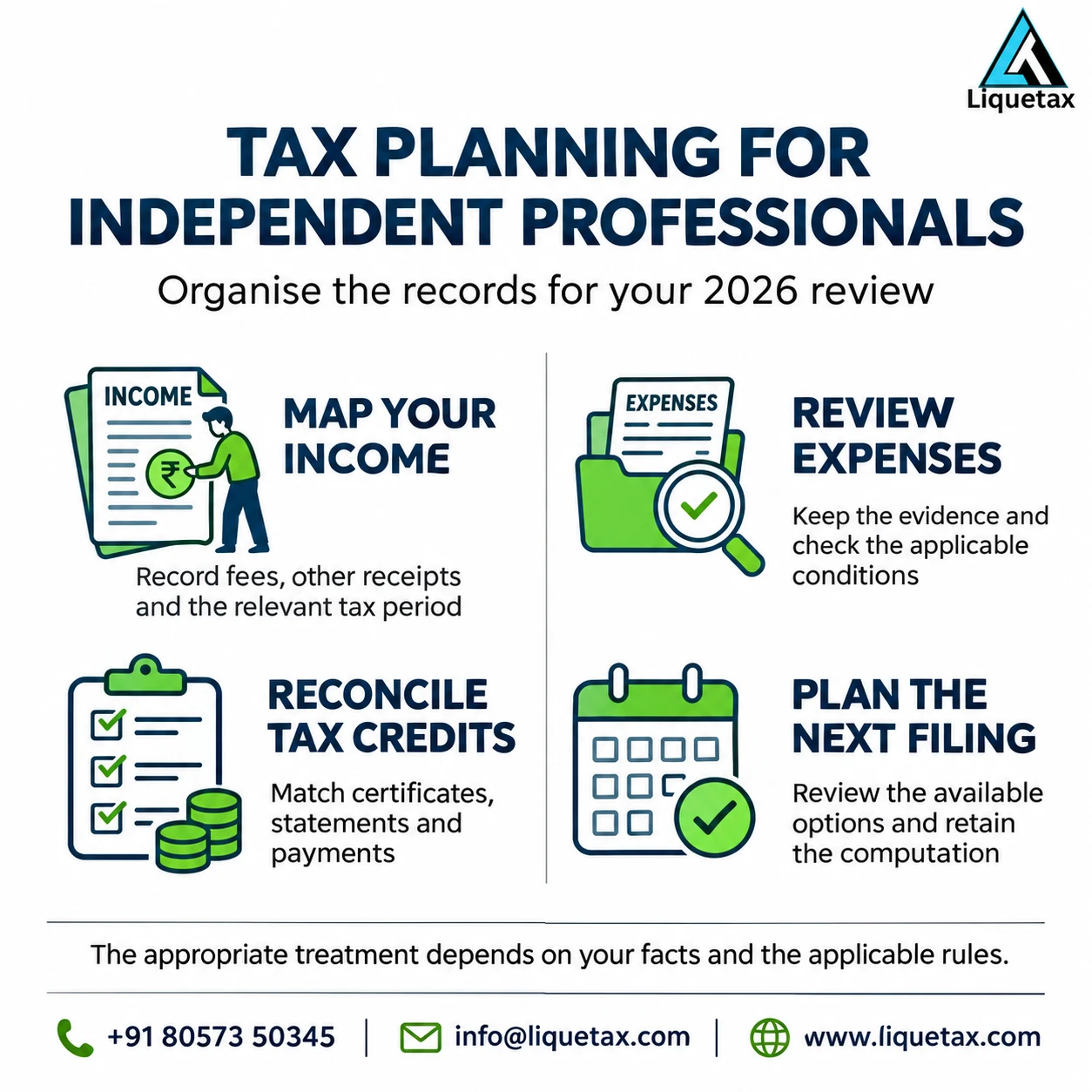
- 1. Choose the period
Identify the year and applicable framework.
- 2. Collect income
Reconcile invoices, payouts and credits.
- 3. Review expenses
Keep genuine business evidence.
- 4. Compare options
Check eligibility before selecting a route.
Separate the tax period from the calendar year
A return filed during 2026 may concern an earlier income period. Identify the financial year and assessment year for an earlier-period return, or the applicable tax-year framework for later work. Do not apply a current headline or a new section number to every past-period filing.
Keep a period-wise file so that salary, freelance income, interest and other receipts are connected to the correct return. If you are correcting an earlier submission, compare the filed records and the relevant law for that period before deciding on a revised, rectification or other route.
Reconcile the full freelance income
Prepare a client-wise invoice register and compare it with bank entries, platform statements and withholding information. Platforms can deduct commissions and fees, so the net payout may not describe your gross earnings. Explain unpaid invoices, advances, refunds and unusual receipts.
If you also have employment income, keep that evidence available rather than assuming the business return concerns freelance work alone. Overseas engagements require their own contract and payment records. Foreign currency and overseas customers do not automatically make income exempt from Indian income tax.
Keep genuine expense evidence
Maintain invoices and a clear explanation of the business use of software, professional services, equipment and other expenses. Separate personal and mixed-use costs. The appropriate deduction or accounting treatment depends on the facts and applicable framework, not simply on whether you have paid from a business account.
Avoid fabricating purchases or labelling every payment as a business expense. A good review identifies legitimate items supported by evidence and flags uncertain treatment. Keep the working so that you can explain the reported result if a question arises later.
Check eligibility before choosing presumptive or regime options
Presumptive taxation is not available on the same basis to every person who describes themselves as a freelancer. Activity, taxpayer type, receipts and other conditions matter. Ask the reviewer to identify the relevant provision and eligibility before choosing a simplified route.
Compare available regime choices using the same complete income and genuine deductions. Some options have timing or continuation conditions, particularly where business income exists. A lower-looking calculation is not useful unless you are entitled to choose it for that period.
Plan payments and filing evidence
Review tax already withheld and paid, expected remaining liability and any applicable advance-tax requirements. Keep tax challans and reconcile credits before submission. A cash reserve based on your actual figures helps you plan better than a general promise that freelancers always save a fixed amount.
After authorising the return, retain the submitted copy, computation, acknowledgement and verification status. Review GST separately; income-tax planning does not settle the tax treatment of your customer invoices. Ask for a clear list of unresolved records and next-period improvements.
Freelancer tax-review file
| Record | Purpose |
|---|---|
| Invoices and client list | Explain gross income and activity. |
| Payout and bank statements | Reconcile commissions, receipts and advances. |
| Expense evidence | Support genuine business treatment. |
| Tax-credit and challan records | Check amounts already withheld or paid. |
| Earlier returns and options | Review period, eligibility and corrections. |
Illustrative example
Illustrative example: a consultant receives a platform payout after fees and also has bank interest. A complete review considers the gross consulting records, the fees and the interest, along with tax credits. Reviewing only the net payout would leave important information out.
Frequently asked questions
Does every freelancer qualify for presumptive taxation?
No. Check the actual profession or business, taxpayer category and applicable conditions.
Can foreign receipts be ignored?
No. Review residence, income source and the applicable treatment using the actual contracts and payment records.
Will every software or equipment bill be deductible?
The evidence, business use and applicable treatment need review. Payment alone does not decide the answer.
Is a large refund the aim of good planning?
Accurate liability and lawful choices matter. A refund depends on eligible credits and the final tax position, not a promised percentage.
Does this review also settle GST?
No. GST registration and supply treatment require a separate assessment of the freelance transactions.
Get clarity before your next filing
Bring the records listed above to a LIQUETAX conversation. Ask for the applicable work, documents, responsibilities and fee components in writing before you authorise a submission. Government charges, professional fees and applicable GST should be shown separately.
Book a conversationOfficial references
Check the linked authority for the rule, form and notification that applies to your facts and period. This guide explains preparation and does not record a professional opinion on an individual case.