
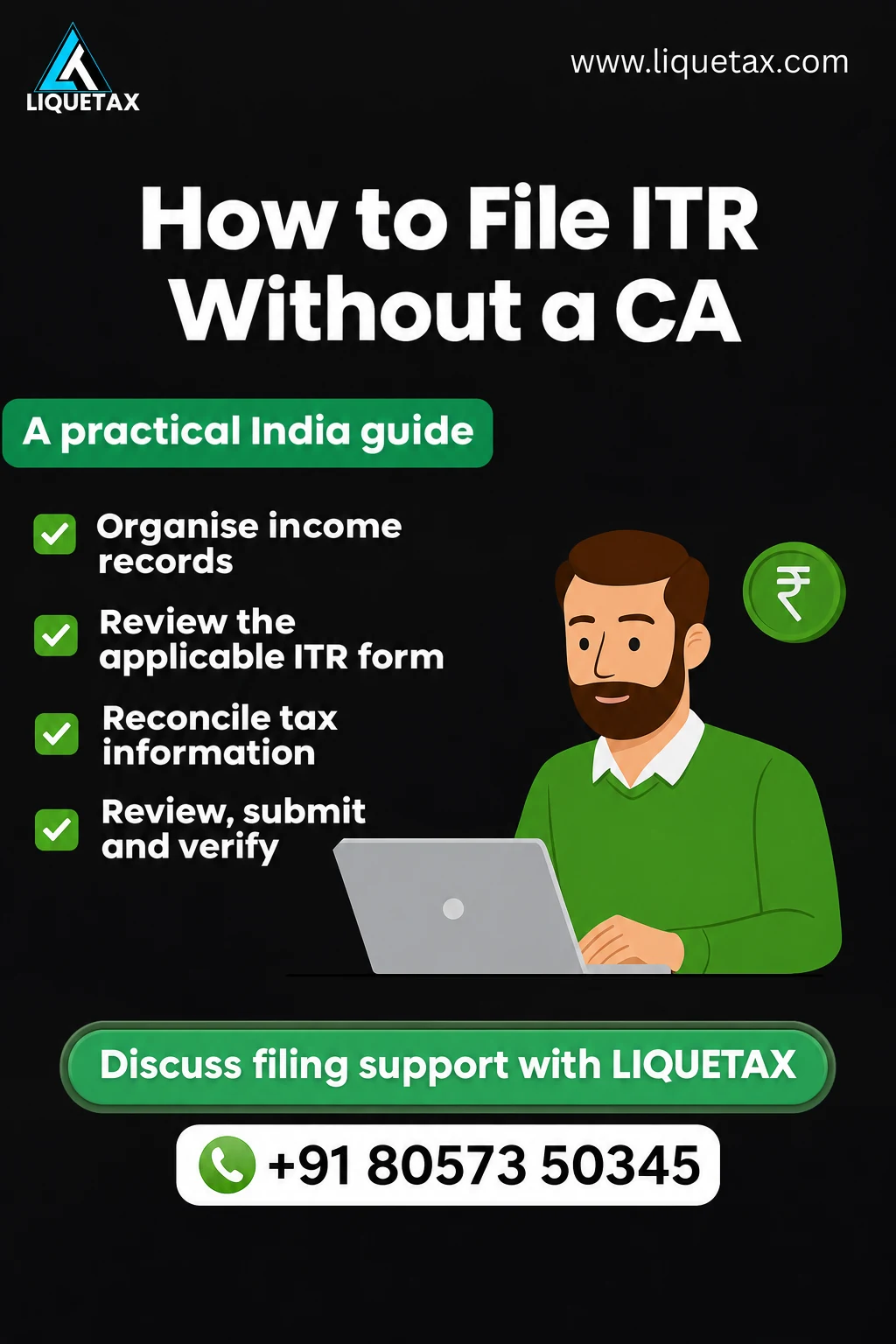
- 1. Choose the year
Match the income period to the correct assessment year or tax year before opening the return.
- 2. Reconcile records
Collect income evidence, AIS, tax credits, challans and deduction records and investigate differences.
- 3. Review and submit
Select the eligible form, calculate the applicable tax, pay any balance correctly and review the preview.
- 4. Verify and follow up
Complete the required verification, retain acknowledgements and monitor processing or notices.
Check whether filing independently is sensible
Do-it-yourself filing works best where the income sources, residency, deductions and tax credits are clear and the records reconcile. Make a complete list before deciding it is a simple salary return: savings interest, fixed-deposit interest, dividends, rent, another employer, asset sales and side work may also need reporting.
Professional help is useful where residency is uncertain, there are foreign assets or overseas income, a business loss, complex capital gains, company directorship, ESOPs, derivatives, notices or an audit requirement. A return can be filed personally without eliminating a separate legal requirement for an audit or a prescribed professional report.
Even when someone assists you, review the completed return and computation before authorising submission. You remain responsible for the information declared. Request an explanation for a deduction you do not recognise or an income figure that differs from your records; a large proposed refund is not proof that the return is correct.
First select the correct year and form
Choose the period deliberately. AY2026–27 concerns FY2025–26 income; Tax Year2026–27 concerns a different income period. Do not select the newest-looking option merely because you are filing in 2026. An older return needs its own applicable form, rules and available filing route.
The department’s downloads page contains the current utilities and form descriptions. Eligibility can change between years. ITR-1 is for eligible resident individuals with permitted simpler income; it is not a universal form for every employee. ITR-2 covers individuals and HUFs without business or professional income who need that form. ITR-3 concerns business or professional income, while ITR-4 is an optional simplified form for eligible presumptive cases.
Check the full notified instructions and exclusions for your year. Do not choose ITR-4 solely because you freelance, or ITR-1 solely because salary is your largest income. Foreign assets, losses, business income and specified capital gains can affect form selection. Current official overview pages can lag behind utilities, so resolve any inconsistency against the notified form and instructions.
| Record | Use it for | Check carefully |
|---|---|---|
| Form16 from each employer | Salary and related TDS information for the relevant year | A change of job or duplicate deduction reporting. |
| Bank interest and account statements | Interest, receipts and year-end supporting information | Income omitted because no tax was deducted. |
| AIS/TIS and Form26AS | Information reported to the department and tax-credit reconciliation | Duplicate entries, missing credits and incorrect reporting. |
| Investment, donation and expense evidence | Eligible claims for the selected regime and income activity | A payment is not automatically a deductible claim. |
| Broker and asset-sale records | Transaction values, costs, dates and capital-gain reporting | Gross sale value is not the same as taxable gain. |
| Tax challans and earlier returns | Correct year, payments and relevant brought-forward information | A challan assigned to another year or claim without evidence. |
Reconcile income instead of accepting every prefilled figure
Prefilled information is a starting point. Compare salary with all employer records and match interest with certificates and statements. Check reported investment sales against broker data and identify whether a receipt is income, a transfer, reimbursement or another type of transaction. The correct tax treatment follows the facts, not the label in your bank narration.
Compare AIS/TIS with your own evidence and Form26AS with the TDS or tax-payment records. If an entry is incorrect, use the relevant feedback or correction process and retain supporting documents. Do not omit real income merely because it is absent from AIS, and do not double-count a receipt shown more than once.
For tax deducted but not reflected correctly, contact the deductor with the certificate and transaction details and assess the appropriate correction. Keep a short reconciliation note for unresolved differences. Filing an unsupported figure to match a desired refund can create a processing adjustment or notice later.
Review the regime and calculate the tax for that period
Compare the applicable tax-regime choices using verified income and eligible claims. The new regime is the default for the relevant eligible categories under the current framework, while opting out is subject to the applicable conditions and timing. Business-income cases can have additional option-form requirements and restrictions; do not apply a salaried person’s flexibility to every freelancer.
Keep the regime decision with the computation. Do not claim an old-regime deduction in a regime that does not allow it. A tax-saving investment, insurance premium, rent payment or donation should be supported by evidence and tested against the conditions for that particular claim.
Review the computation for tax, applicable interest or fees, credits and any balance payable. If payment is required, use the official tax-payment process and select the correct year and details. Check that the payment is reflected in the return rather than assuming the bank debit alone finishes the work. A refund arises from the final calculation and eligible credits; filing does not guarantee an amount or processing date.
Submit, verify and keep an accessible record
Use the official e-filing portal and the correct current utility or available filing method. Update relevant profile and bank details, complete the schedules that apply, and review the final preview line by line. Check personal details, income totals, deductions, tax credits, year, form and refund account before submitting.
Submission and verification are distinct. Complete the prescribed verification promptly using an available method for your case, such as an eligible Aadhaar OTP, electronic verification code, net-banking route or DSC. Follow the current verification time requirement and keep the successful acknowledgement. An upload that remains unverified can have adverse consequences.
Save the filed return, computation, acknowledgement, challans and reconciliation records in a secure folder you control. Do not send passwords or OTPs to an unknown caller claiming to release a refund. If you use assisted filing, agree how documents are shared and how access is handled.
After filing, monitor the portal and registered communications. Read the processing intimation and compare it with your computation. Respond to a defective-return notice or other communication within the period stated. If you discover an error, check the legally available revised, rectification or other remedy for that year and stage. An updated return is not a general route to increase a refund.
Frequently asked questions
Do I need a CA for every income-tax return?
No. A person can file their own return if they understand the applicable form and records. A separate audit or professional-report requirement, where applicable, still has to be satisfied.
Which year should I select for FY2025–26 income?
Select AY2026–27 and the relevant forms under the Income-tax Act, 1961. Do not confuse it with Tax Year2026–27, which concerns FY2026–27 income.
Can I use ITR-1 because most of my income is salary?
Check all the year-specific eligibility conditions and exclusions. Salary being the largest source does not by itself make ITR-1 correct.
Is the prefilled return always complete?
No. Reconcile it with your own income records, AIS/TIS, Form26AS and payment evidence, and investigate missing or duplicate information.
Is my work finished after uploading the ITR?
No. Complete the required verification, retain the acknowledgement and monitor processing and any notices. Submission does not guarantee a refund or date.
Get help with a defined scope
If you need a review, share the correct year, all income sources, AIS, Form26AS, relevant certificates, challans and the draft computation through an agreed secure channel. Ask LIQUETAX for a defined scope: form selection, reconciliation, computation review, filing or a specific notice response.
Confirm professional charges in ₹, applicable GST and any tax, interest or government fee separately. Ask whether revisions, notices and older periods are included. Advice should explain assumptions and unresolved differences, with no promise of a particular refund or processing time.