
- Choose the correct income period
- Establish your actual deadline and responsibilities
- Build a complete income inventory
- Reconcile credits and claims before the final week
A good filing checklist assigns a document, a decision and a completion date to each task. It is more useful than a reminder to file before a generic 31 July deadline. Start early enough to resolve employer, bank or broker discrepancies, and leave time for payment and verification after the computation is ready.
Choose the correct income period
For income earned from 1 April 2025 to 31 March 2026, select Assessment Year (AY) 2026-27 and apply the Income-tax Act, 1961. Income earned from 1 April 2026 belongs to Tax Year 2026-27 under the Income-tax Act, 2025. These are different periods. A return or notice about an earlier year does not move to the new Act merely because you handle it after April 2026.
Establish your actual deadline and responsibilities
Identify the assessment year, taxpayer category, audit requirements and any transfer-pricing report obligation. Check current CBDT extensions and distinguish the return date from audit-report, payment and election dates. If a professional is assisting, agree who obtains missing records, reviews the computation, pays tax and completes verification. Delegating preparation does not remove the taxpayer’s responsibility for accurate facts.
Build a complete income inventory
List every employer, bank account, investment account, property and business activity. Include accounts closed during the year and transactions with no TDS. Gather Form 16, interest certificates, capital-gains records, rental details and business accounts as relevant. Check foreign income and assets against residential status. Mark each source as received, not applicable or outstanding so that a missing document remains visible.
Reconcile credits and claims before the final week
Match TDS certificates and challans with Form 26AS, and compare AIS information with source records. Ask deductors to investigate missing or incorrect reporting promptly. For each deduction or exemption, check the regime, beneficiary, payment date and ceiling. Do not postpone a known mismatch until the last day or invent a balancing amount to make the draft refund match expectations.
Review form selection and the draft computation
Choose the form based on all income and exclusions, not last year’s habit. Compare eligible regime options and verify any required election form. Review special-rate income, losses, tax, interest and fees separately. Check personal details and the pre-validated refund account. A computation should be understandable enough that you can explain the source of each material amount before authorising submission.
Leave time for payment and verification
Where tax remains payable, pay through the official service using the correct year and details and retain the challan. Submit the final reviewed return and verify it within the applicable period; the general e-verification period is 30 days. Save the acknowledgement, filed copy and verification result. A draft prepared before the due date is not the same as a return properly filed and verified.
Keep a post-filing task list
After submission, review the eventual processing intimation and any notices. A tax-credit correction still in progress needs follow-up. If a material error is discovered, assess the available revision or other statutory remedy promptly. Track refund status using the official portal. A filing checklist should end with a retained record and a clear owner for pending matters, rather than with deletion of the supporting documents.
Practical checklist
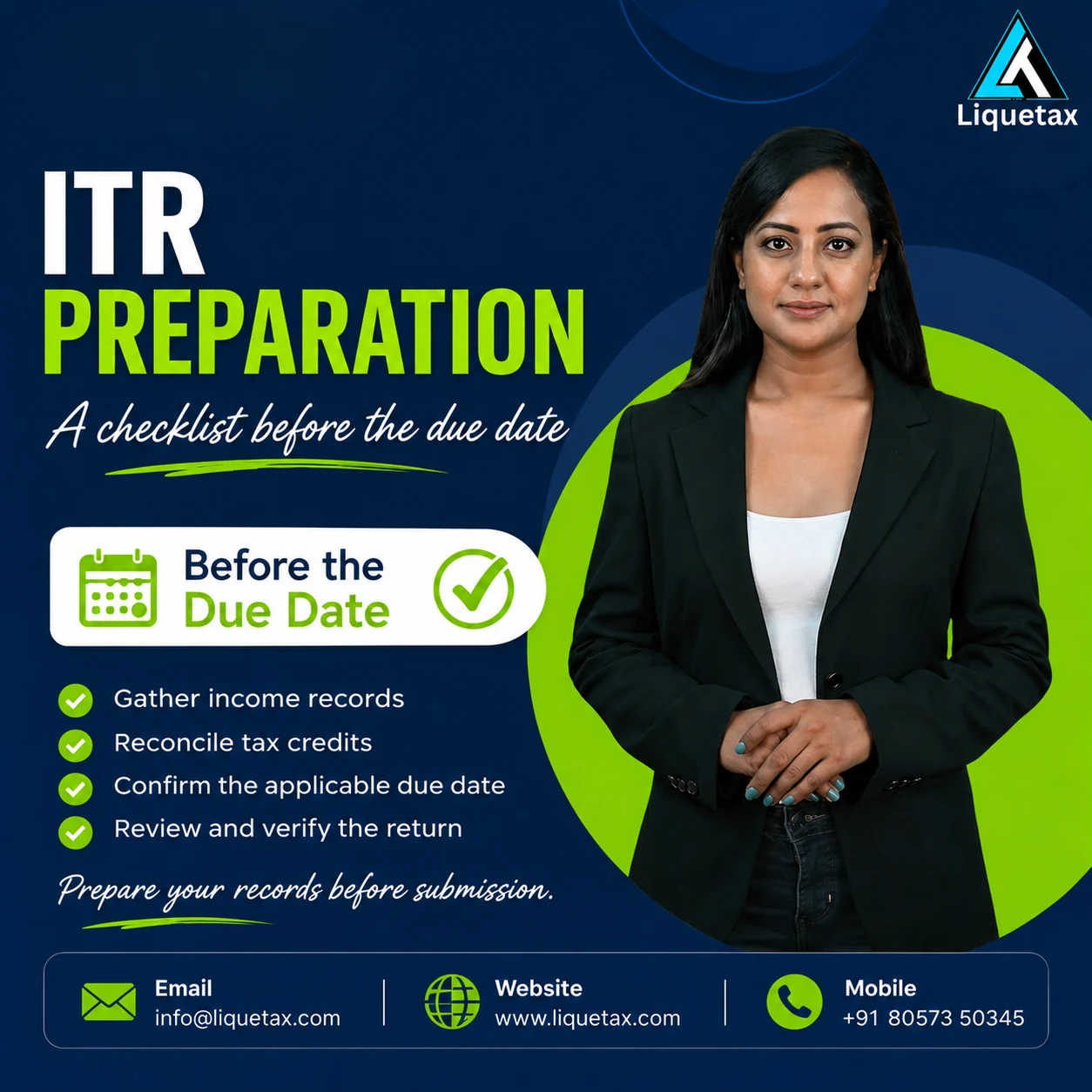
- Record the exact return category, due date and any supporting circular.
- List all income sources and request missing records with a target date.
- Reconcile Form 26AS, AIS, certificates and tax-payment challans.
- Approve the final form, regime choice and computation from evidence.
- Complete payment, submission and verification and keep the final record.
Worked example
Illustration: a taxpayer schedules filing a week before the deadline but discovers that a former employer has not corrected a TDS entry. Because the discrepancy was listed early, the taxpayer already has a written follow-up and can assess the appropriate reporting and next step. An early checklist does not guarantee that the deductor will act in time, but it prevents the issue from first appearing at the submission screen.
Frequently asked questions
Should everyone plan around 31 July?
No. Confirm your statutory taxpayer category and any applicable extension for the specific assessment year.
Can I submit before checking the computation?
You should review material figures and declarations first. Submission makes a formal statement about those facts.
Does timely filing remove all interest?
Not necessarily. Advance-tax interest can arise separately from late-return interest.
What if a document is missing near the deadline?
Investigate promptly and assess the legally supported position. Do not guess income or credits or assume an extension.
What should I keep after filing?
Retain the final return, computation, challans, acknowledgement, verification record and evidence for material claims.
Official references
- Income Tax Department: current return obligations and deadlines
- Income Tax Department: current circulars and extensions
- Income Tax Department: e-verification manual
- Income Tax Department: current return forms and utilities
For help reviewing your documents and the correct next step, contact LIQUETAX. The scope and any professional fee should be agreed in writing after the facts are checked. This article provides general information; individual eligibility depends on the applicable law and records.