
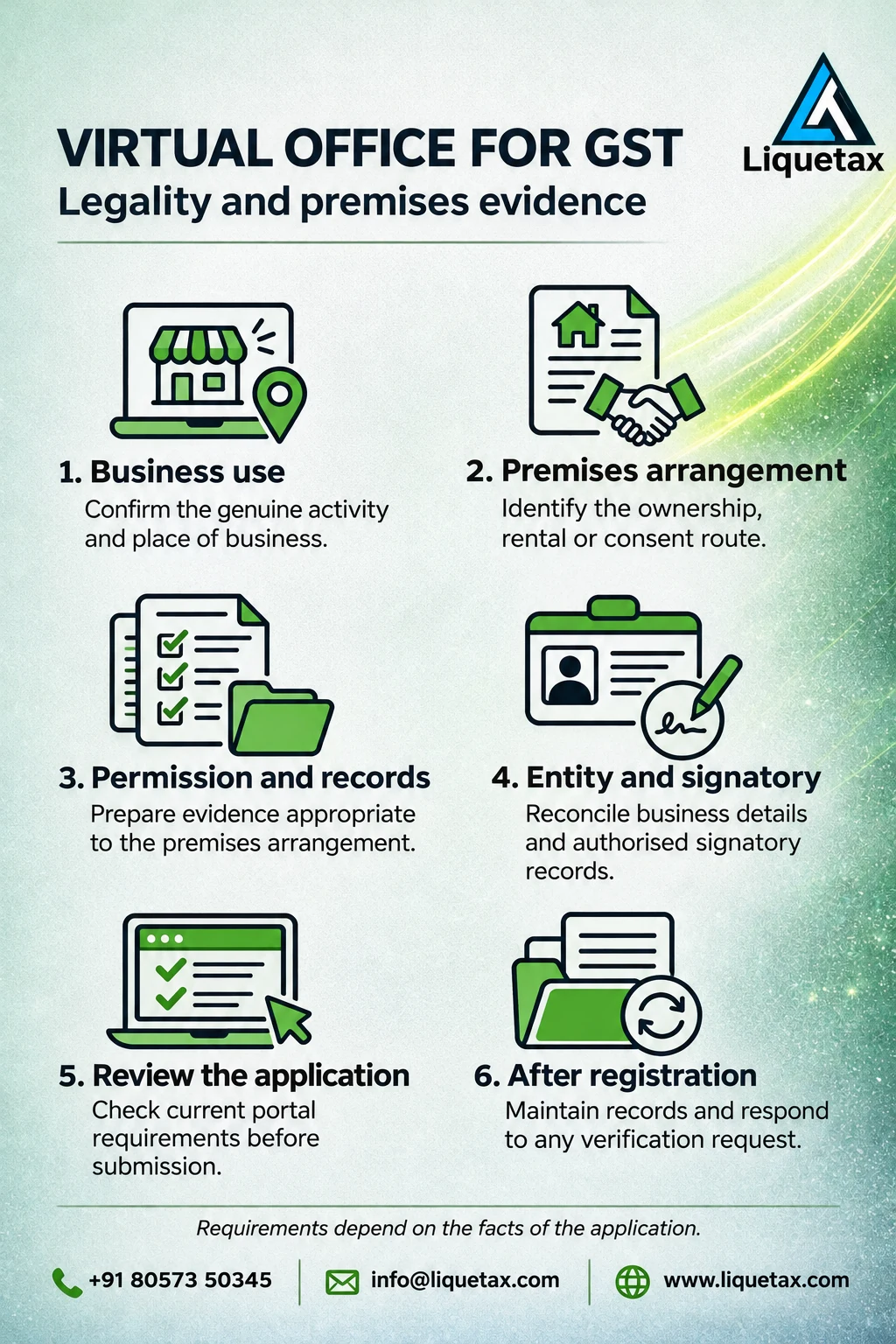
- Can a virtual office qualify for GST registration?
- Check whether this is the right GST place of business
- Use the evidence route matching the occupancy
- Prepare an application that can be verified
Can a virtual office qualify for GST registration?
A genuine shared premises can be considered for GST registration when the applicant's business facts, right to use it and supporting evidence meet the applicable requirements. The phrase virtual office is a commercial label, not a separate GST approval category. Buying a package does not guarantee acceptance, and a paper-only address cannot substitute for an actual place of business.
CBIC's Instruction 03/2025-GST expressly addresses shared premises and different ownership, rental and consent arrangements. It supports assessing the real arrangement rather than assuming that every shared office is prohibited or every virtual-office product is approved. Start with the business activity and the evidence for the particular premises.
Check whether this is the right GST place of business
First assess whether registration is required or a voluntary application is appropriate, and in which state. The declared principal and additional places must reflect the business facts. A company's registered-office address, a mailing service and a GST place of business answer different questions; acceptance by MCA or a bank does not determine GST eligibility.
Before paying a provider, establish who owns or lawfully controls the premises, what use the agreement permits and what access is available. Identify where goods are stored, work is carried out and relevant records are maintained. Do not select a distant address merely to obtain a GSTIN while concealing the actual operating arrangement.
Use the evidence route matching the occupancy
The following distinctions come from Instruction 03/2025-GST. They replace a universal demand for a registered lease, NOC and several ownership documents together.
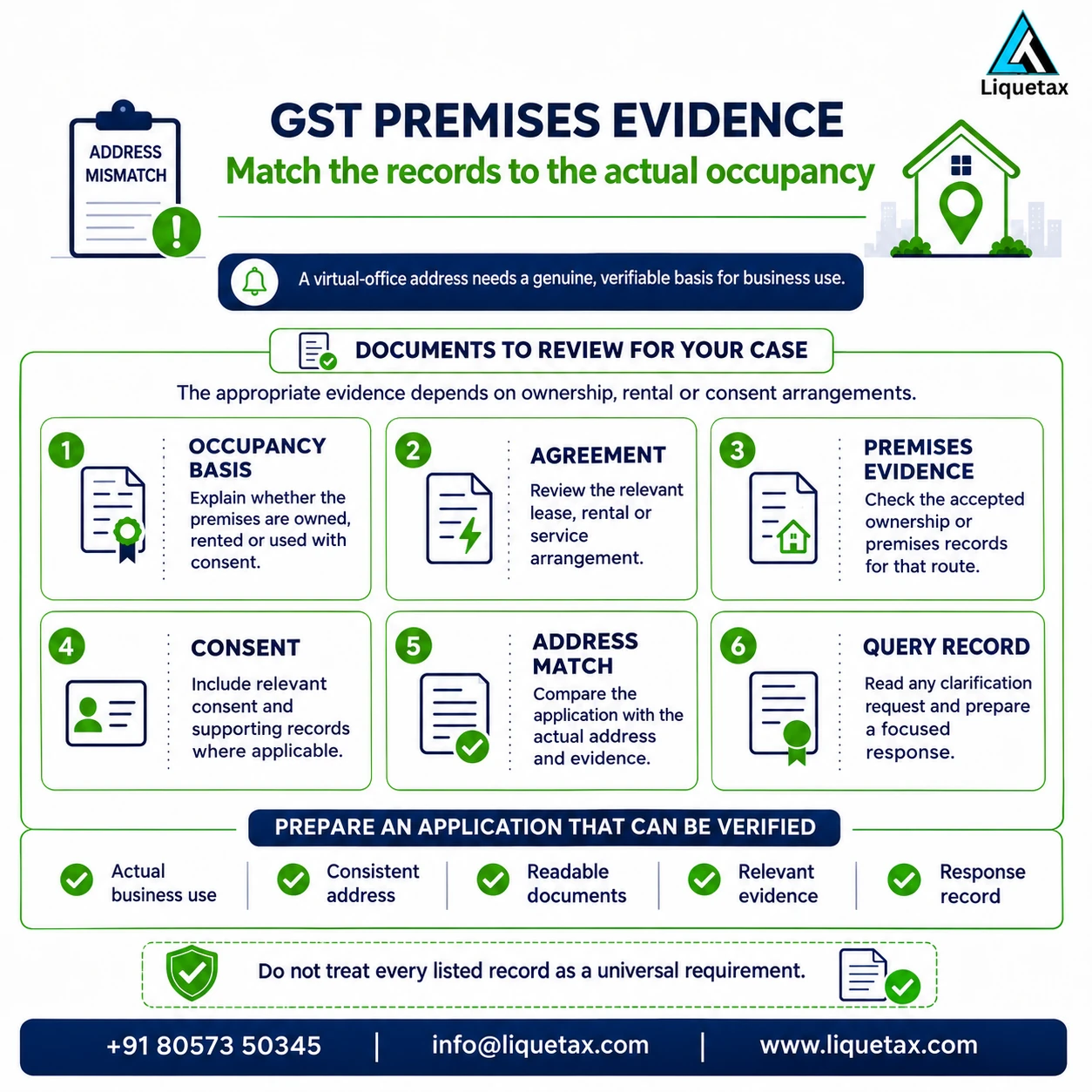
| Arrangement | Premises evidence |
|---|---|
| Owned | One suitable ownership document, such as the latest property-tax receipt, municipal khata or electricity bill. A qualifying comparable ownership record can also be used. |
| Rented, including shared premises with a lease | The valid agreement and one appropriate lessor-ownership document. An unregistered agreement additionally calls for lessor identity evidence; a registered agreement does not require that extra identity proof under the instruction. |
| Consent arrangement, including relevant shared premises without a lease | A plain-paper consent letter, the consenter's identity proof and one appropriate document supporting the consenter's ownership. |
| Genuinely rented premises without an agreement | The instruction provides a separate affidavit-and-possession-evidence route, with specified execution requirements. It is not permission to invent an occupancy arrangement. |
Other specific circumstances, including a utility connection in the tenant's name or SEZ premises, have their own treatment. Read the relevant paragraph before submitting.
Prepare an application that can be verified
Match the full address, unit, applicant name and occupancy details across FORM GST REG-01 and its attachments. Use readable records and explain genuine discrepancies rather than editing official documents. A provider's consent is useful only if the provider has the relevant authority; establish the ownership or leasing chain.
Keep someone responsible for official correspondence and lawful verification. If a clarification is issued, respond to the actual missing or inconsistent information through the prescribed process and within the stated period. Officers should follow the prescribed evidence requirements rather than demand unrelated documents. Authentication, risk checks and verification can affect processing, so a seven-day client story is not a universal approval promise.
Separate bank details, service charges and late registration
The normal taxpayer workflow allows bank details to be added after GSTIN grant through a non-core amendment. For persons covered by Rule 10A, supply them within 30 days of registration or before furnishing GSTR-1/IFF outward-supply details, whichever is earlier. Check the applicable exceptions and current portal instructions. A bank statement is not a universal substitute for premises evidence.
The government registration application has no filing fee. A provider's address-service charge and any agreed professional assistance are separate commercial costs. There is no general ₹50-per-day late-registration fee: failure to register when legally liable falls under separate statutory provisions. Assess the actual default, tax and other consequences instead of borrowing a return-late-fee figure.
Before submitting: practical checklist
- Confirm the registration basis, relevant state and genuine principal or additional place of business.
- Choose the owned, rented, consent or other applicable evidence route.
- Verify the provider's authority, complete address and permitted use.
- Arrange access, correspondence handling and a responsible person for queries.
- Keep submitted records and acknowledgements, then complete bank and other post-registration obligations.
Illustrative example
A remote consultant considers shared premises under an unregistered lease. The consultant checks the lessor's authority, obtains the agreement, relevant ownership and identity evidence, and confirms the business facts before applying. Another applicant using a relative's premises by consent follows the consent route instead. The examples explain different evidence categories; neither arrangement guarantees approval.
Frequently asked questions
Is every virtual office legal for GST registration?
No package receives automatic approval from its name. Assess the actual premises, business use, lawful permission and prescribed evidence for the application.
Must every applicant submit a registered lease and NOC?
No. Owned, rented, consent and shared arrangements have different evidence routes. Apply the relevant official instructions to the genuine occupancy facts.
Can more than one business use shared premises?
The instructions recognise shared premises. Each applicant still needs accurate business facts and appropriate supporting evidence; sharing alone proves neither eligibility nor ineligibility.
Will the premises always be physically inspected?
Do not assume either universal inspection or universal exemption. The applicable authentication, risk and verification process governs the case, and the premises must be genuine.
Does GST approval remove further address duties?
No. Maintain accurate registration details and handle notices. Review amendments when premises or business facts change, and retain the supporting records.
Official references and next step
- CBIC: Instruction 03/2025-GST, premises evidence and application scrutiny
- GST portal: normal taxpayer registration guide
- CBIC: Rule 10A, bank account details after registration
- GST portal: non-core amendments and bank details
- CBIC: CGST Act penalty provisions
- GST Council: registration application fee
For help assessing your occupancy documents and application, contact LIQUETAX with the business activity, state and proposed premises arrangement. Request a written scope before engaging filing support.