
Tax & Compliance Experts | Since 2008
Call: +91 80573 50345 | Email: info@liquetax.com
NGO Registration in India 2026: Complete Step-by-Step Guide
Learn the complete process of NGO registration in India 2026. Understand eligibility, documents, fees, and how Liquetax simplifies your registration.
About Liquetax
12+ years of expertise in tax planning & compliance. We help you register your NGO smoothly.
⚖️ Legal Structure
Choose between Trust, Society, or Section 8 Company for your NGO.
📄 Document Checklist
MOA, AOA, PAN, address proof, and ID proofs are key documents.
📋 Step-by-Step Process
From name approval to registration certificate – complete guide.
💰 Government Fees
Fee varies by structure: Trust (₹1,000+), Society (₹500+), Section 8 (₹3,000+).
🎬 Watch: NGO Registration in India 2026 – Complete Guide
Introduction: NGO Registration in India 2026
Registering an NGO (Non-Governmental Organization) in India is a structured process that gives your organization legal status to work for social, cultural, or charitable causes. In 2026, the process remains streamlined with clear guidelines. This guide covers everything you need to know about NGO registration – from choosing the right structure to completing the application.
What is NGO Registration?
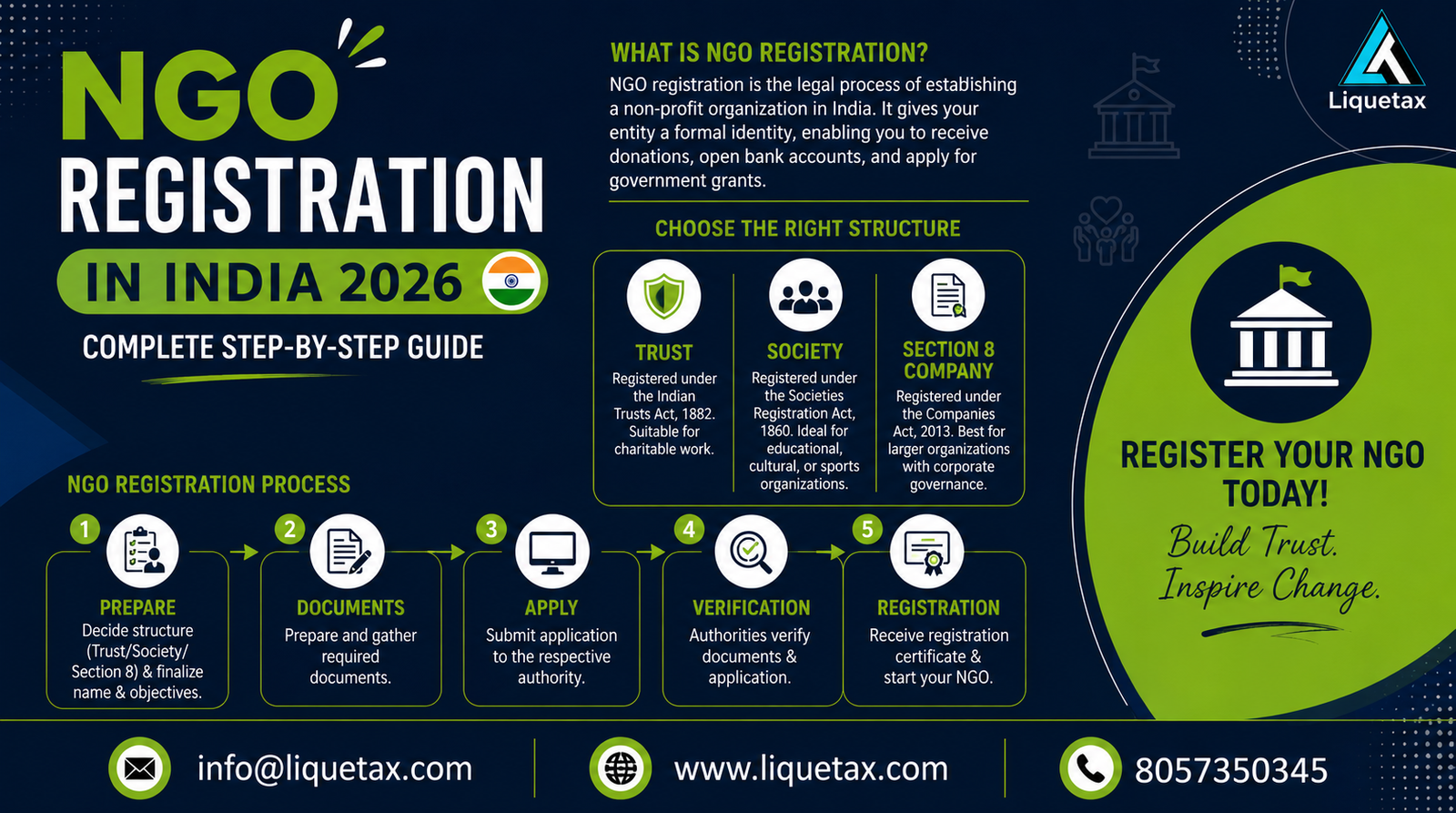
NGO registration is the legal process of establishing a non-profit organization in India. It gives your entity a formal identity, enabling it to receive donations, open bank accounts, and apply for government grants. The three main legal structures are:
- Trust: Registered under the Indian Trusts Act, 1882. Suitable for charitable work.
- Society: Registered under the Societies Registration Act, 1860. Ideal for educational, cultural, or sports organizations.
- Section 8 Company: Registered under the Companies Act, 2013. Best for larger organizations with corporate governance.
Why is NGO Registration Important for Social Organizations in India?
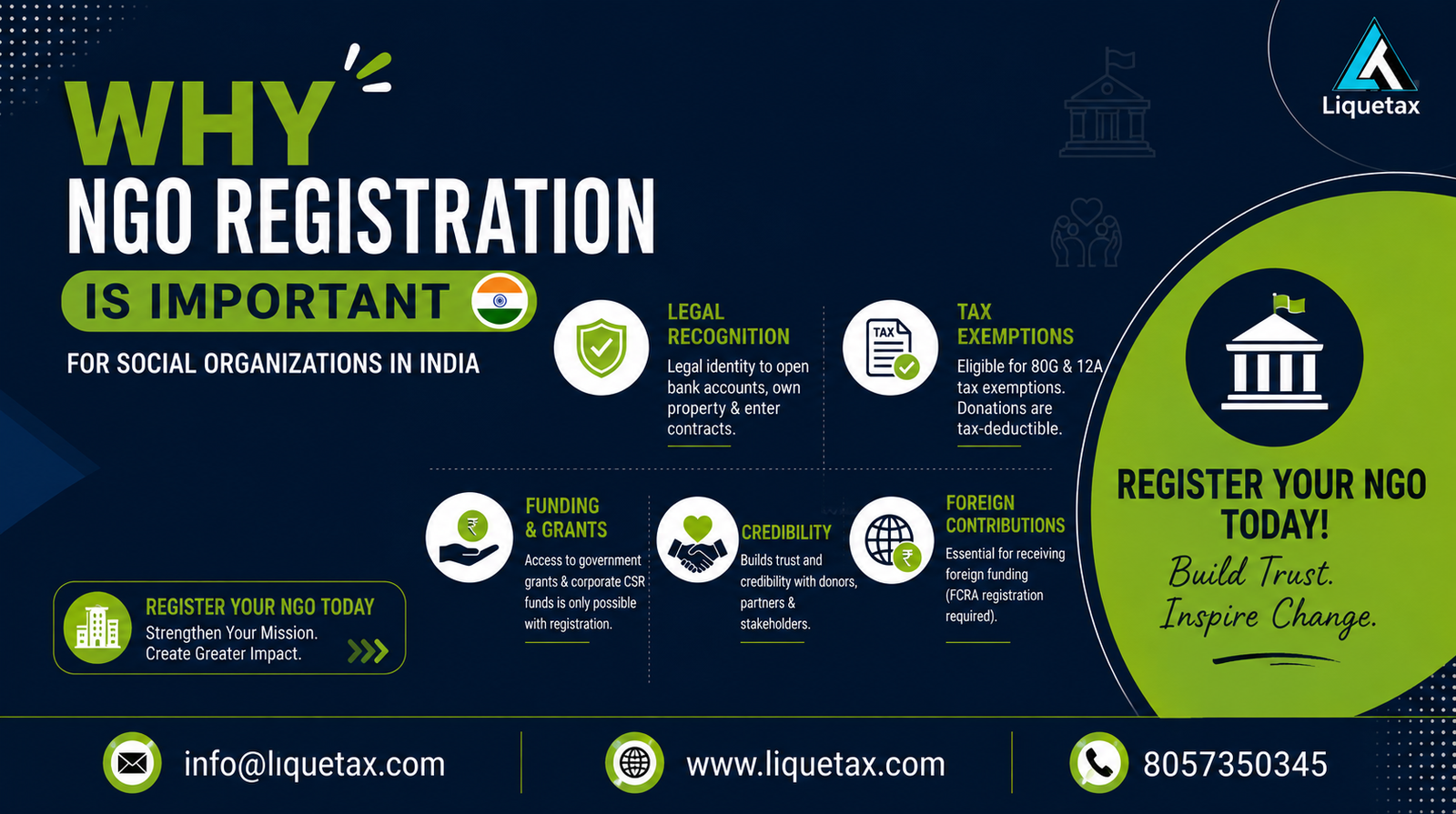
- Legal Recognition: Registered NGOs have a legal identity and can open bank accounts, own property, and enter contracts.
- Tax Exemptions: Registered NGOs can apply for 80G and 12A tax exemptions, making donations tax-deductible.
- Funding & Grants: Government and corporate CSR funds are only available to registered NGOs.
- Credibility: A registered NGO is more credible and trustworthy to donors and stakeholders.
- Foreign Contributions: Registration is a prerequisite for receiving foreign funding (FCRA).
Eligibility & Requirements for NGO Registration
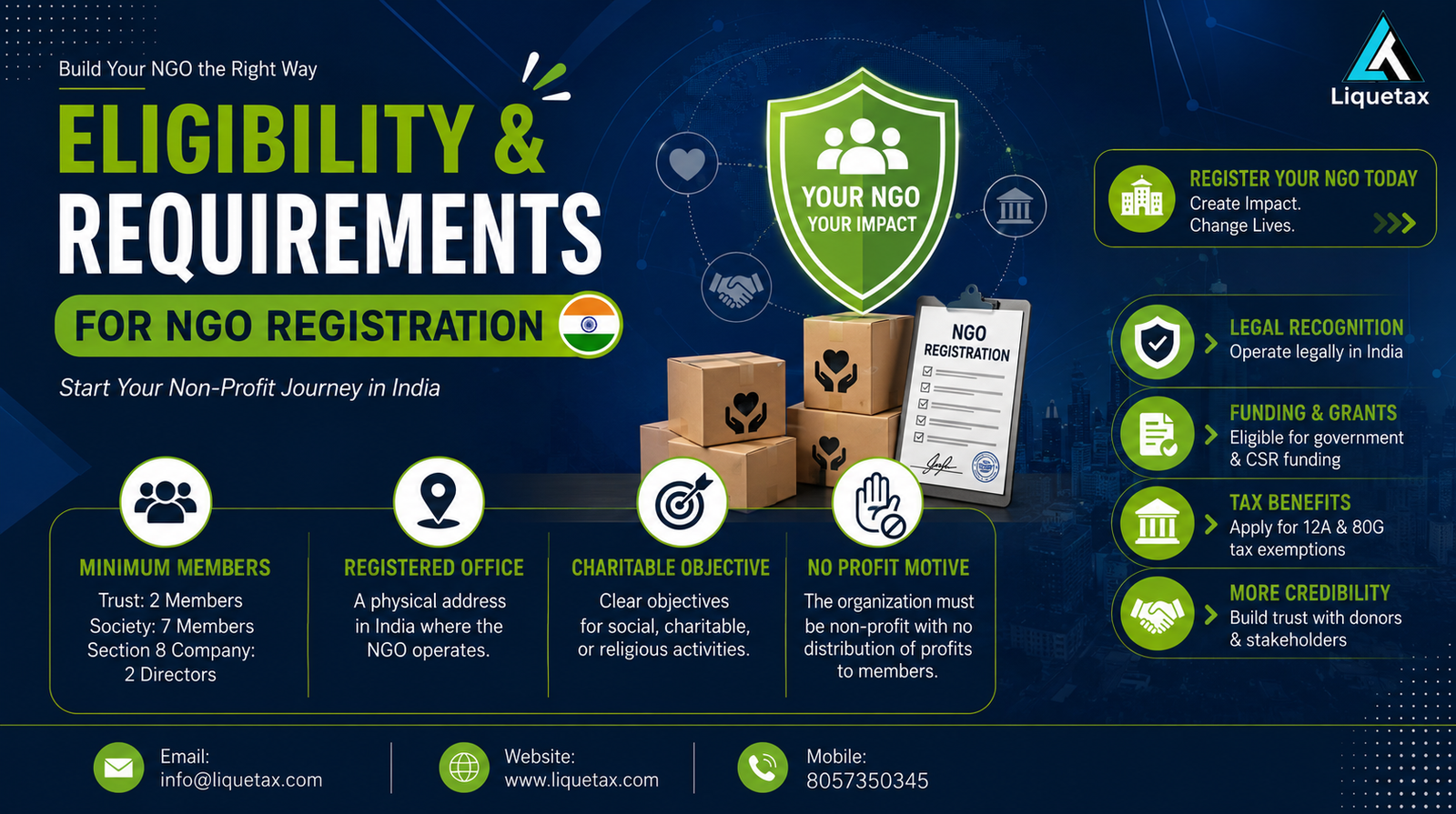
- Minimum Members: At least 2 members for a Trust, 7 for a Society, and 2 directors for a Section 8 Company.
- Registered Office: A physical address in India where the NGO operates.
- Charitable Objective: Clear objectives for social, charitable, or religious activities.
- No Profit Motive: The organization must be non-profit with no distribution of profits to members.
Step-by-Step Process to Register an NGO in India 2026
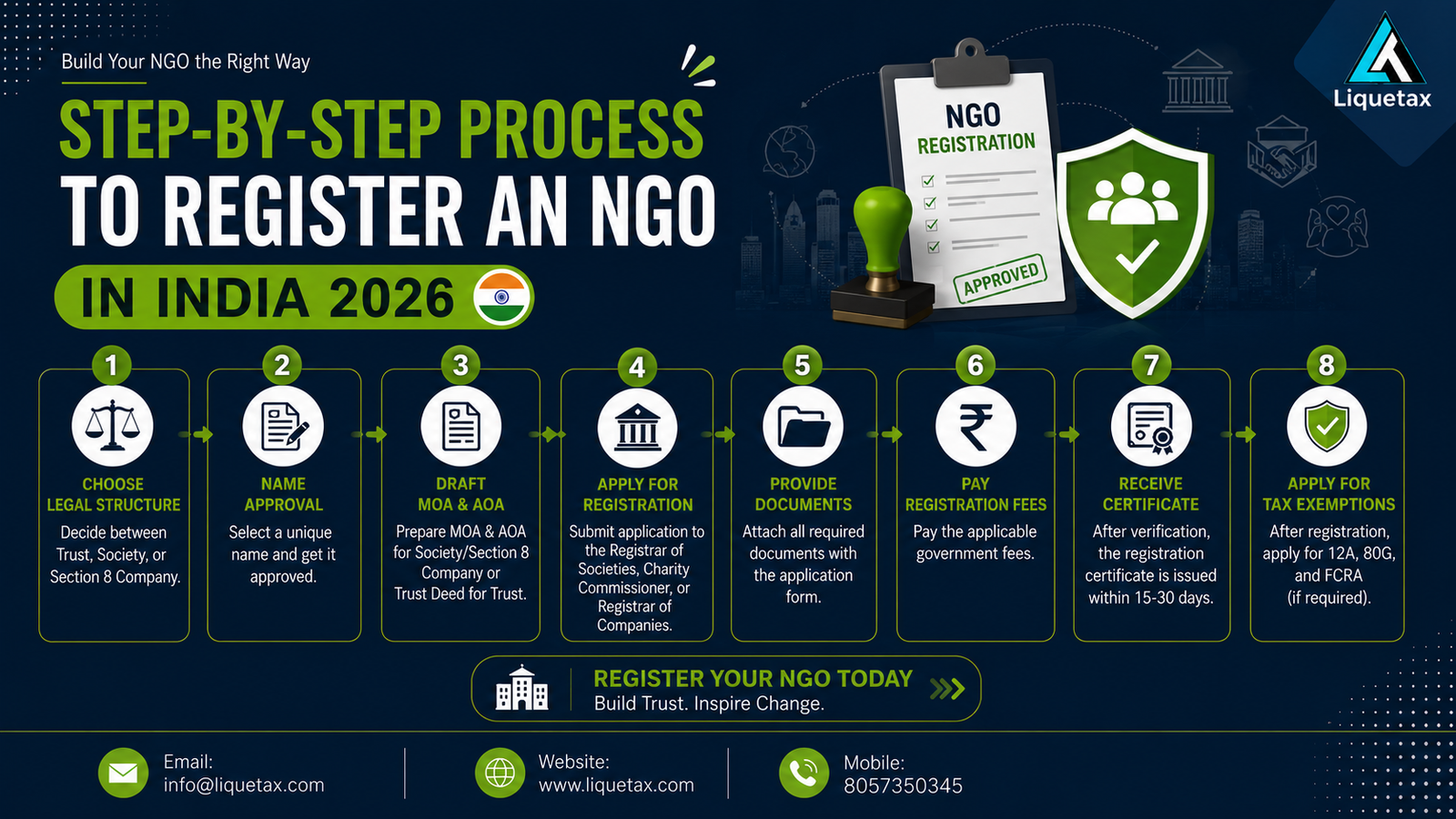
- Choose a Legal Structure: Decide between Trust, Society, or Section 8 Company.
- Name Approval: Select a unique name and get it approved from the concerned authority.
- Draft MOA & AOA: Prepare the Memorandum of Association (MOA) and Articles of Association (AOA) for Society or Section 8 Company. For Trust, prepare the Trust Deed.
- Apply for Registration: Submit the application to the Registrar of Societies (for Society), the Charity Commissioner (for Trust), or the Registrar of Companies (for Section 8 Company).
- Provide Documents: Attach all required documents along with the application form.
- Pay Registration Fees: Pay the applicable government fees.
- Receive Certificate: After verification, the registration certificate is issued within 15-30 days.
- Apply for Tax Exemptions: After registration, apply for 12A, 80G, and FCRA (if required).
Documents Required for NGO Registration 2026
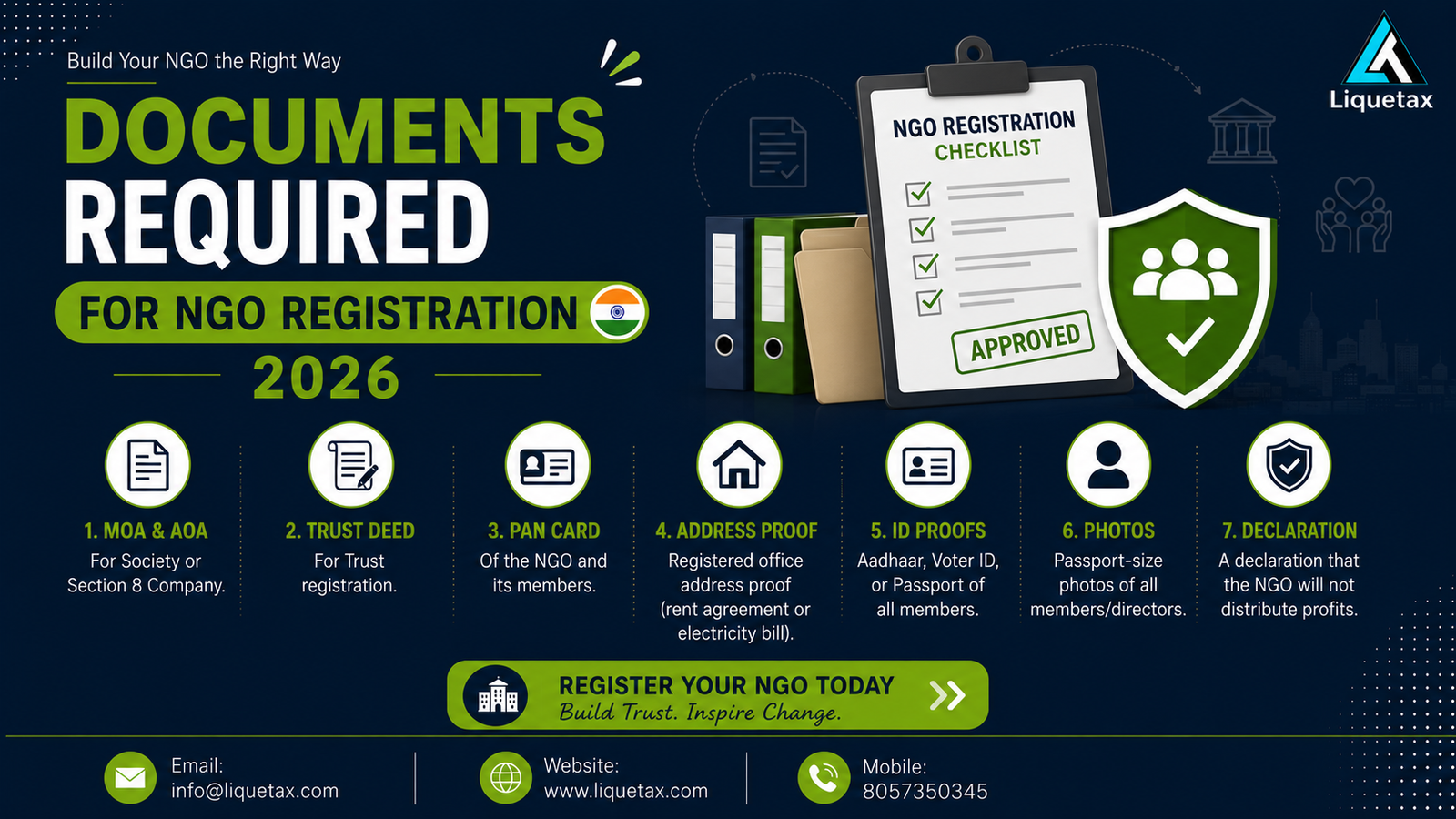
- MOA & AOA: For Society or Section 8 Company.
- Trust Deed: For Trust registration.
- PAN Card: Of the NGO and its members.
- Address Proof: Registered office address proof (rent agreement or electricity bill).
- ID Proofs: Aadhaar, Voter ID, or Passport of all members.
- Passport-size Photos: Of all members/directors.
- Declaration: A declaration that the NGO will not distribute profits.
Government Fees for NGO Registration in India 2026
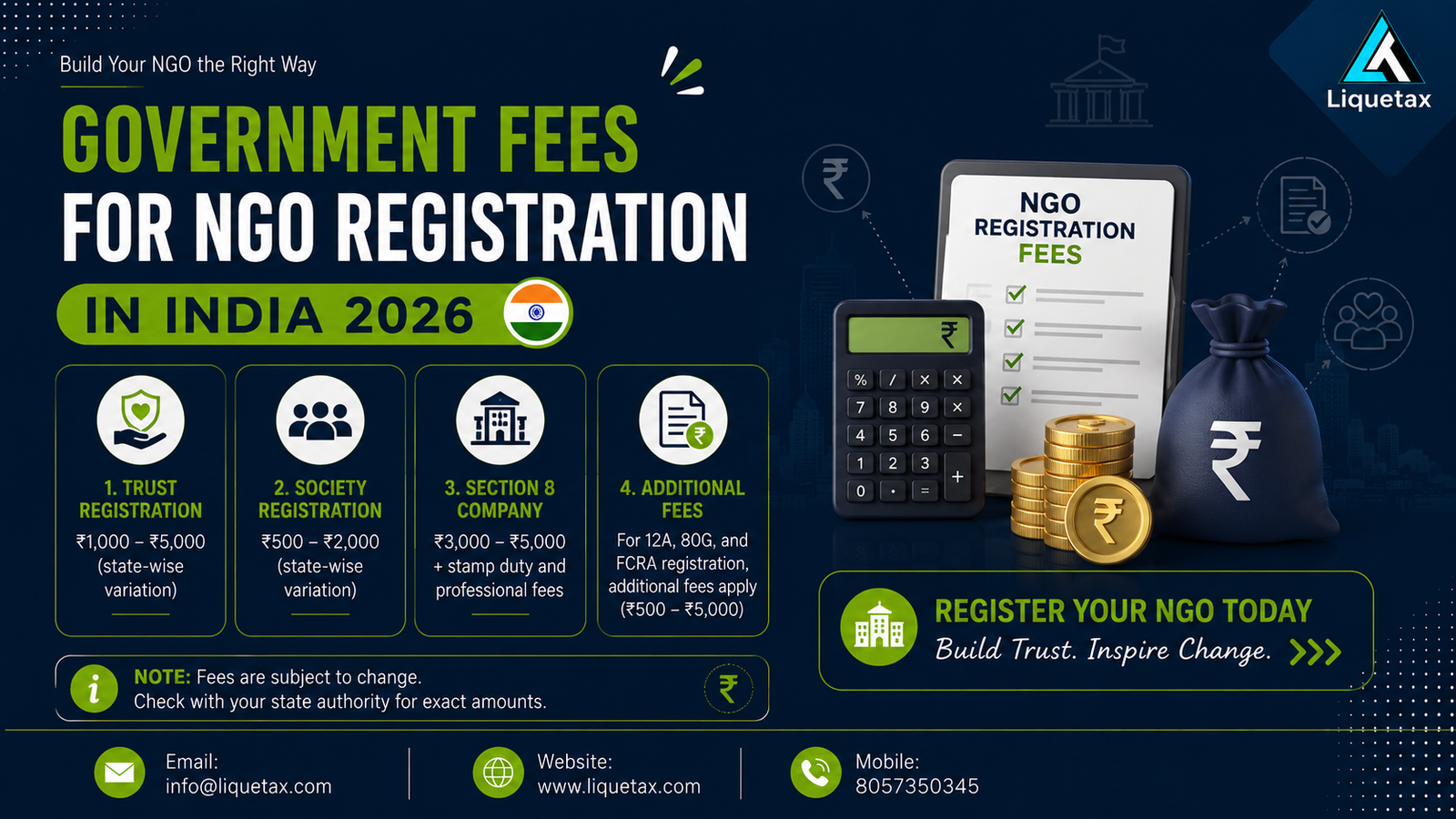
The registration fee varies depending on the structure chosen:
- Trust Registration: ₹1,000 – ₹5,000 (state-wise variation).
- Society Registration: ₹500 – ₹2,000 (state-wise variation).
- Section 8 Company: ₹3,000 – ₹5,000 + stamp duty and professional fees.
- Additional Fees: For 12A, 80G, and FCRA registration, additional fees apply (₹500 – ₹5,000).
How Liquetax Can Help You Register Your NGO
- Structure Selection: We help you choose the right legal structure for your NGO.
- Document Drafting: We draft the MOA, AOA, or Trust Deed as per your objectives.
- Application Filing: We file the application with the relevant authority on your behalf.
- Follow-up: We track the status and follow up with the authorities for faster processing.
- Tax Exemption: We help you apply for 12A, 80G, and FCRA after registration.
- End-to-End Support: From name approval to certificate delivery – we handle it all.
Choose Liquetax for a hassle-free NGO registration experience.
Client Success Story: NGO Registration Made Easy
With Liquetax, you can register your NGO quickly and start working towards your social mission.
FAQs on NGO Registration in India 2026
It depends on your goals. Trust is simple, Society is democratic, and Section 8 Company offers professional governance. Choose based on scale and needs.
Typically 15-30 days, depending on the authority and completeness of documents. Liquetax can help expedite the process.
Yes, most states allow online registration. For Section 8 Company, the process is entirely online via the MCA portal.
Liquetax provides end-to-end assistance – from choosing the structure, drafting documents, filing applications, and obtaining tax exemptions.
Register Your NGO Smoothly – Start Your Social Mission Today!
Don't let complex paperwork delay your NGO. Let Liquetax handle your registration accurately and on time.