
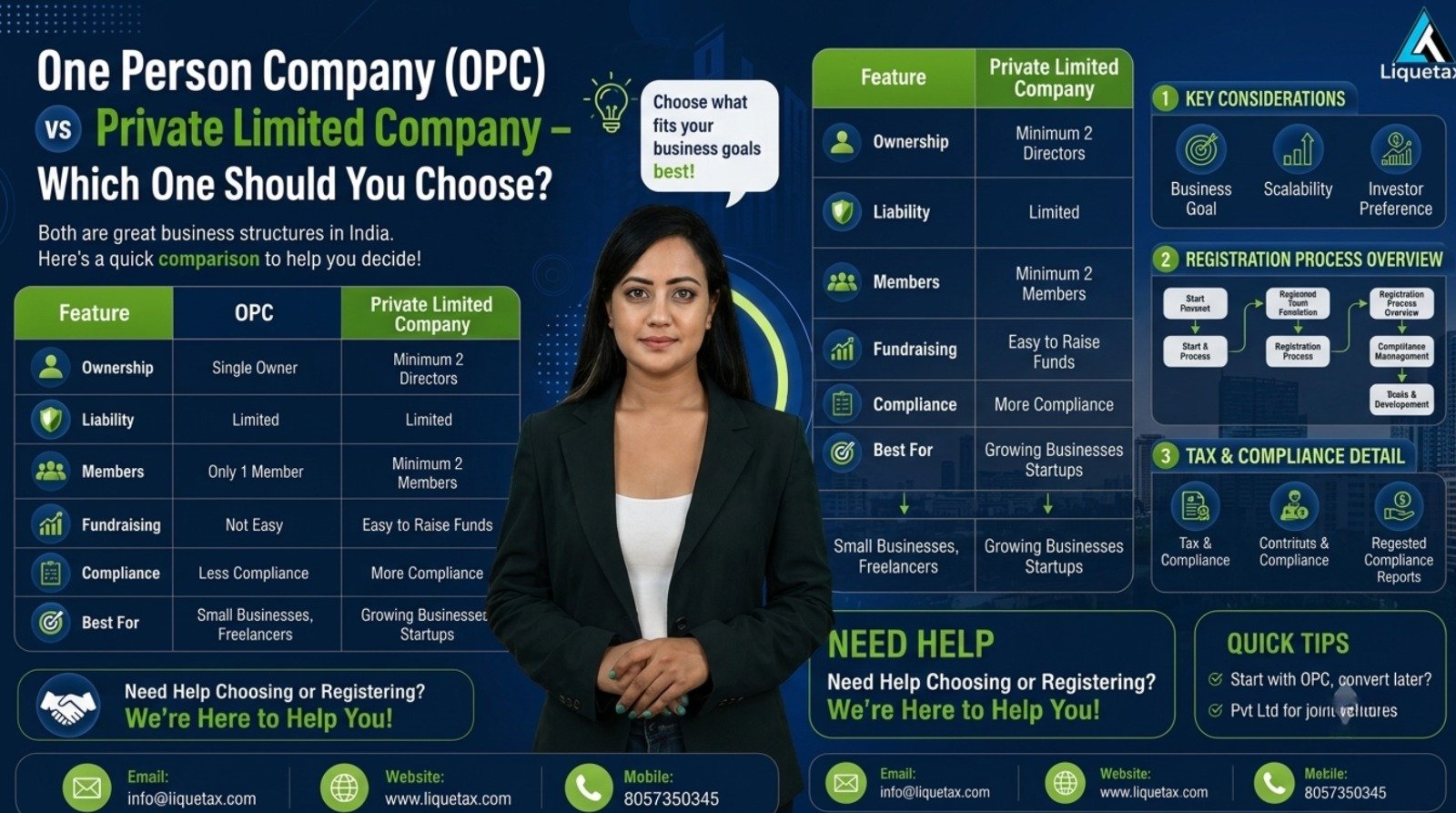
👤 One Person Company
Single owner, limited liability, separate legal entity. Best for solo entrepreneurs.
🏢 Private Limited Company
Minimum 2 members, limited liability, better for startups and funding.
⚖️ Liability Protection
Both offer limited liability, but Pvt Ltd has more credibility for investors.
📈 Growth & Funding
Pvt Ltd can raise equity, OPC has restrictions. Choose based on your growth plans.
🎬 Watch: OPC vs Private Limited Company – Which is Better?
 ▶ Tap to play
Introduction: OPC vs Private Limited Company – Choose the Right Structure
Starting a business in India? Choosing between One Person Company (OPC) and Private Limited Company (Pvt Ltd) is a critical decision. Both offer limited liability, but they differ in ownership, compliance, and growth potential. This guide explains everything you need to know to make the right choice.
What is One Person Company (OPC) & Private Limited Company?
One Person Company (OPC): A company with only one member (owner). It provides limited liability and separate legal identity, making it perfect for single entrepreneurs who want the benefits of a company without a partner.
Private Limited Company (Pvt Ltd): A company with at least 2 members and maximum 200 members. It is the most popular structure for startups and growing businesses, offering credibility, easy fundraising, and better employee incentives.
- OPC: Single member, no partner required.
- Pvt Ltd: Minimum 2 members, maximum 200.
- Both: Limited liability, separate legal entity, perpetual succession.
Why Choosing the Right Structure Matters for Your Business
- Liability protection: Both limit personal liability, but Pvt Ltd is more recognized by investors.
- Funding options: Pvt Ltd can issue equity shares and raise venture capital; OPC has restrictions.
- Compliance burden: OPC has lighter compliance; Pvt Ltd has stricter annual filings.
- Business credibility: Pvt Ltd is often preferred for larger contracts and partnerships.
- Exit & succession: Easier to transfer shares in Pvt Ltd; OPC has limitations.
Eligibility & Requirements for OPC and Private Limited Company
- OPC: Only one member (natural person, Indian resident). Minimum 1 director.
- Private Limited: Minimum 2 members (individuals or companies), 2 directors.
- Common: All directors must have DIN and DSC. Company name approval, registered office, and MOA/AOA.
- Capital: No minimum capital requirement for either (as per Companies Act 2013).
Step-by-Step Process to Register OPC or Private Limited Company
- Obtain DSC & DIN: Digital Signature Certificate and Director Identification Number for all directors.
- Name approval: Apply for company name through RUN or SPICe+ form.
- File incorporation forms: SPICe+ (INC-32) for company registration with MOA & AOA.
- PAN & TAN: Apply for Permanent Account Number and Tax Deduction Account Number.
- Bank account: Open a current account in the company's name.
- GST registration: Apply for GST if applicable.
Documents Required for Company Registration
- PAN card & Aadhaar of all directors and members.
- Passport-size photographs of directors.
- Address proof (Voter ID, Driving Licence, Passport).
- Registered office proof: Rent agreement or ownership document, electricity bill, NOC from owner.
- DSC & DIN of all directors.
- MOA & AOA (drafted as per company objectives).
Government Fees for OPC and Private Limited Company Registration
- ROC filing fees: Based on authorised capital. Approx ₹5,000 – ₹15,000.
- Stamp duty: Varies by state, approx ₹500 – ₹2,000.
- Professional fees: Liquetax charges competitive fees for end-to-end registration.
- GST registration: Additional fee if applicable.
How Liquetax Can Help You Choose and Register the Right Structure
- Expert consultation: We analyze your business needs and recommend OPC or Pvt Ltd.
- Document preparation: We draft MOA, AOA, and all forms accurately.
- Name approval: We ensure your company name is approved quickly.
- End-to-end filing: We file all forms with ROC and get your incorporation certificate.
- Post-registration support: Help with PAN, TAN, GST, and bank account opening.
- Compliance guidance: We guide you on annual filings and director meetings.
Choose Liquetax for a smooth, hassle-free company registration experience.
FAQs on OPC vs Private Limited Company
OPC has only one member, while Pvt Ltd requires at least 2 members. Pvt Ltd can raise equity funding, whereas OPC has restrictions.
OPC is ideal for single founders who want limited liability and separate legal identity. Pvt Ltd is better if you plan to add partners or raise funding later.
Yes, OPC can be converted to Pvt Ltd voluntarily or mandatorily if paid-up capital exceeds ₹50 lakh or turnover exceeds ₹2 crore.
With Liquetax, company registration takes 7–15 days, depending on name availability and document readiness.
Ready to Register Your Company? Let's Get Started!
Get expert advice on choosing between OPC and Private Limited Company. Fast, reliable, and affordable registration with Liquetax.