
- 1. Check the facts
Start with the actual entity and proposed activity.
- 2. Prepare evidence
Use genuine, consistent supporting records.
- 3. Review the application
Resolve missing facts before authorising submission.
- 4. Keep the outcome
Retain the filed version and follow-up responsibilities.
Recognition begins with the actual business
DPIIT recognition is a separate step from creating a legal entity. The application should describe the enterprise that exists, its history and what it does. A company-versus-LLP comparison may help at formation, but it cannot replace recognition preparation.
Start a file containing the entity’s registration details, incorporation date, activity and ownership information. Identify any earlier business involved in the proposed enterprise. If the history is unclear, resolve it before choosing an answer in the application.
Check the current recognition route
Startup India’s official recognition page now refers applicants to G.S.R. 108(E). Eligibility involves the entity form, age, financial history and nature of the business; the Deep Tech category has additional distinctions. Do not assume that an older eligibility headline is the complete current test.
Read the applicable definition and application questions alongside your records. Prepare an eligibility note stating which facts are supported and which need clarification. Ask for advice where a restructuring or unusual entity history affects the assessment. A website describing a business as innovative does not itself establish eligibility.
Explain the problem and your genuine contribution
A reviewer should be able to understand the customer problem, what you offer and how the proposed solution differs or improves on existing practice. Broad claims such as revolutionary technology do not explain the business.
Write a short, specific description using language a reader outside your team can understand. Describe the actual stage: concept, development, pilot or trading, as appropriate. Keep claims consistent with product material and other evidence. Do not invent customers, patents, revenue, testing or partnerships to make the application look more mature.
Build an evidence pack around the statements
Treat every material statement as a question about evidence. If the business says it has developed a product, identify the genuine material that explains it. If it describes a scalable model, explain how delivery and growth could work rather than simply repeating the word scalable.
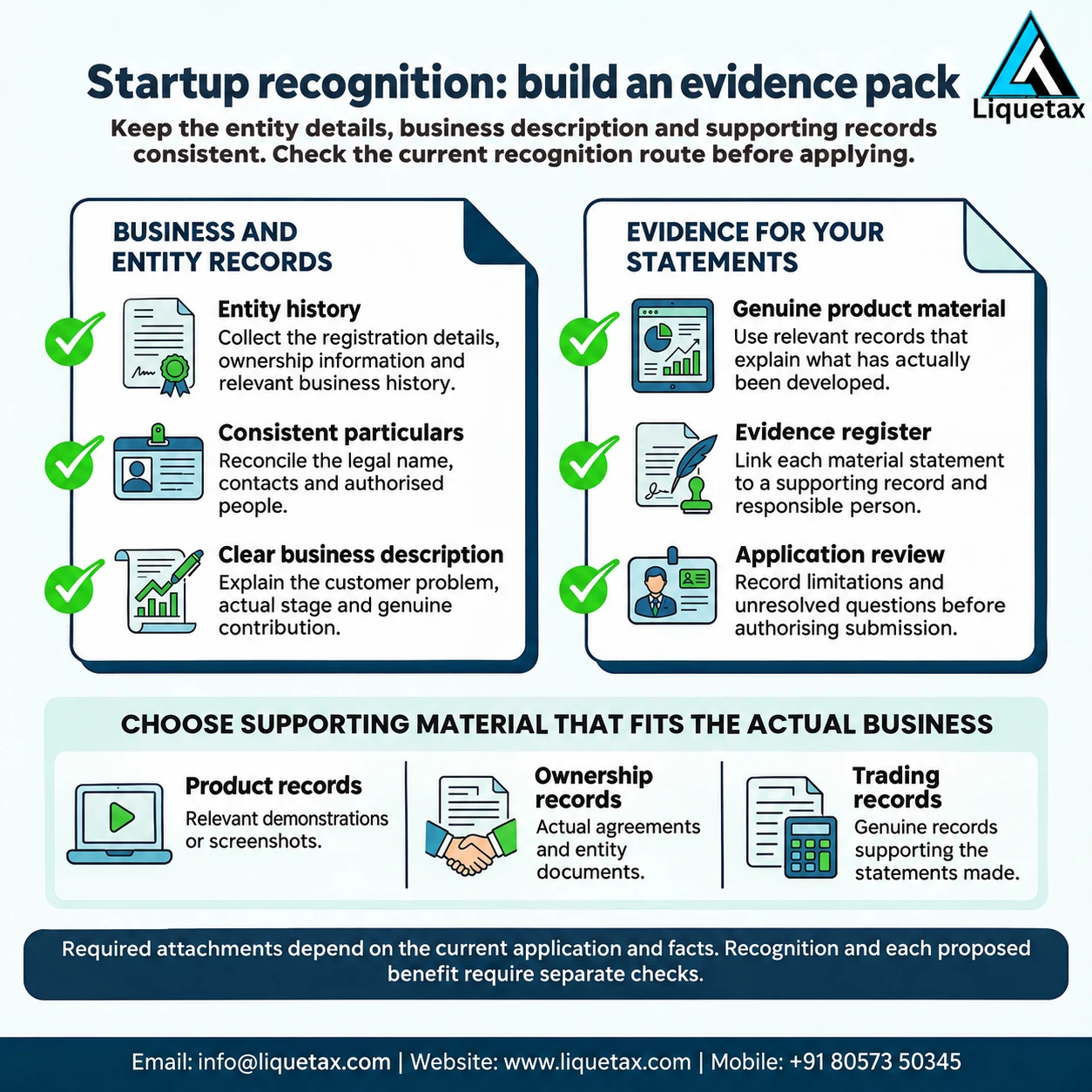
Keep an evidence register with the statement, supporting record, owner and any limitation. A small truthful pack is more useful than a large collection of unrelated brochures. Separate public product information from confidential technical or customer material and agree the appropriate sharing method before sending records to an adviser.
Use the official application route and your own account
The recognition page directs applicants to the National Single Window System and the startup-registration application. It states that the startup should apply using its own details and that DPIIT has not appointed recognition agents or franchises. Recognition itself carries no ministry fee.
Keep the official account, contact details and submission under the startup’s control. A private adviser’s preparation charges should be clearly identified as professional fees. Do not confuse paid assistance with a government charge or privileged access. Read the current portal steps when applying because screen labels and document prompts can change.
Review the whole submission before authorising it
Review the entity particulars, business description and attachments together. A polished narrative is not enough if it contradicts the registration record or evidence supplied elsewhere. Ask the people responsible for the underlying facts to check them.
Maintain one approved version and record any unanswered question. Where an application requests clarification, respond to that point with the relevant evidence. Keep the reference and submitted response together so that a later reviewer can understand what changed and why.
Separate recognition from each proposed benefit
Recognition should not be sold as automatic tax relief, a loan sanction, seed funding or a government order. Each proposed benefit has its own conditions and decision process. Incorporation, sector permissions and routine compliance also remain separate questions.
Prepare a benefit-by-benefit plan showing the official scheme, applicable conditions, evidence needed and responsible person. Assess the commercial usefulness before paying for further assistance. An adviser should explain the work they can perform without guaranteeing the authority’s or lender’s decision.
Keep the outcome useful after the application
Retain the submitted version, correspondence and outcome with the entity’s records. If recognition is granted, check the certificate particulars and any continuing conditions or update requirements. If it is not granted, read the stated reasons before deciding the next lawful step.
For a useful first consultation, bring the entity history, current business description, evidence list and the particular benefit you want to explore. Ask for the eligibility questions, preparation scope, exclusions and handover in writing. This makes the discussion about an accurate application rather than supposed approval secrets.
Frequently asked questions
Is DPIIT recognition the same as incorporation?
No. Recognition and entity formation serve different purposes and require separate checks.
Can a private adviser guarantee recognition?
No. An adviser can assist with preparation; the authority decides the application.
Does DPIIT charge a recognition application fee?
The official recognition page states that the ministry does not charge for its recognition certificate. Private preparation fees are separate.
Should the adviser use their own email for my application?
The official instructions require the startup to use its own details and contacts. Keep control of the account.
Does recognition automatically approve funding or tax relief?
No. Review the current conditions and approval process for each particular benefit.
Agree the work before sharing confidential records
Ask LIQUETAX for the proposed deliverables, responsible person, exclusions and fee components in writing. Share sensitive documents only through the agreed channel. Keep passwords, OTPs and digital-signature credentials under the authorised person’s control. Preparation support does not guarantee an authority’s decision.
Related guides
Official references and review limits
Prepared on 9 October 2026 using official portal information and indexed official guidance. Some direct document retrievals were restricted. Check the current form instructions before filing. This is editorial preparation guidance; no named professional opinion or endorsement is recorded.