
- Choose the correct income period
- Separate the basic exemption from the rebate
- Identify the legal taxpayer
- Review additional mandatory-filing triggers
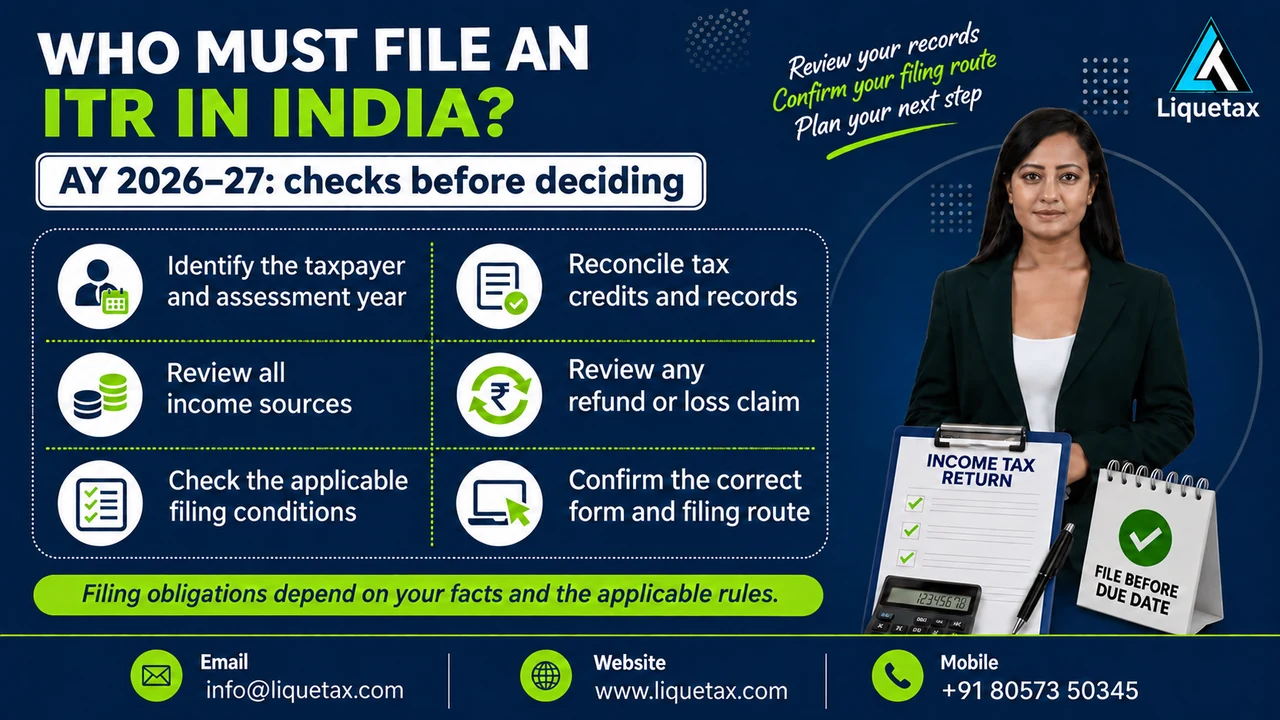
Having no tax to pay does not necessarily mean that no income-tax return is required. A rebate, TDS or advance tax can eliminate the balance payable while a filing obligation remains. Conversely, a voluntary return should contain accurate figures and a clear purpose. Start with taxpayer type and the relevant statutory filing conditions.
Choose the correct income period
For income earned from 1 April 2025 to 31 March 2026, select Assessment Year (AY) 2026-27 and apply the Income-tax Act, 1961. Income earned from 1 April 2026 belongs to Tax Year 2026-27 under the Income-tax Act, 2025. These are different periods. A return or notice about an earlier year does not move to the new Act merely because you handle it after April 2026.
Separate the basic exemption from the rebate
For AY 2026-27 the new-regime basic exemption is ₹4 lakh, while old-regime thresholds depend on age and residence where relevant. The rebate available to an eligible resident individual can reduce final tax at a higher income level; it does not replace the filing threshold. Statutory filing tests may use income before specified deductions or exemptions, so checking only the final taxable figure can be misleading.
Identify the legal taxpayer
Companies and firms, including LLPs, have filing obligations that are not simply an individual’s basic-exemption test. Other entities, trusts and institutions may be governed by specific return provisions. A sole proprietorship is normally reported by its owner, while a partnership or company has a separate identity. Avoid using the owner’s personal tax result to decide whether the entity must file its own return.
Review additional mandatory-filing triggers
Section 139 and associated rules include specified high-value transactions and other conditions that can require filing despite low income. These include particular deposits, expenditure and business, professional or tax-deduction circumstances. Check the exact thresholds, aggregation period and exceptions in the current rule rather than relying on an old headline. A bank credit is not automatically income, but some transactions can independently trigger filing.
Examine foreign assets and residential status
Certain resident taxpayers have filing duties linked to foreign assets, financial interests or signing authority, subject to statutory details. Residency is determined under tax rules and should not be inferred from citizenship alone. Foreign income, foreign tax relief and asset reporting may also require schedules that simplified returns cannot accommodate. If an overseas account exists, collect the facts before deciding that low Indian income removes the obligation.
Consider voluntary filing for a valid purpose
An otherwise eligible return can claim excess tax credit, preserve eligible losses when filed within the relevant conditions, or provide a documented income record. It does not guarantee finance, visas or approval by another institution. If there was no income, do not invent salary or business receipts just to create a financial history. Check whether the proposed return type and filing window permit the intended claim.
Practical checklist
- Identify the taxpayer type, relevant year and residential status.
- Compute income using the statutory filing test, not just the balance tax payable.
- Review the applicable regime and distinguish exemption from rebate.
- Check specified transactions, business facts and foreign-asset conditions.
- Choose the correct form and calendar if filing is required or useful.
Worked example
Illustration: an eligible resident individual’s new-regime computation may result in no tax after rebate, although income is above the basic exemption. It does not follow that a return can be skipped. In a different case, a person below the income threshold may need to file because a separate statutory condition is met. Both cases show why one “tax-free income” headline cannot answer every filing-obligation question.
Frequently asked questions
Is the rebate ceiling the filing threshold?
No. A rebate reduces calculated tax; filing is governed by separate statutory tests.
Does every person with a bank account have to file?
No. Apply income and other mandatory-filing conditions to the actual facts.
Must an LLP file even if there is no profit?
Its obligations follow the firm/LLP rules, not an individual’s basic-exemption threshold. Assess them separately.
Can a voluntary return guarantee a home loan?
No. It can document declared income, while the lender independently evaluates eligibility and authenticity.
What if I only want a TDS refund?
Check genuine credits, the correct form and the available filing route. Updated returns cannot create or increase refunds.
Official references
- Income Tax Department: returns and updated returns
- Finance Act 2026, enacted text
- Income Tax Department: AY 2026-27 salary tax guidance
For help reviewing your documents and the correct next step, contact LIQUETAX. The scope and any professional fee should be agreed in writing after the facts are checked. This article provides general information; individual eligibility depends on the applicable law and records.