
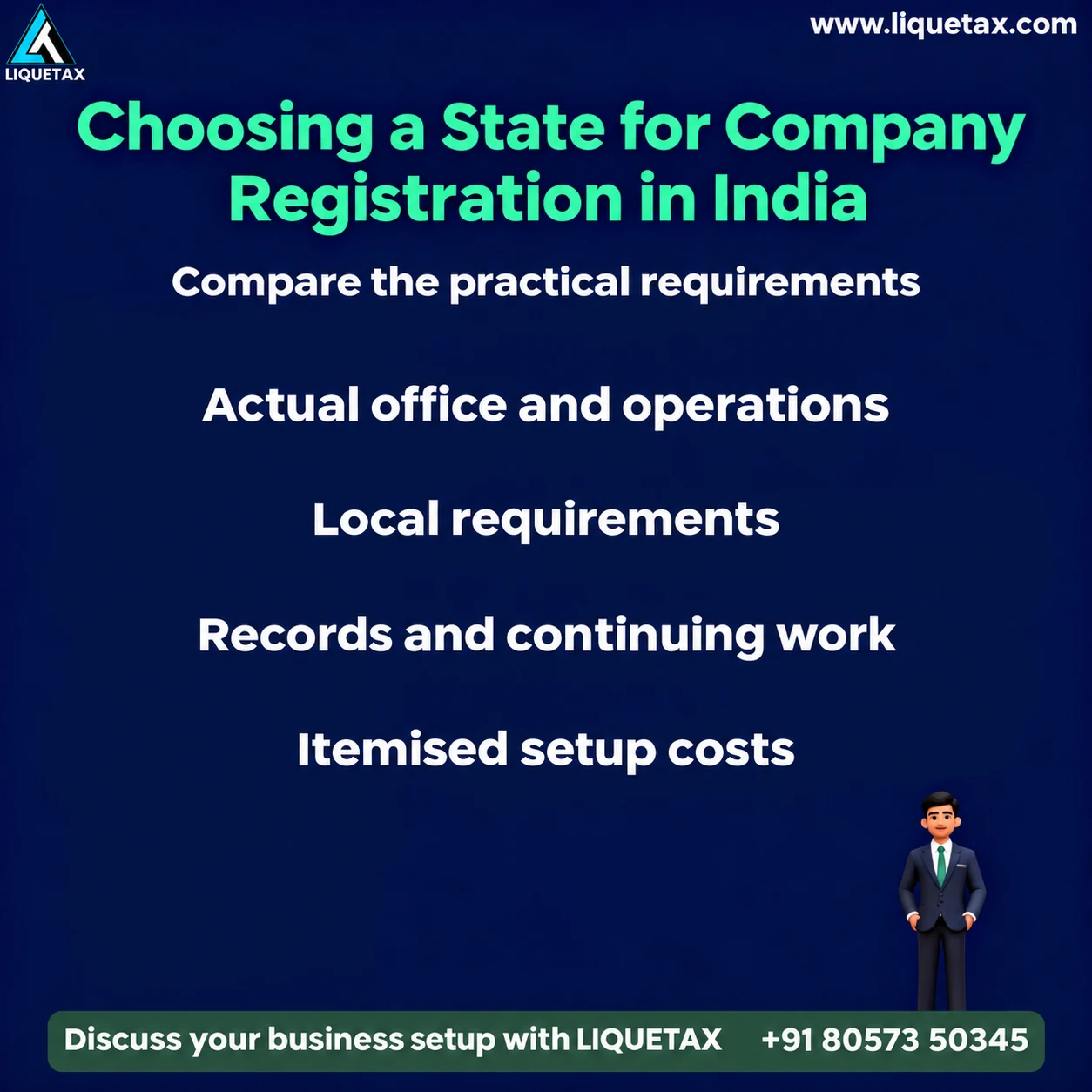
- Choose a workable registered office
- Separate tax questions from incorporation charges
- Map where business actually takes place
- Compare the whole first year
Choose a workable registered office
The best state for a company is usually the one that supports its real operations and a reliable registered office. A company is incorporated under central company law, while its registered-office state affects jurisdiction and some charges and local obligations. Choosing an address solely because a package looks cheaper can create greater administrative costs later.
Consider where founders work, where notices will be received, where staff or equipment are located and which premises permissions are available. A company can have operations in more than one state, but its registered office must remain capable of receiving and acknowledging communications. Incorporation does not make every operating location compliant.
Separate tax questions from incorporation charges
State stamp duty on incorporation documents and property or local registrations can differ. Compare these using the actual authorised capital and applicable state schedule rather than an internet price range. Also budget for professional work, digital signatures, office arrangements and the first compliance cycle. These are different cost categories.
Corporate income-tax treatment is not generally chosen by putting the registered office in a particular Indian state. The company’s eligible tax regime, income, deductions and other statutory conditions require a separate calculation. A claimed state incentive must be checked against its notified scheme, eligible activities, investment, location and application conditions. An incentive brochure is not a sanction letter.
Map where business actually takes place
GST registration follows the relevant law and facts of taxable supplies and places of business. A company registered in one state may require GST registration in another state where it operates. Shops and establishments requirements, professional tax where applicable, municipal permissions, labour obligations and sector licences also depend on the activity and location.
For a factory, warehouse, restaurant or clinic, premises suitability and operating permissions may be more significant than incorporation charges. For a remote consulting business, mail access and credible office evidence may be the main location questions. There is no universal state ranking that answers both situations correctly.
Compare the whole first year
Prepare a comparison with recurring rent or address-service charges, staff access, travel, registrations and accounting support. Ask what happens if the address agreement ends. A future registered-office move can involve corporate approvals, filings and, for an interstate move, additional procedures. Treat a temporary promotional discount as one input rather than the main decision.
Name reservation and incorporation processing are handled through MCA systems. Assertions that a particular state guarantees approval in a set number of days need evidence and should not drive a legal decision. Track document readiness, query risk and any special regulatory approvals instead. Confirm an incentive’s eligibility before including it in a cash-flow forecast.
Practical checklist
- List the actual office, warehouse, staff and sales locations.
- Obtain comparable written quotes using the same capital and service scope.
- Check the office owner’s permission and long-term access to notices.
- Separate MCA charges, state stamp duty, GST and professional fees.
- Record the scheme name and approval conditions for every claimed incentive.
Illustrative example
A founder lives in Pune but sees a lower-cost address package elsewhere. After comparing travel, mail forwarding, local staff and future address-change costs, the founder chooses the location that can be maintained reliably. The decision is based on operating facts; it does not assume that moving the registered office creates a lower income-tax rate.
Frequently asked questions
Is one state always cheapest?
No. Capital, stamp duty, office costs and the registrations the business needs change the comparison. Use a like-for-like written estimate.
Can a company operate across India?
It can operate beyond its registered-office state, subject to the registrations, licences and location requirements relevant to those operations.
Will a different state reduce income tax?
Not merely because the registered office changes. Verify any specific tax provision or notified incentive against the business’s facts.
Can the registered office be moved later?
Yes, through the applicable approval and filing process. An interstate move is not simply an edit to the company’s letterhead.
Should I choose a state for faster approval?
Avoid unsupported processing rankings. Complete, consistent documents and responsiveness to official queries are more useful planning factors.
Official references and next step
- India Code: Companies Act, 2013
- MCA: SPICe+ and linked filing FAQs
- CBIC: registration evidence instructions, April 2025
For help applying this checklist to your documents, contact LIQUETAX with the relevant facts and the support you need. Request a written scope and fee breakdown before work begins.