
- Ask what the quoted price actually covers
- Government charges depend on the application
- Identify private and optional costs
- Budget beyond the certificate
Ask what the quoted price actually covers
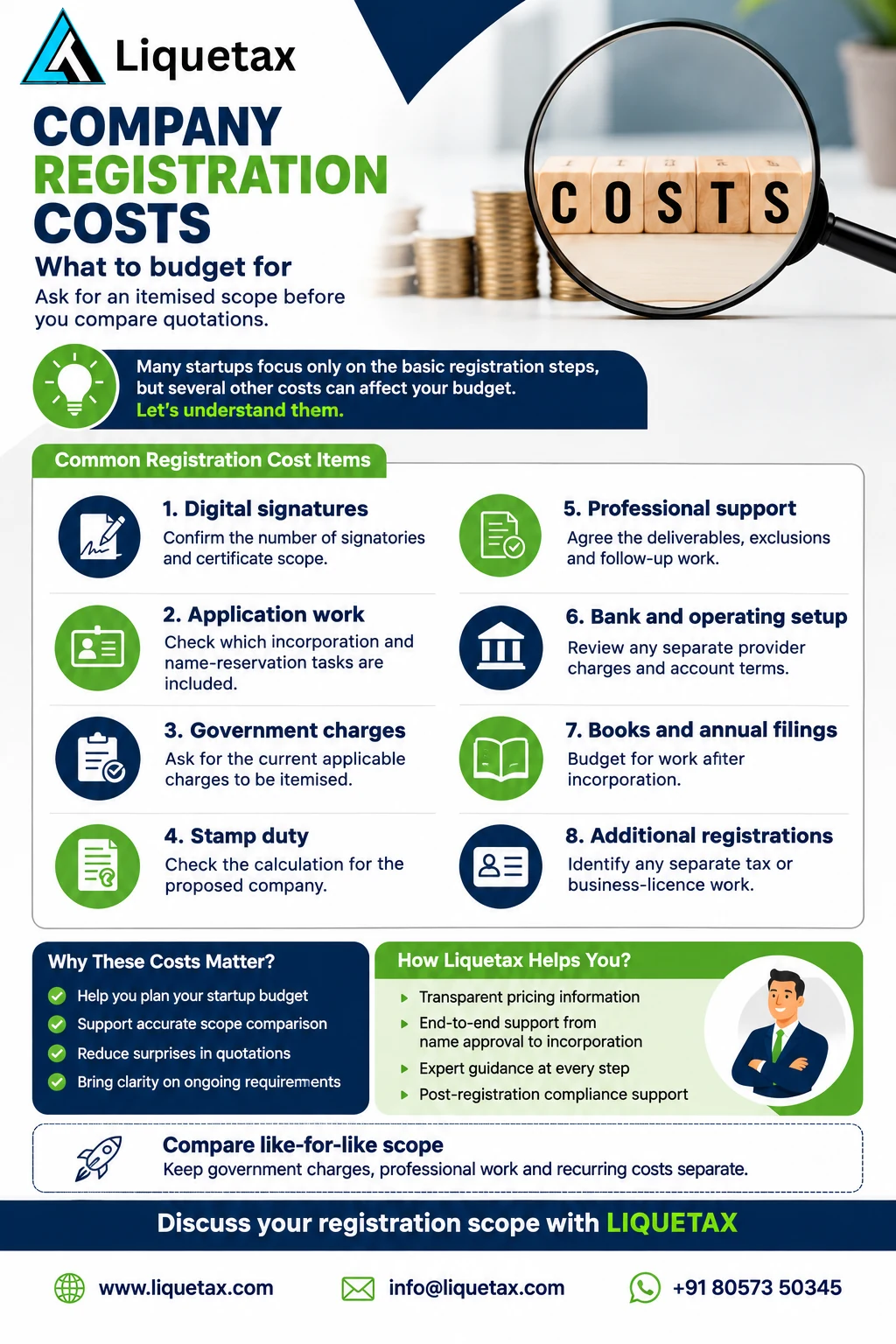
A low incorporation price can be difficult to compare with another quote because the included services differ. Start with the intended entity, registered-office state, authorised capital, subscribers and any overseas documents. Ask for an itemised scope rather than assuming that a headline price includes every government charge and the first year of compliance.
Separate government fees, state stamp duty, private third-party charges and professional fees. Also separate money contributed to the company as capital from the cost of registration. Subscription money belongs to the company after payment; it is not automatically a fee paid to the incorporation service provider.
Government charges depend on the application
The applicable MCA fee schedule, authorised capital or company category and linked services determine charges. Stamp duty can vary by state and instrument. An incorporation concession does not necessarily remove stamp duty or every other charge. Use the live MCA calculation and current rules for the actual filing rather than a fixed fee table copied from another case.
Name reservation for a new company uses SPICe+ Part A. Eligible first-director DIN requests and PAN/TAN services are part of the integrated workflow. A quote should not automatically multiply a standalone DIN application fee by every director. Check what is actually being filed and why. Do not assume a rejected or abandoned name application is refundable.
Identify private and optional costs
Digital-signature charges are set by the relevant provider and may depend on validity, token and verification arrangements. Overseas authentication, translations, courier services and document execution can add cost. These should be disclosed as applicable items rather than presented as identical government fees for all founders.
Registered-office rent, a shared-office service, mail forwarding and bank-account terms are separate commercial decisions. Some may be unnecessary if the business already has a suitable premises or banking arrangement. Ask whether any quoted add-on is legally required, needed for your facts or simply optional convenience. Review renewal charges as well as the introductory amount.
Budget beyond the certificate
A company has continuing accounting and corporate responsibilities even when revenue is low. Plan for records, statutory audit where applicable, annual filings, tax returns and event-based changes. GST or employment compliance depends on the business’s registrations and activities. A promise of free incorporation is not a promise of free lifetime compliance.
Define who will handle bank onboarding, subscription evidence, commencement declarations where applicable, registers and the first statutory appointments or meetings. Ask whether these are included in the engagement. If they are excluded, obtain a separate scope and calendar rather than discovering the gap close to a deadline.
Compare quotes using one set of assumptions
Give competing providers the same facts. Compare the private limited registration scope and fee breakdown against those facts. Request a written list of deliverables, exclusions, expected third-party charges, taxes on services, resubmission work and the treatment of cancellation or changed requirements. Keep actual portal receipts and invoices after filing; a round-number estimate is not a substitute for evidence of government payment.
Choose based on scope, document quality, communication and responsibility as well as price. No fee can purchase guaranteed MCA approval. If an application changes, ask for the reason and revised amount before authorizing additional paid work. Do not share a digital signature or banking access merely because someone requests a payment.
Practical checklist
- State the entity type, office state, capital and number of subscribers in every quote request.
- Separate capital contributions from registration expenses.
- Identify statutory charges, stamp duty, third-party costs and professional work individually.
- Confirm first-year compliance, resubmission support and address renewals in writing.
- Retain payment receipts, submitted forms and an agreed handover list.
Illustrative example
Two quotes have different totals. One includes drafting, linked forms and a post-incorporation checklist; the other excludes digital signatures, stamp duty and commencement work. The founders request the same scope from both providers before comparing. The example demonstrates a method of budgeting and does not set or imply an approved LIQUETAX price.
Frequently asked questions
Is there one standard incorporation cost?
No. State, capital, entity category, documentation and professional scope affect the total. Obtain a case-specific breakdown.
Is authorised capital paid as a government fee?
No. It is a capital concept used in the company’s constitution and can influence charges. It is not itself the government registration fee.
Must I pay separately for every director’s DIN?
Do not assume so. Eligible first-director applications may be included in SPICe+. Verify the actual route and charges.
Does free registration mean no stamp duty?
Not necessarily. A fee concession can coexist with stamp duty and other applicable charges. Check the current calculation.
Are annual compliance costs included?
Only if the written engagement says so. Clarify the period, filings, accounting, audit and event-based services included before accepting a package.
Official references and next step
- MCA: SPICe+ and linked filing FAQs
- India Code: Companies Act, 2013
- MCA: current forms, notices and help
For help applying this checklist to your documents, contact LIQUETAX with the relevant facts and the support you need. Request a written scope and fee breakdown before work begins.