
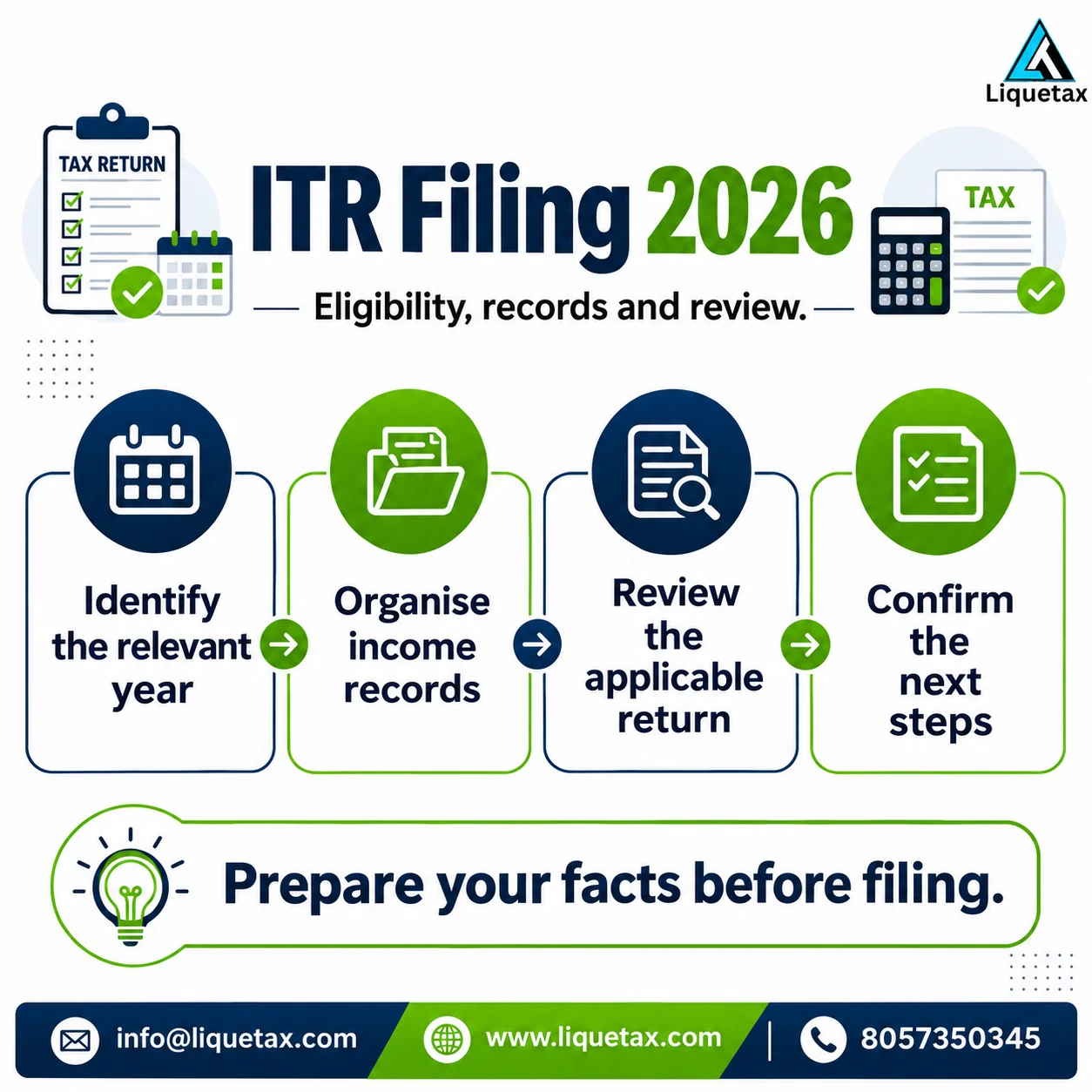
- Choose the correct income period
- Decide whether a return is required
- Match the form to the full financial picture
- Build evidence before computing the result
An income-tax return brings several decisions together: whether filing is required, which law and form apply, how income is computed and how tax already paid is credited. Treat the process as a short review project. An accurate final return depends on the quality of those decisions, not on how quickly someone can fill the portal fields.
Choose the correct income period
For income earned from 1 April 2025 to 31 March 2026, select Assessment Year (AY) 2026-27 and apply the Income-tax Act, 1961. Income earned from 1 April 2026 belongs to Tax Year 2026-27 under the Income-tax Act, 2025. These are different periods. A return or notice about an earlier year does not move to the new Act merely because you handle it after April 2026.
Decide whether a return is required
Check taxpayer type, residence, income and other statutory conditions. An individual’s basic exemption varies with the applicable regime and circumstances, while a rebate can eliminate tax without eliminating filing duties. Companies, firms and other entities have their own provisions. Specified transactions or foreign-asset conditions can also require filing even where an ordinary income-threshold test appears not to be met.
Match the form to the full financial picture
ITR-1 and ITR-4 are simplified forms with limitations. Wider individual cases may require ITR-2 or ITR-3, while entities use the applicable ITR-5, ITR-6 or ITR-7 framework. Do not choose a form solely from the largest source of income. Prepare a list of salary, property, capital gains, business, other sources, foreign disclosures and losses before checking the notified form’s eligibility.
Build evidence before computing the result
Collect certificates from all employers and banks, investment transaction reports, property documents, business accounts and eligible deduction evidence. Download Form 26AS and AIS and reconcile them with those records. Pre-filled data is useful but may be incomplete or incorrect. Ask deductors or reporting entities to investigate discrepancies and keep an explanation file rather than quietly adjusting figures to match a desired outcome.
Compute liability and select available options
Compare legally available regimes using supported deductions and the full income mix, including special-rate income. Check election timing and business-income restrictions. Calculate applicable tax, interest and fees separately, then subtract genuine tax credits. Assess whether an audit or other report is needed. A refund is the resulting excess credit, not a figure that should guide the choice of unsupported deductions.
Complete filing and review the next stage
Confirm the applicable original deadline and any valid extension or alternative filing window. Pay any required balance through the official service, review all declarations, submit and verify within the required period. Save the final pack. Later compare the processing intimation with your computation and address any proposed adjustment or notice through its own procedure; filing is not a guarantee of immediate refund or unquestioned acceptance.
Practical checklist
- Document the filing-obligation assessment and correct tax year.
- List all income sources and required disclosures before choosing a form.
- Prepare a complete evidence file and reconcile credits and pre-fill information.
- Review the computation, elections, audit needs and deadline category.
- Save submission and verification records and schedule a processing-status review.
Worked example
Illustration: a person’s main income is salary, but the year also includes a property sale and overseas account information. The initial task is not simply uploading Form 16. The person reviews residency and disclosure requirements, gathers sale-cost records, selects an appropriate form and computes the complete tax result. The online submission becomes the final step of that review, not a substitute for it.
Frequently asked questions
Does a nil tax calculation mean filing is unnecessary?
Not always. Check statutory filing conditions separately from the final tax balance.
Are documents normally attached to every return?
Returns are generally annexure-less, but supporting evidence should be retained and provided if properly requested.
Can one form cover every individual taxpayer?
No. Form eligibility and required schedules depend on the complete facts.
Who is responsible if someone else prepares the return?
The taxpayer should review and authorise accurate facts and declarations. Professional preparation does not remove that responsibility.
What should happen after submission?
Complete verification, retain the return and monitor processing, refund status and any communication requiring a response.
Official references
- Income Tax Department: current return obligations and deadlines
- Income Tax Department: current return forms and utilities
- Income Tax Department: e-verification manual
- Income Tax Department: AY 2026-27 salary tax guidance
For help reviewing your documents and the correct next step, contact LIQUETAX. The scope and any professional fee should be agreed in writing after the facts are checked. This article provides general information; individual eligibility depends on the applicable law and records.