

- Choose the correct income period
- Section 234F: the late-return fee
- Section 234A: interest linked to late filing
- Sections 234B and 234C: advance-tax issues
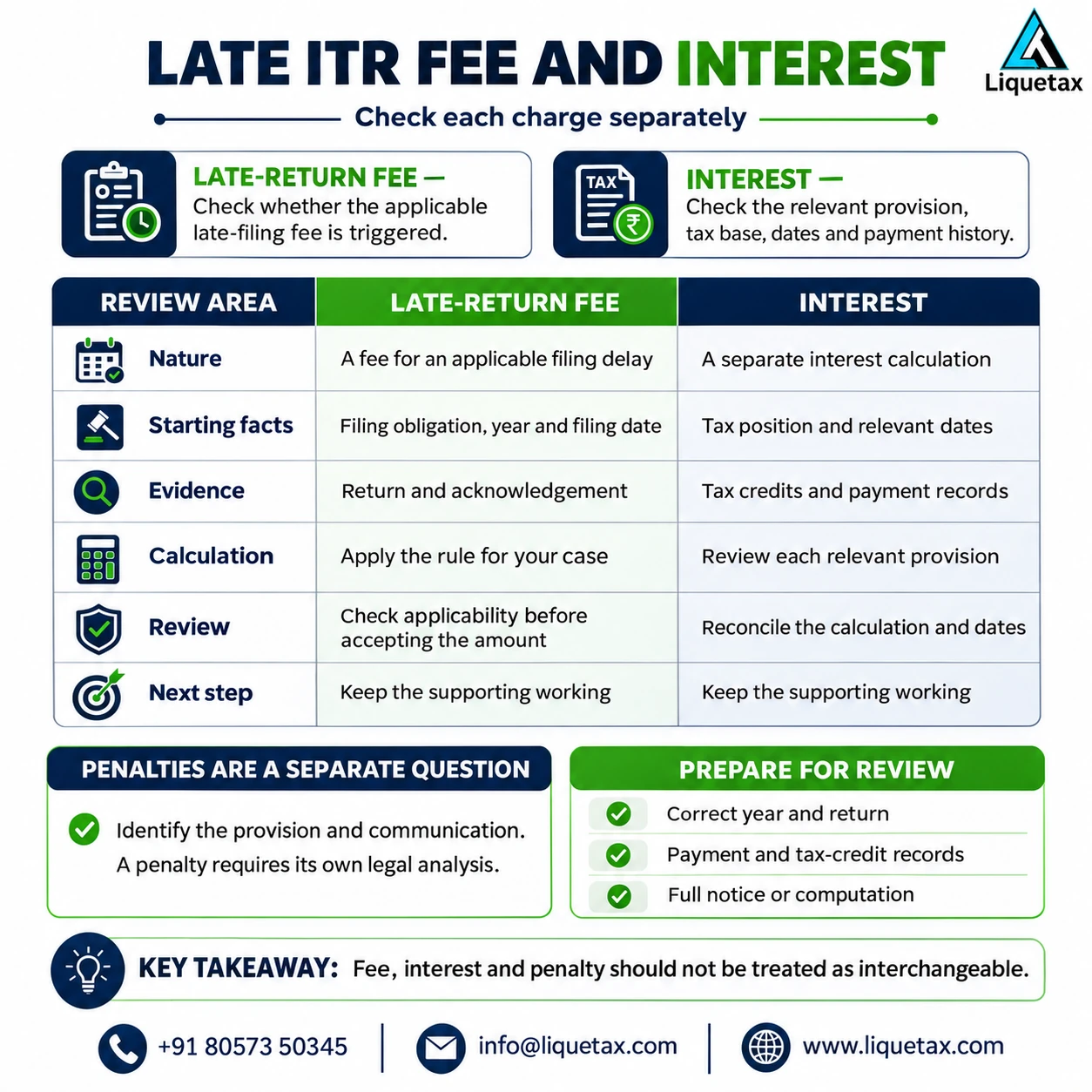
A late return does not attract one universal “penalty percentage.” Tax, filing fees, interest and penalties are different charges with different legal conditions. Start with the applicable deadline and the amount of tax paid on relevant dates. A clear calculation should show each component rather than combining them into an unexplained service quote.
Choose the correct income period
For income earned from 1 April 2025 to 31 March 2026, select Assessment Year (AY) 2026-27 and apply the Income-tax Act, 1961. Income earned from 1 April 2026 belongs to Tax Year 2026-27 under the Income-tax Act, 2025. These are different periods. A return or notice about an earlier year does not move to the new Act merely because you handle it after April 2026.
Section 234F: the late-return fee
Where section 234F applies, the fee is ₹5,000, restricted to ₹1,000 where total income does not exceed ₹5 lakh. The former ₹10,000 figure should not be used as a current blanket rule. First assess the filing obligation and actual due date, including a valid category-specific extension. The fee is a government charge; a professional preparation fee is separate and should be agreed by scope.
Section 234A: interest linked to late filing
Section 234A generally concerns delay in furnishing a return and is calculated on the relevant unpaid tax after statutory adjustments. Its usual rate is 1% per month or part of a month, but the correct period and base matter. Do not multiply a headline tax figure by the number of calendar days or assume that a refund estimate automatically settles the interest position. Review actual payments and due dates.
Sections 234B and 234C: advance-tax issues
These provisions address failure or shortfall in advance tax and deferment of instalments. They can apply even when the return itself is filed on time. Different conditions and computation methods matter, including eligible presumptive cases. A taxpayer who paid everything immediately before filing may still need to calculate earlier advance-tax interest. Keep dated challans and a working paper explaining the liability and payment timeline.
Revision fees and updated-return additional tax
The AY 2026-27 portal validation rules apply section 234-I fees to eligible revised returns after 31 December 2026: ₹1,000 at total income up to ₹5 lakh and ₹5,000 otherwise. ITR-U has separate additional-tax bands and eligibility restrictions; it is not merely a late fee and cannot create or increase a refund. Confirm the correct filing route before calculating charges.
Penalties require their own legal analysis
Under-reporting, misreporting and other defaults can have separate consequences, but they are not automatically established by late filing or by receiving a notice. Do not describe 50% and 200% consequences interchangeably or assume every mismatch produces a fixed penalty. Read the actual provision and proceeding, preserve evidence and respond within the allowed time. Paying a filing fee does not necessarily close an unrelated issue.
Practical checklist
- Confirm the statutory due date and any applicable extension.
- Separate tax payable from filing fee, interest and any actual penalty demand.
- Prepare a dated list of TDS, advance-tax and self-assessment-tax credits.
- Check the filing route and any revision or updated-return charge separately.
- Retain calculations, challans and the filed return for later comparison.
Worked example
Illustration: two taxpayers miss the same original date but have different total incomes and tax-payment histories. One may be within the ₹1,000 section 234F cap while the other faces the ₹5,000 amount. Their interest can also differ because payments were made on different dates. The same number of days late therefore does not establish the same total charge, and neither example proves that a separate penalty is due.
Frequently asked questions
Is the professional’s fee part of section 234F?
No. The statutory filing fee and any agreed professional charge are distinct.
Does timely filing always avoid interest?
No. Advance-tax interest can arise separately even where the return is on time.
Is the late fee still ₹10,000?
That is not the current general section 234F amount. Apply the present provision and relevant income cap.
Does receiving a notice automatically mean a penalty?
No. The notice’s purpose, facts and applicable proceeding must be examined.
Is ITR-U additional tax the same as a filing fee?
No. It is a separate statutory component with its own calculation, timing and eligibility restrictions.
Official references
- Income Tax Department: penalties and fees
- Income Tax Department: returns and updated returns
- AY 2026-27 ITR-3 validation rules
- Finance Act 2026, enacted text
For help reviewing your documents and the correct next step, contact LIQUETAX. The scope and any professional fee should be agreed in writing after the facts are checked. This article provides general information; individual eligibility depends on the applicable law and records.