

- 1. Choose the objective
Define the benefit you actually need.
- 2. Check the route
Read current scheme and category rules.
- 3. Prepare evidence
Match the requirement to real records.
- 4. Track the decision
Retain applications and outcomes separately.
Start with the business need
Explain whether you need recognition, capital, tax relief, intellectual-property support or access to a procurement opportunity. Each objective can have a different process. A broad promise of 'all Startup India benefits' is not a usable scope for a customer.
Check whether the business is eligible under the current recognition framework and whether recognition is needed for the proposed route. Keep the entity and activity evidence available. Entity incorporation remains a separate requirement.
Review current recognition categories
The February 2026 framework revised the general turnover ceiling and introduced expanded Deep Tech conditions and eligible cooperative categories. Use the official portal and full criteria for the actual enterprise. Recognition status should be established from the certificate and current record.
A recognition application should describe genuine activity and claims. Do not invent research, patents or traction in order to fit a category. If the evidence is incomplete, identify what can be supplied and which claim should not be made.
Tax benefits need their own assessment
Review the relevant tax period, entity, activity and approval conditions for the proposed benefit. Recognition should not be presented as an automatic three-year exemption for every startup. The appropriate tax framework and current approval route must support the claim.
Keep accounts, ownership history, business evidence and application decisions together. A benefit that was described under an earlier law or period should not be copied into every current calculation without checking the governing provision.
Funding depends on the particular scheme and decision-maker
Seed funding, investment and credit arrangements can have separate windows, eligible costs, stage requirements and selection processes. Ask which scheme or institution is involved and whether applications are actually open. A certificate does not promise that money will be provided.
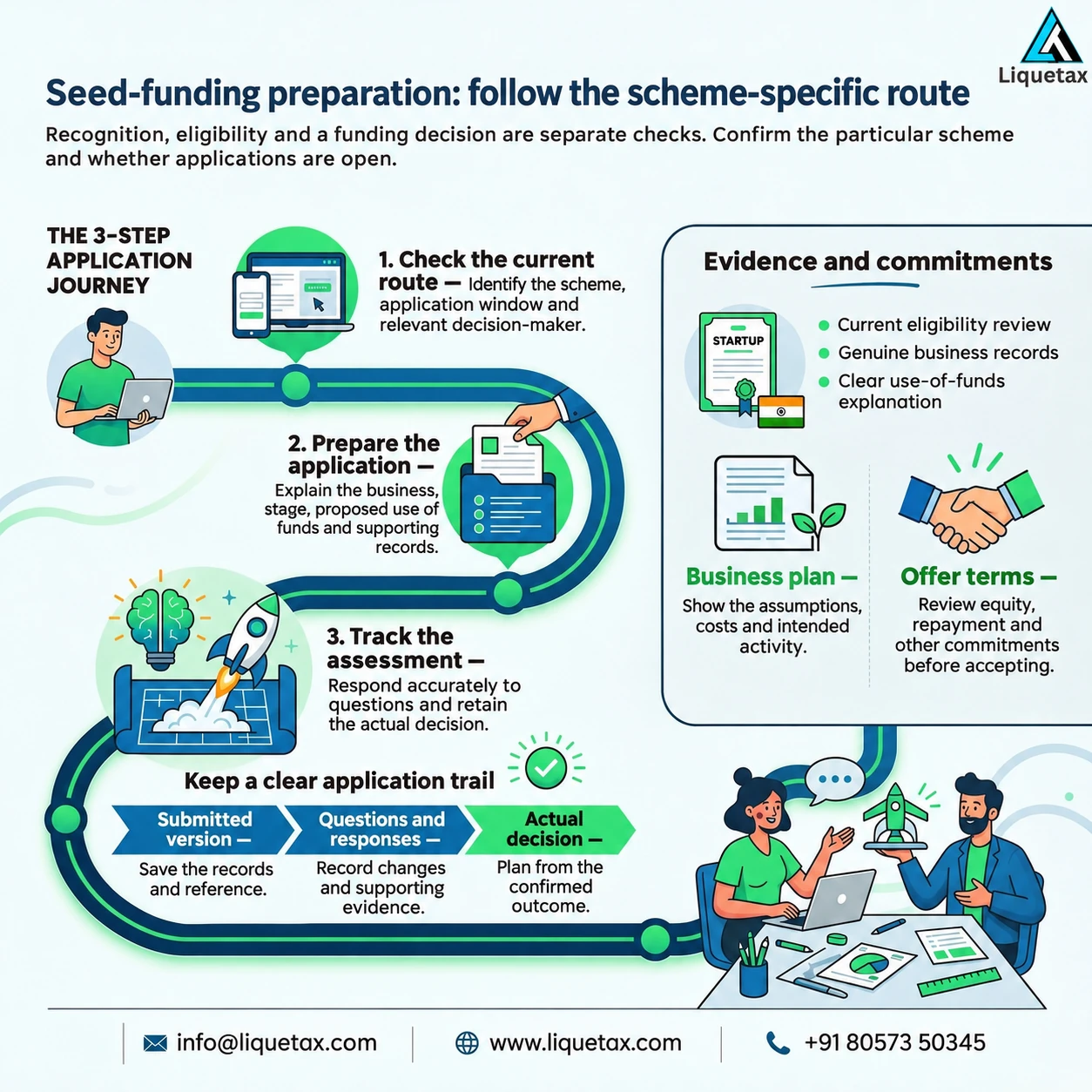
Prepare a clear business plan, use-of-funds explanation and genuine supporting records. Keep commercial investment terms separate from government recognition. Founder equity, repayment and other commitments should be reviewed before accepting a funding offer.
Procurement and other support also have conditions
Read the actual tender, programme or application requirement. A stated relaxation may concern one qualification or procedure without guaranteeing an order. Product quality, delivery capacity and customer requirements still matter.
Maintain a benefit register showing the route, eligibility, evidence, dates and decision. This lets the founder prioritise useful work and avoid paying for multiple applications based only on a list of possible benefits. Agree a service scope around the specific action to be prepared.
Startup benefit register
| Route | Record separately |
|---|---|
| DPIIT recognition | Current category, application and certificate. |
| Tax benefit | Relevant framework, eligibility and approval. |
| Funding or credit | Institution, window, conditions and decision. |
| Procurement | Actual tender and applicable qualification. |
| Other programme | Purpose, evidence, application and outcome. |
Illustrative example
Illustrative example: a recognised startup wants funding and a tax benefit. It creates two workstreams with separate conditions and applications. Recognition supports the review where relevant, but neither financial outcome is treated as already approved.
Frequently asked questions
Does recognition approve every listed benefit?
No. Review the separate conditions and decision process for each route.
Can every startup claim a tax holiday immediately?
No. The entity, period, governing framework and approval conditions require a specific assessment.
Is a funding scheme always open?
Check the actual current window and participating institution before preparing or paying for an application.
Does a tender relaxation guarantee an order?
No. It concerns the specified condition; the procurement decision and other requirements remain.
How should I compare preparation services?
Ask which specific route, records, application and completion evidence the quoted scope covers.
Get clarity before your next filing
Bring the records listed above to a LIQUETAX conversation. Ask for the applicable work, documents, responsibilities and fee components in writing before you authorise a submission. Government charges, professional fees and applicable GST should be shown separately.
Book a conversationOfficial references
- Startup India: official recognition and schemes
- DPIIT: revised startup recognition framework
- Income-tax Act, 2025, amended by Finance Act, 2026
Check the linked authority for the rule, form and notification that applies to your facts and period. This guide explains preparation and does not record a professional opinion on an individual case.