
- Choose the correct income period
- Check the year, form and income schedules
- Reconcile credits and remove unsupported claims
- Use revision only where the return itself needs correction
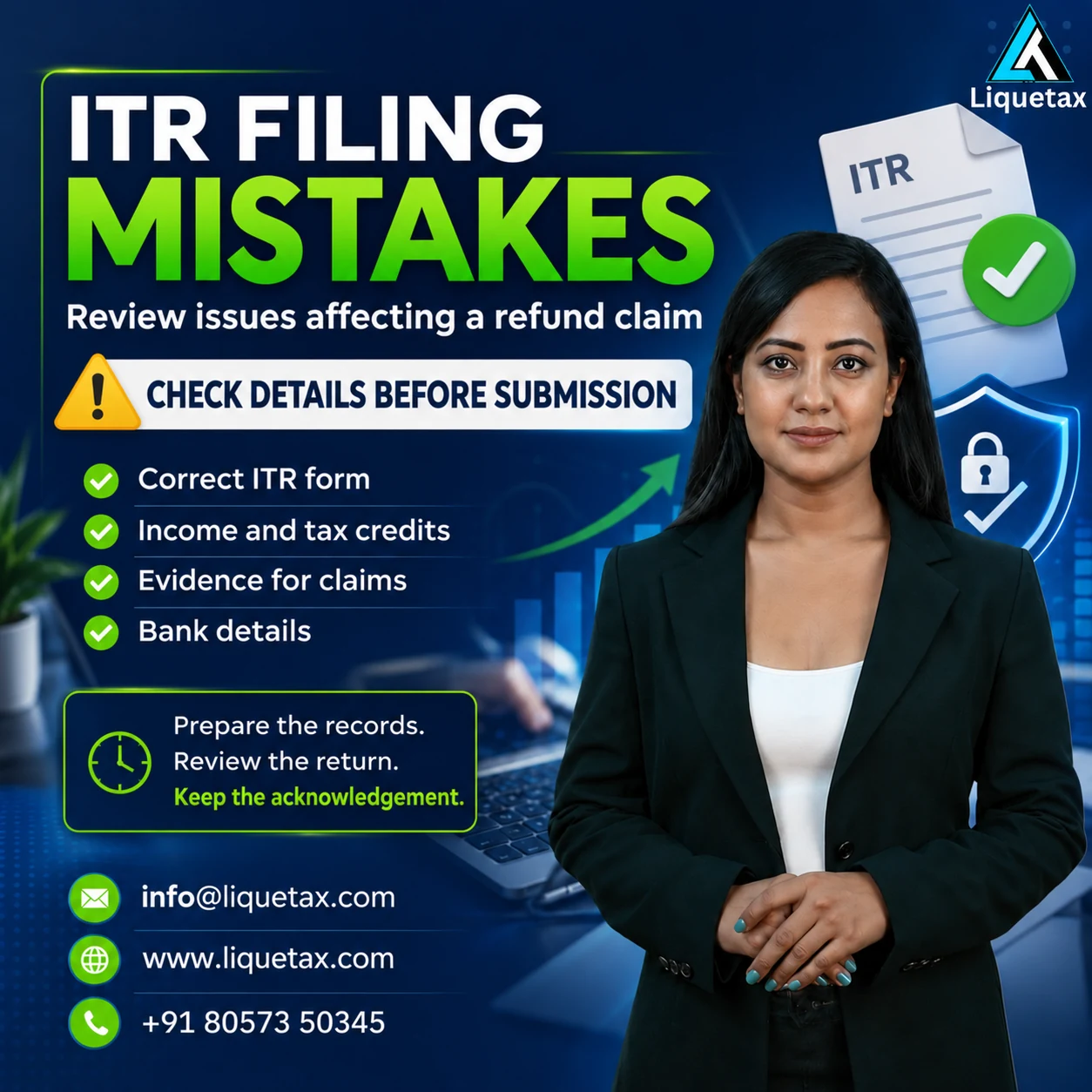
A refund problem is easier to resolve when you separate errors in the return from errors in processing or payment. Filing another return without diagnosing the issue can repeat the mistake or use the wrong statutory route. Start with the acknowledgement, the filed schedules, the processing intimation and the latest portal status.
Choose the correct income period
For income earned from 1 April 2025 to 31 March 2026, select Assessment Year (AY) 2026-27 and apply the Income-tax Act, 1961. Income earned from 1 April 2026 belongs to Tax Year 2026-27 under the Income-tax Act, 2025. These are different periods. A return or notice about an earlier year does not move to the new Act merely because you handle it after April 2026.
Check the year, form and income schedules
Confirm that you selected the correct assessment year and a form eligible for all your circumstances. Review salary from multiple employers, interest, capital gains, property and business income. A simplified form cannot be used to avoid required disclosures. Compare each material figure with source records, including genuine income missing from pre-filled data, before deciding that only the refund field needs changing.
Reconcile credits and remove unsupported claims
Match TDS and tax-payment entries with certificates, Form 26AS and genuine challans. Check the relevant year and corresponding income. Ask a deductor to investigate incorrect reporting where necessary. Separately review deductions, exemptions and regime eligibility. A refund based on a fabricated investment or duplicate credit is not valid; correcting it may reduce the refund or produce tax payable, and the revised calculation should show why.
Use revision only where the return itself needs correction
A valid original or belated return containing an omission or wrong statement may be revised within the applicable statutory window. For AY 2026-27, the revision date can extend to 31 March 2027 or assessment completion, whichever is earlier, with applicable fee rules after December. Prepare a comparison of changed schedules and retain the earlier acknowledgement. Check actual eligibility instead of assuming revision is always open.
Distinguish processing errors and bank failures
If a correct return was processed with an apparent mistake, assess whether rectification or another statutory remedy is appropriate. If a refund was determined but payment failed, correct the bank issue and use the refund-reissue process where available. An unverified return needs attention to verification, while a notice needs a timely response. A grievance about delay does not itself amend income or overturn an order.
Close the correction with an evidence trail
Save the corrected computation, payment proof where needed, submission acknowledgement and verification record. Track the result rather than assuming that a successful upload settles everything. If a notice or appeal deadline is running, handle it separately. Do not use ITR-U to create or increase a refund, and do not accept a guarantee that an adviser can obtain payment within a fixed number of days.
Practical checklist
- Download the exact filed return and relevant processing intimation.
- Classify the issue as return data, credit reporting, processing, verification or bank failure.
- Reconcile the affected figures and document every proposed change.
- Choose the legally available correction or response route and check its deadline.
- Keep the new acknowledgement and monitor the resulting status or order.
Worked example
Illustration: one taxpayer omitted bank interest, while another filed the correct income and credits but nominated a closed bank account. The first needs a fresh computation and assessment of the available return-correction route. The second may need bank correction and refund reissue after a failed payment. They should not both file an updated return merely because the expected money has not arrived.
Frequently asked questions
Should I change only the refund amount?
No. Refund is the result of the full computation. Correct the underlying income, claims or credit information where needed.
Can a wrong bank account require a revised return?
A processed refund failure may instead require bank correction and the official reissue process. Diagnose the status first.
What if the employer reported TDS incorrectly?
Ask the employer to investigate its statement and preserve your evidence, while separately meeting any notice-response deadline.
Is rectification identical to revision?
No. They address different situations and have different legal conditions. Select the remedy that fits the error and processing stage.
Will correcting an error always increase the refund?
No. Accurate correction may reduce a refund or create an amount payable. The correct result follows the records and law.
Official references
- Income Tax Department: rectification and tax-credit correction
- Income Tax Department: refund status manual
- Income Tax Department: refund reissue
- Income Tax Department: notice authentication and responses
- Income Tax Department: returns and updated returns
- AY 2026-27 ITR-3 validation rules
For help reviewing your documents and the correct next step, contact LIQUETAX. The scope and any professional fee should be agreed in writing after the facts are checked. This article provides general information; individual eligibility depends on the applicable law and records.