Tax & Compliance Experts | Since 2008
Call: +91 80573 50345 | Email: info@liquetax.com
New ITR Filing Deadline 2026-27: Key Dates for Salaried & Business Taxpayers
Don't miss the new ITR filing deadline 2026-27. Know the key dates, late fees, and how to file on time. Expert guidance from Liquetax.
About Liquetax
12+ years of expertise in tax planning, compliance & audits. We help you stay ahead of tax laws.
📅 New Deadline
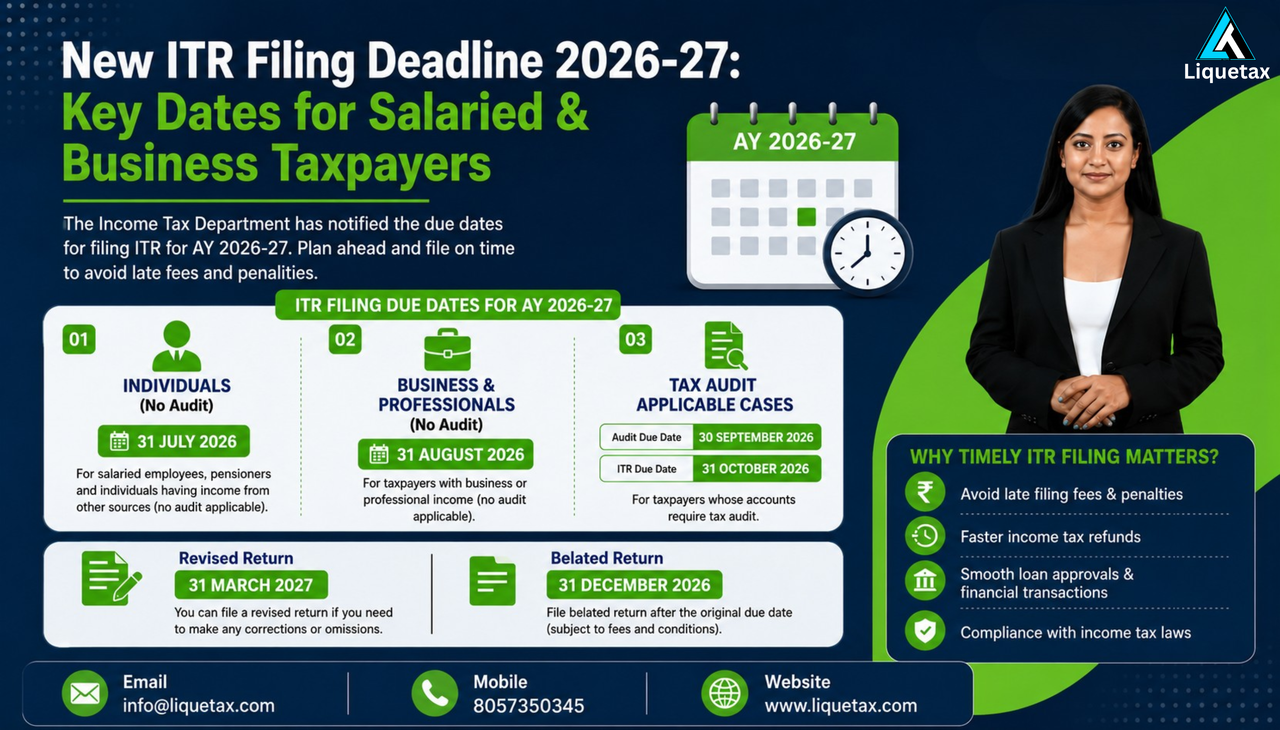
ITR filing last date for AY 2026-27: 31 July 2026 for salaried, 31 Oct 2026 for businesses.
⚠️ Late Fee
If you file late, you may have to pay up to ₹10,000 as penalty under Section 234F.
💡 Expert Tip
File your return early to avoid last-minute problems. Liquetax can help you file without errors.
📊 Quick Checklist
Check Form 26AS, make sure your bank account is valid, and e-verify your return right away.
🎬 Watch: ITR Filing Deadline 2026-27 – Key Dates & Tips
 ▶ Tap to play
Introduction: New ITR Filing Deadline 2026-27
The Income Tax Department has released the official dates for filing Income Tax Returns (ITR) for the Assessment Year 2026-27. If you are a salaried employee or a business owner, you need to know these dates so you can file on time and avoid paying extra fees. This guide explains the new deadlines, who needs to file, what documents you need, and how Liquetax can help you file your ITR easily.
What is the ITR Filing Deadline and Why Does it Matter?
The ITR filing deadline is the last date by which you must submit your income tax return. For the financial year 2025-26 (Assessment Year 2026-27), the important dates are:
- Salaried employees and individuals (no audit): 31 July 2026
- Businesses that need audit: 31 October 2026
- Belated returns (late filing): 31 December 2026 (but you will have to pay a late fee)
Why ITR Filing Deadlines are Important for Businesses and Individuals
- Avoid Penalties: Late filing can cost you up to ₹10,000 in fees.
- Get Refunds Fast: Filing on time means your refund will be processed quicker.
- Carry Forward Losses: If you file late, you might lose the chance to carry forward business losses.
- Stay Compliant: Filing on time keeps you in good standing with the tax department.
- Better Financial Planning: Having your tax return filed helps with loans, visas, and other financial matters.
Who Needs to File ITR and What are the Requirements?
- Who must file? Individuals, HUFs, companies, and firms whose income is more than the basic exemption limit.
- Basic exemption limit: ₹3,00,000 for people below 60 years (₹3,00,000 for senior citizens, ₹5,00,000 for super senior citizens).
- Even if your income is below the limit, you may still need to file if you have TDS, foreign assets, or want to claim a refund.
- Check Form 26AS to make sure the tax deducted (TDS) matches your records.
- Aadhaar-PAN link: Your Aadhaar must be linked with your PAN.
Step-by-Step Process to File ITR Before the Deadline
- Collect all documents: Form 16, bank statements, investment proofs, etc.
- Pick the right ITR form: ITR-1 for salaried people, ITR-3 for business owners, etc.
- Log in to the e-filing portal at www.incometax.gov.in.
- Fill in your income, deductions, and tax details.
- Match with Form 26AS to ensure TDS and other credits are correct.
- Calculate your tax liability and pay any remaining tax, if needed.
- Submit the return and then e-verify it using Aadhaar OTP, EVC, or DSC.
- Save the acknowledgment for your records.
Documents You Need for ITR Filing
- Form 16/16A – TDS certificates from your employer or bank.
- Bank account details – for refund and to validate your account.
- Investment proofs – for deductions under Section 80C, 80D, etc.
- Property details – if you earn rent from a property.
- Business income details – profit & loss statement, audit report if applicable.
- Aadhaar & PAN – must be linked and valid.
- Details of foreign assets (if you have any).
Government Fees and Late Filing Penalties
- Late filing fee under Section 234F: ₹5,000 if you file after 31 July but before 31 December (₹1,000 if your income is below ₹5 lakh).
- Interest under Section 234A: 1% per month on the unpaid tax amount if you file after the due date.
- No fee for on-time filing – file before the deadline and save money.
How Liquetax Can Help You File ITR on Time
- Expert Advice: We help you choose the correct ITR form and claim all valid deductions.
- Document Checklist: We give you a tailored list of documents so you don't miss anything.
- Error-Free Filing: Our experts review your return to make sure everything is correct.
- E-Verification Support: We guide you through the e-verification process step by step.
- Post-Filing Support: We track your refund and help you respond to any notices from the department.
Client Success Story: Filed ITR in Just 3 Days with Liquetax
Don't let the deadline stress you. Let Liquetax handle your ITR filing smoothly.
FAQs on ITR Filing Deadline 2026-27
For salaried individuals (non-audit), the deadline is 31 July 2026. For businesses that need audit, it's 31 October 2026.
You can still file a belated return by 31 December 2026, but you will have to pay a late fee of ₹5,000 (or ₹1,000 if income is below ₹5 lakh).
Yes, you can file a revised return by 31 December 2026 if you find any mistakes in the original filing.
It's not compulsory, but you should file if you have TDS, want to claim a refund, or have foreign assets.
Liquetax offers complete ITR filing services – from document review and form selection to filing, e-verification, and refund tracking.
Don't Miss the ITR Deadline – File with Liquetax!
Get expert help to file your ITR on time, avoid penalties, and claim the maximum refund.
 Liquetax, Private Limited, 4th Floor, Centre O-451, Greater Noida W Rd,
  Reliable
 Affordable
 Assurity